Location Image

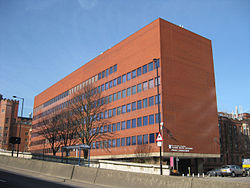
Western Bank Library

Western Bank Library is a library at the University of Sheffield located on Western Bank, forming part of the Western Bank Campus. Formerly the Main Library, it is a Grade II* listed building opened in 1959 by Nobel prize-winning poet T. S. Eliot. The library was designed and built as a result of a national competition announced by the university in 1953. It was the university's main library until the Information Commons was opened in April 2007. Western Bank Library is linked to the Arts Tower (opened later in 1966) via a bridge between their mezzanine floors. The two buildings are intended to be viewed together according to their architect Gollins Melvin Ward. The library has 730 study spaces. It is accessed by the ground floor entrance or via entrances on the mezzanine level.

Nearby Places View Menu
Location Image
51 m

Arts Tower

The Arts Tower is a building at 12 Bolsover Street in Sheffield, England, belonging to the University of Sheffield and which opened in 1965. A spokesperson for English Heritage described it as "the most elegant university tower block in Britain of its period". At 78 m (256 ft) tall, it is the second-tallest building in the city, after the 101 m (331 ft) St Paul's Tower on Arundel Gate, which was topped out in 2009. Mitchell Construction a British civil engineering firm, built the Arts Tower. Photographs from their topping out ceremony in October 1964 help to document a different era in UK working conditions.
Location Image
118 m

Alfred Denny Building

The Alfred Denny Building is a 7-storey red brick building in Sheffield, England named after the first Professor of Zoology at the department. It is part of the Western Bank Campus of the University of Sheffield, linked to Firth Court via the Addison Building.
Location Image
144 m

University of Sheffield

The University of Sheffield (informally Sheffield University or TUOS) is a public research university in Sheffield, South Yorkshire, England. Sheffield is formed from 21 academic schools which are organised into five faculties. The annual income of the institution for 2024–25 was £845.2 million, of which £204.2 million was from research grants and contracts, with an expenditure of £847.7 million. The university is one of the original red brick universities and a founding member of the Russell Group. It is also part of the Worldwide Universities Network, the N8 Group of the eight most research intensive universities in Northern England and the White Rose University Consortium. In recent years, the University has faced criticism over several issues. The institution has been subject to industrial action due to disputes over proposed job cuts and management decisions. In 2022-2023, student protests led to controversy when it was reported that the University had hired a private investigator to monitor participants. Additionally, staff members have reported experiencing a culture of racism, particularly affecting individuals of African and South Asian origin. There are six Nobel laureates affiliated with Sheffield, as either the alumni or former long-term staff of the university. They are contributors to the development of penicillin, the discovery of the citric acid cycle, the investigation of high-speed chemical reactions, the discovery of introns in eukaryotic DNA, the discovery of fullerene, and the development of molecular machines. Alumni also include several heads of state, Home Secretaries, Court of Appeal judges, Booker Prize winners, astronauts and Olympic gold medallists.
Location Image
151 m

Firth Court

Firth Court is a Grade II listed Edwardian red-brick building that forms part of the Western Bank Campus of the University of Sheffield in the United Kingdom. Located on the northern side of Western Bank, it is the main administrative centre for the university and also houses the School of Biosciences. The main entrance to Firth Court is on floor C, from this point up there are four complete floors (up to F floor which houses the first of the Molecular Biology and Biotechnology lecture theatres (F2) and research labs) and then G floor which is divided into several sections (housing the second lecture theatre (G2) and seminar rooms). This gives the five floors sometimes quoted, however the department's nuclear magnetic resonance (NMR) facility extends downwards from floor C and is housed on B (which is ground level at the back of the building), A and a further floor below this which has no official designation. In places the building extends above G floor, these towers do not have official floor letters but extend to what would be I floor. Counted from the bottom of the NMR pit to the highest research laboratory (that of Milton Wainwright) Firth court is 10 floors. The Main Block of Firth Court is linked, via the Addison Building, to the Alfred Denny Building. The Edwardian Block also links the North Block to the Perak Laboratories.