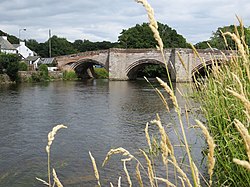
Location Image

Brougham, Cumbria

Brougham is a small village (or more properly a collection of hamlets) and civil parish on the outskirts of Penrith in the Westmorland and Furness unitary authority area in Cumbria, England. According to the 2001 census the parish had a population of 279, falling marginally to 277 at the 2011 Census. Within the parish are the remains of Brocavum Roman fort. The ruins of the medieval Brougham Castle, once home to Lady Anne Clifford, are next to the fort. The mainly 19th century Brougham Hall, the former seat of the Lords Brougham and Vaux is nearby. The 17th-century Countess Pillar, set up by Lady Anne, is beside the A66 near the castle.

The parish has two Anglican churches:

The historic Ninekirks, dedicated to St Ninian, is situated by the banks of the River Eamont and was extensively rebuilt by Lady Anne Clifford. It was previously a Norman foundation, probably on the site of an earlier Anglo-Saxon church. There is reputed to have been an even more ancient monastery nearby, founded by St Ninian (see also History of Cumbria). St Wilfred's or Brougham Chapel is next to the hall, overlooking the River Lowther. Brougham "village" itself is no more than a scattering of farms and modern housing near the hall and is, along with neighbouring Eamont Bridge, often classed as an outlying suburb of Penrith. There are some more cottages next to the castle, which is partially built on the site of the Roman fort. Within the parish is Whinfell Forest the site of a Red squirrel reserve, a Center Parcs holiday village, and the site of RAF Hornby Hall World War II aerodrome.

Nearby Places View Menu
Location Image
652 m

Brougham Hall

Brougham Hall is a historic house museum located in the village of Brougham just outside Penrith, Cumbria, England.
Location Image
868 m

Eamont Bridge

Eamont Bridge is a small village immediately to the south of Penrith, Cumbria, England. The village is named after the bridge over the River Eamont and straddles the boundary between the historic counties of Cumberland and Westmorland. One of the houses in the village is called the "Welcome Inn" and was at one time the "Welcome into Cumberland Inn".
Location Image
913 m

Clifton Hall, Cumbria

Clifton Hall was a fortified manor house in the village of Clifton, Cumbria. Dating from around 1400, it was constructed by either Elianor Engaine or her son-in-law William Wybergh, and was held by the Wybergh family until the 19th century. Initially taking the form of an "H"-plan design built around a central hall, around 1500 a three-storey stone pele tower was added, providing both additional security and acting as a status symbol for the family. At the start of the 17th century a new stone hall was added to the south of the tower. The Wyberghs were able to retain Clifton Hall, despite the challenges of the English Civil War, but the house was caught up in the Jacobite risings of 1715 and 1745. In the early 19th century most of Clifton Hall was pulled down to make way for a new farmhouse, and only the pele tower survived. In the 21st century the tower is in the care of English Heritage and operates as a tourist attraction.
Location Image
1.1 km

Yanwath and Eamont Bridge

Yanwath and Eamont Bridge is a civil parish in Westmorland and Furness, Cumbria, England, consisting of the small village of Yanwath and most of the neighbouring village of Eamont Bridge. In the 2001 census it had a population of 457, increasing to 535 at the 2011 Census. The parish was created in 1866 and was formerly a township of Barton. The boundaries are now partially marked by the Rivers Eamont and Lowther. The parish council meets at the village hall in Eamont Bridge. Half a mile north-west of Yanwath, Yanwath Hall is a fortified tower and hall house built in the early to mid 15th century, with 16th and 17th century alterations.