

 English
 Français
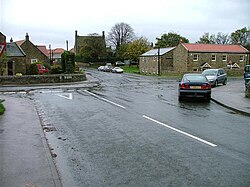
Melsonby
Melsonby est un village et une paroisse civile du Yorkshire du Nord, en Angleterre.
Nearby Places View Menu
7 m
Melsonby
Melsonby is a village and civil parish in the county of North Yorkshire, England. It lies 1.2 miles (2 km) west of the A1(M) motorway and 1.2 miles (2 km) north of the A66.

259 m
St James' Church, Melsonby
St James' Church is in the village of Melsonby, North Yorkshire, England. It is an Anglican parish church in the deanery of Richmond, the archdeaconry of Richmond, and the Diocese of Leeds. Its benefice is united with those of four local churches to form the Stanwick Group of Churches. The church is recorded in the National Heritage List for England as a designated Grade II* listed building.

2.2 km
Kneeton Hall
Kneeton Hall is a historic building in Middleton Tyas, a village in North Yorkshire, in England.
The house was constructed, probably in 1597, and a south wing was added in 1616. It is believed that the house originally had a private chapel, from which foundations may survive. The building was altered in the late 18th century, from which period much of the interior dates. The building later became a farmhouse. In the 20th century, the coach house was converted into a garage. The building was grade II listed in 1951, along with an attached outbuilding to the north.
The farmhouse and outbuilding are built of stone with a pantile roof, shaped kneelers and stone coping. The farmhouse has two storeys and attics, a main range of five bays, a rear wing, and a cross-wing on the left. On the right of the main block are quoins, and in the centre is a doorway with a moulded architrave, a fanlight, a pulvinated frieze and a cornice, and the windows are sashes in architraves. The cross-wing contains two mullioned windows and one mullioned and transomed window, and there are more mullioned windows at the rear and in the rear wing. To the right is a lower outbuilding with two storeys, containing a coach house doorway with a quoined surround and a segmental-pointed arch, a doorway in an architrave, and shuttered openings with chamfered surrounds in the upper floor. Inside, there is an 18th-century staircase.
2.6 km
Scot's Dyke
Scot's Dyke, also known as the Scots Dyke or the Scots Dike, is a linear earthwork in the district of Richmondshire in the county of North Yorkshire, England. It is about fourteen kilometres (8.7 miles) long and runs from the river Swale to the river Tees.
Camden in Britannia says:
“and neere at hand there is seene a ditch by Stanwig a little village, that runneth eight miles in length betweene the river Tees and Swale.”
The Scot's Dyke varies in size and form throughout its length, which show that each section was built by a separate group of workers. South of the A66 road the dyke had a bank up to 1.5 metres (4 ft 11 in) high and 10m wide with a ditch 7 metres (23 ft) wide and 1 metre (3 ft 3 in) deep. On the eastern side of the ditch traces could be seen of a counterscarp bank approximately 5m wide.
Parts of the dyke are possibly a double dyke (two banks with a ditch in the middle) as shown by the Ordnance Survey maps at the northern end of the dyke. A link with the earthworks of the oppidum at Stanwick near the northern end of the dyke would make sense but there is no evidence of this.
Excavations in advance of the A66 road improvements in 2006-2007 gave an opportunity for the dyke to be investigated. No artefacts were recovered from the excavation and the relationship between the Scot's Dyke and the Roman road was not established but samples of the ditch fills were taken for dating:
“Archaeomagnetic dating of sediment fills from Scots Dyke in 2006 provided results suggesting that the feature was starting to fill up in the period from the first century BC to the first century AD.”
The Scot's Dyke should not be confused with the Scots' Dike that marks part of the border between England and Scotland.

2.7 km
Middleton Lodge
Middleton Lodge is a Georgian Palladian mansion set within 200 acres (81 ha) of open countryside, on the outskirts of the village of Middleton Tyas, a mile or so off the A1 near Scotch Corner and a 15-minute drive from Darlington, County Durham.
Middleton Lodge was designed by the architect John Carr, and was built between 1777–1780 for George Hartley Esquire.
In recent years, the estate has undergone a sensitive restoration program, with new additions including The Fig House, designed by Rebecca Tappin.
The Hartley family was one of the major land owning families in the area. George's father, Leonard Hartley, lived in East Hall, one of the larger houses in Middleton Tyas. The Hartleys continued to live in Middleton Lodge until the late 1870s.
In 1890 The Hon. Mrs Margaret Dundas, widow of the Hon. John Charles Dundas, MP (1808–1866), is recorded as living there. She died in 1907. It was later the family home of coal owner Sir Arthur Pease, 1st Baronet, who died there in 1927.
Middleton Lodge is still a family home to the Allison family, who have lived there since 1980. From 2006, the Main House has been available for exclusive private hire. In 2014, James Allison owner and partner Rebecca Tappin, opened the Coach House as a Restaurant with Rooms. Since then, The Fig House, designed by creative director Rebecca Tappin in the Walled Garden has been added as an additional wedding venue alongside the 2.5 acre Walled Garden designed by landscape architect Tom Stuart-Smith. The Forest Spa, designed by Rebecca around the concept of forest bathing was added in 2023. Today the hotel comprises 2 restaurants, 2 wedding venues, 50 bedrooms across the orchard, potting sheds, dairy, and farmhouse, and a Spa and is renowned for its beautiful and sensitive renovation. In 2024, the hotel was awarded as the Top 10 Boutique hotel in the country. In 2025, the second restaurant, Forge, won a Michelin Star, to add to the Green Michelin Star awarded in 2024, and Young Chef of the Year award for head chef Jake Jones.
It was the filming location for the television film Perfect Day and the Hindu-language children's film Hari Puttar: A Comedy of Terrors.