


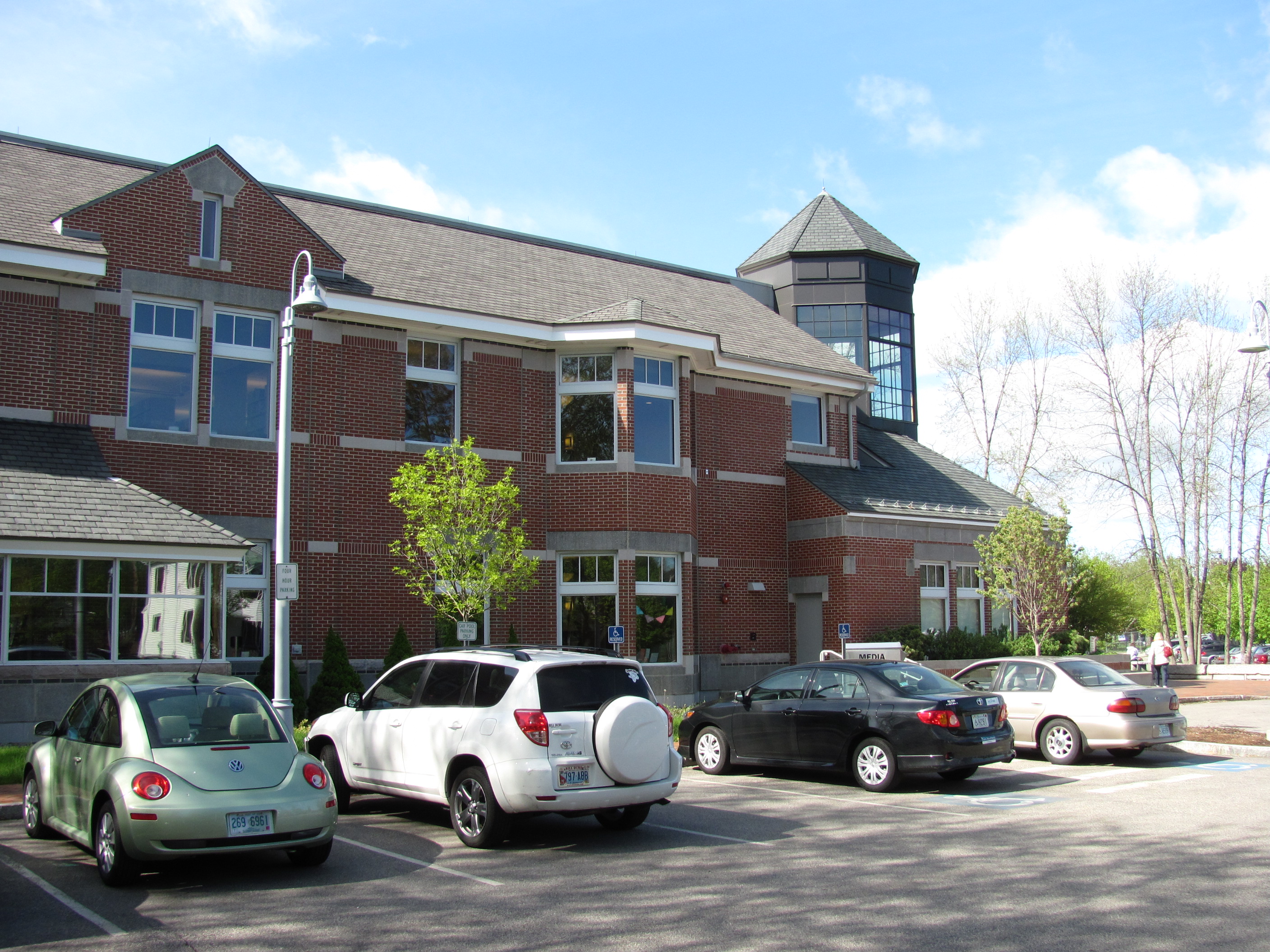
Portsmouth Public Library is the public library of Portsmouth, New Hampshire. Established in 1896, the library's mission is to provide popular media materials to the public as well as to supply information and access to reference works. It also does community outreach, attempting to provide services and material to foster an appreciation for reading and learning in youth as well as offering activities engineered to appeal to older demographics.
Location
1 explorer visited this place
153 m
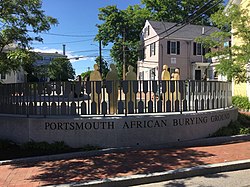
The Portsmouth African Burying Ground is a memorial park on Chestnut Street in Portsmouth, New Hampshire, United States. The memorial park sits on top of an 18th century gravesite containing almost two hundred freed and enslaved African people. It is the only archeologically verified African burying ground for the time period in New England.
The site was discovered in 2003 when construction workers discovered the buried while trying to dig a manhole. Remains of eight individuals were exhumed and determined to be of African descent. Of the eight remains, four were men, one was a female, one a child, and the rest were unable to be determined.
187 m
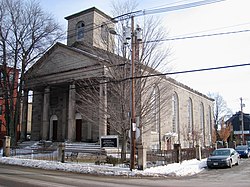
South Parish is the historic name of a church at 292 State Street in Portsmouth, New Hampshire, in the United States. The church building, built in 1824–26, is one of the earliest examples of Classical Revival architecture in New England, and was listed on the National Register of Historic Places in 1979.
Now known as South Church or South Unitarian Universalist Church, the congregation is a covenanting member of the Unitarian Universalist Association, and is an accredited Green Sanctuary. Unitarian Universalism is a liberal religion with Jewish-Christian roots. It has no creed. It affirms the worth of human beings, advocates freedom of belief and the search for advancing truth, and tries to provide a warm, open, supportive community for people who believe that ethical living is the supreme witness of religion. The church is a Welcoming Congregation for bisexual, gay, lesbian, and transgender people.

191 m
The Governor John Langdon House, also known as Governor John Langdon Mansion, is a historic mansion house at 143 Pleasant Street in Portsmouth, New Hampshire, United States. It was built in 1784 by Founding Father John Langdon, a merchant, shipbuilder, American Revolutionary War general, signer of the United States Constitution, and three-term President of New Hampshire. The house he built for his family showed his status as Portsmouth's leading citizen and received praise from George Washington, who visited there in 1789. Its reception rooms are ornamented by elaborate wood carving in the rococo style. The house was declared a National Historic Landmark in 1974, and is now a house museum operated by Historic New England.
The house Langdon had built resembles typical late Georgian houses, with five bays across, a center entry, and four rooms on each floor, flanking a grand central hall and stairway. It is built on a larger and grander scale than most houses, and has very high quality interior woodwork. The interior joinery is attributed to Ebenezer Clifford, a leading woodworker of the Portsmouth area. The main entry is also particularly elaborate with a large door flanked by pairs of engaged columns, and sheltered by a semi-circular portico supported by Corinthian columns and topped by a balustrade.
After Langdon's death in 1819, his lone surviving daughter continued to use the house, but did not live there. Between 1833 and 1902 the house passed through several hands. In the 1850s a fire severely damaged the southwest corner of the house, which was reconstructed. In 1877 the house came into the hands of Frances E. Bassett, a descendant of John Langdon's brother Woodbury. Her son and daughter-in-law, Woodbury and Elizabeth Langdon, converted the house into a Colonial Revival showplace, adding a two-story wing designed by McKim, Mead & White whose details harmonize well with the original structure, and include a dining room based on one built by the ancestral Woodbury Langdon and preserved in the Rockingham Hotel. Elizabeth Langdon deeded the property to Historic New England in 1947.
The house was declared a National Historic Landmark in 1974. It is open to the public for tours on weekends from June to October, and the grounds are available for functions.

205 m
The Rockingham Hotel is a historic former hotel and contemporary condominium at 401 State Street in Portsmouth, New Hampshire, United States. Built in 1885, it is a prominent early example of Colonial Revival architecture, built in part in homage to Woodbury Langdon, whose 1785 home occupied the site. Langdon's home and the hotel both played host to leading figures of their day, and the hotel was one of the finest in northern New England. The hotel, now converted to condominiums, was added to the National Register of Historic Places in 1982.

254 m
The John Paul Jones House is a historic house at 43 Middle Street in Portsmouth, New Hampshire. Now a historic house museum and a National Historic Landmark, it is where American Revolutionary War naval hero John Paul Jones, resided from 1781 to 1782 when it was operated as a boarding house. He also lived in a home in Fredericksburg, Virginia, on Caroline Street, owned by his brother.
It is located at 175 Parrott Avenue.