


L'École dentaire belge est un édifice de style Art nouveau géométrique édifié à Etterbeek, une commune de Bruxelles en Belgique, par Jean-Baptiste Dewin, un architecte qui s'est fait une spécialité de la construction d'édifices à vocation médicale.
Gallery


Sponsored
Location

65 m
Brussels is considered the de facto capital of the European Union, having a long history of hosting a number of principal EU institutions within its European Quarter. The EU has no official capital but Brussels hosts the official seats of the European Commission, Council of the European Union, and European Council, as well as a seat of the European Parliament. In 2013, this presence generated about €250 million and 121,000 jobs. The main rationale for Brussels being chosen as "capital of the European Union" was its halfway location between France, Germany and the United Kingdom, the three countries whose rivalry played a role in starting the two world wars and whose reconciliation paved the way for European integration.
115 m
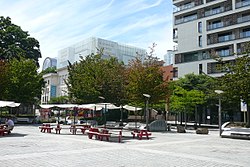
The Place Jean Rey or Jean Reyplein is a square in the European Quarter of Brussels, Belgium. It was inaugurated in 2001 and is named after Jean Rey, the second president of the European Commission.
The headquarters of some of the major EU institutions, including those of the Council of the European Union and the European Parliament, are located on or close to the square. This area is served by Brussels-Luxembourg railway station, as well as by the metro stations Maelbeek/Maalbeek and Schuman on lines 1 and 5.
152 m
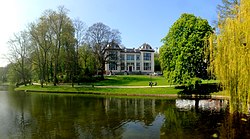
Leopold Park]; Dutch: Leopoldpark) is a public park of 6.43 ha located within the Leopold Quarter of Brussels, Belgium. It is adjacent to the Paul-Henri Spaak building, the seat of the European Parliament. This area is served by Brussels-Luxembourg railway station, as well as by the metro stations Maelbeek/Maalbeek and Schuman on lines 1 and 5.
The park's outstanding feature is its pond, fed by the Maelbeek stream. Many rare trees and animals such as mallards, moorhens, coots, and even Egyptian geese and rose-ringed parakeets thrive in this urban environment.

162 m
The House of European History is a history museum and cultural institution in Brussels, Belgium, focusing on the recent history of Europe. It is an initiative by the European Parliament, and was proposed in 2007 by the Parliament's then-president, Hans-Gert Pöttering; it opened on 6 May 2017.
As a cultural institution and exhibition centre, the House of European History intends to promote the understanding of European history and European integration through a permanent exhibition and temporary and travelling exhibitions. The museum houses a collection of objects and documents representative of European history, educational programs, cultural events and publications, as well as a wide range of online content. By interpreting history from a European perspective, it connects and compares shared experiences and their diverse interpretations. It also aims to initiate learning on transnational perspectives across Europe.
The museum is located in the former Eastman Dental Hospital, in Leopold Park, next to the Lycée Émile Jacqmain and close to the European institutions. This area is served by Brussels-Luxembourg railway station, as well as by the metro stations Maelbeek/Maalbeek and Schuman on lines 1 and 5.

197 m
The Maelbeek or Maalbeek is a stream that flows through several municipalities in Brussels, Belgium, including Etterbeek, Ixelles, Saint-Josse-ten-Noode, Schaerbeek. It is a tributary of the Senne, which it joins up in Schaerbeek, from its source located to the south near La Cambre Abbey. Maelbeek/Maalbeek metro station is located in the central area of this Maalbeek valley.
The name Maalbeek, meaning "mill brook", comes from the Dutch words beek and maal. Molenbeek has a similar derivation. The stream was vaulted in 1872, at which time there were 58 ponds along it. Nowadays, only six are left: the ponds of La Cambre Abbey; of Ixelles; of Leopold Park; of Marie-Louise Square; and of Josaphat Park.
There is another stream in the vicinity named Maalbeek, also a tributary to the Senne, in Grimbergen, and two other streams named Molenbeek, found in Beersel and in Laeken. The Woluwe river also has a tributary named the Kleine Maalbeek, in Kraainem.