Location Image

Marsden Moor Estate

The Marsden Moor Estate is a large expanse of moorland in the South Pennines, between the conurbations of West Yorkshire and Greater Manchester in the north of England. It is named after the adjacent town of Marsden, and is owned and administered by the National Trust to whom it was conveyed in 1955 by the Radcliffe family in lieu of death duties. The estate covers 2,429 ha (5,685 acres) of unenclosed common moorland and almost surrounds Marsden. Part of it is in the most northern section of the Peak District National Park. The landscape is made up of moorland, valleys, peaks and crags and has long been modified by man. Marsden is at the eastern gateway to the important ancient Standedge crossing of the moors and evidence of transport related archaeological remains dating from pre-Roman times have been discovered close to the great engineering structures of the canal and railway ages. The moors have been a water catchment area since the Victorian era when several reservoirs were built, along with their associated catchwaters in the Wessenden Valley. The Pennine Way and the Peak District Boundary Walk run across the moors (following the same route between Wessenden and Redbrook Reservoirs. The landscape supports large numbers of moorland birds such as the golden plover, red grouse, Eurasian curlew and twite. The estate, a designated Site of Special Scientific Interest, forms part of a Special Protection Area and is a candidate Special Area of Conservation. The estate is managed from a base in the old goods yard, adjacent to Marsden railway station, and the old goods shed has been converted into a public exhibition, entitled Welcome to Marsden, which gives an overview of the estate and its history. The moor has been affected by fires. Dozens of firefighters were required to put out a blaze in 2011. A fire in February 2019, during an unseasonal spell of warm weather, was described by West Yorkshire Fire and Rescue Service as one of the biggest moorland fires it had ever had to deal with.

Nearby Places View Menu
Location Image
1.6 km

Standedge Tunnels

The Standedge Tunnels () are four parallel tunnels through the Pennine hills at the Standedge crossing between Marsden in Kirklees, West Yorkshire and Diggle in Oldham, Greater Manchester in northern England. Three are railway tunnels (containing the Huddersfield line) and the other is a canal tunnel. Before boundary changes in 1974, both ends of the tunnels were in the West Riding of Yorkshire. The canal tunnel on the Huddersfield Narrow Canal was authorised by an Act of Parliament on 4 April 1794. Construction of a 5,451-yard (4,984 m) tunnel began months later. Within two years, cost-saving measures pushed back its completion date and progress was slowed by water levels much greater than had been expected. It proved difficult to secure skilled help, some tenders went unanswered and Benjamin Outram withdrew from the venture. In 1807, Thomas Telford drew up a new plan for its completion. In 1811, the tunnel opened. It is the longest and oldest of the four Standedge tunnels and is the longest, highest, and deepest canal tunnel in the United Kingdom. Having been closed to all traffic in 1943, the canal tunnel was re-opened in May 2001. The first, single-track railway tunnel, built for the London and North Western Railway (LNWR) on its line between Huddersfield and Manchester, was completed in 1848. It proved to have insufficient capacity and a second, parallel, single-track tunnel was opened in 1871. The LNWR opened a third, double-track tunnel in 1894. Only the double-track tunnel is currently used for rail traffic; the other two are intact but disused. All four tunnels are linked by cross-tunnels or adits at strategic intervals which allowed the railway tunnels to be built without construction shafts and allowed waste material to be removed by boat. The Standedge Tunnel Visitor Centre, at the Marsden end, is a base for boat trips into the tunnel and has an exhibition depicting the different crossings.
Location Image
1.9 km

Marsden railway station

Marsden railway station serves the village of Marsden near Huddersfield in West Yorkshire, England. The station is on the Huddersfield Line, operated by Northern and is about 7 miles (11 km) west of Huddersfield station. It was opened in 1849 by the London & North Western Railway and is the last station before the West Yorkshire boundary with Greater Manchester. The station is operated by Northern Trains, but only TransPennine Express trains call here.
2.1 km

Standedge

Standedge () is a moorland escarpment in the Pennine Hills of northern England between Marsden, West Yorkshire and Diggle, Greater Manchester. Standedge has been a major moorland crossing point since Roman times and possibly earlier. From east to west, Standedge is crossed by five generations of road crossing, the earliest a Roman road from York to Chester and the latest the A62 road. The Huddersfield Narrow Canal and the railway line from Leeds to Manchester pass underground in the Standedge Tunnels. The Pennine Way long-distance footpath passes through Standedge in a north–south direction along the Pennines. Much of Standedge is in the National Trust's Marsden Moor Estate. Administratively, Standedge is split between Kirklees and Oldham.
Location Image
2.1 km

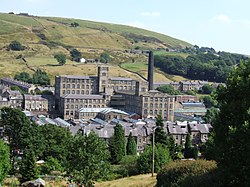
Bank Bottom Mill

Bank Bottom Mill, later known as Marsden Mill, was from 1824 an important centre for the production of woollen cloth in Marsden, West Yorkshire, England. Originally a fulling mill, Bank Bottom Mill reached its heyday in the late nineteenth and early twentieth centuries under the ownership of the Crowther family, in particular John Edward Crowther, a businessman and philanthropist. However, the cloth industry declined in the late twentieth century, and production of woollen cloth finally ceased in 2003.