


Le parc national El Tepeyac (espagnol : Parque nacional El Tepeyac) est un parc national du Mexique situé dans le District fédéral. Cette aire protégée de 15 km2 a été créé en 1937.
Location
1 explorer visited this place

0 m
El Tepeyac National Park is one of a number of federally recognized national parks in Mexico that are protected natural areas and administered by the federal National Commission of Protected Natural Areas, a subsidiary of SEMARNAT. It is one of the few green areas located north of the Mexico City suburbs. 95% of its territory is located in Gustavo A. Madero, D.F. Borough and 5% in the municipality of Tlalnepantla de Baz.
This is one of the large expanses of artificial forest of eucalyptus and was reforested in the first half of the 20th century in the Federal District. The designated territory for the National Park is the Tepeyac Hill, place known for the legend of the apparition of the Virgin of Guadalupe to the indigenous Juan Diego. From the top of the hill a whole view of the Valley of Mexico can be seen. However, this place is threatened by the urban sprawl growing in the surroundings.
This park covers part of the Sierra de Guadalupe mountain range and was created through a decree issued on February 18, 1937. Originally it had an extension of 1,500 ha. Even though several other authors indicate different current numbers depending on the type of topographic study applied. 56% of the park is legally an "ejido" and the 44% left is privately owned.
Because once the territory had a completely lack of vegetation and was restored after reforestation activities, by decrees issued in 1926, 1937 and 1972, El Tepeyac is now considered a protected National Park under reforestation programs of Local and Federal administration.
1.6 km
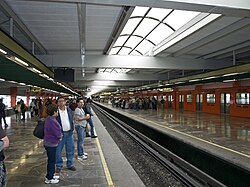
Indios Verdes metro station is a station of the Mexico City Metro along Avenida de los Insurgentes, in Gustavo A. Madero, Mexico City. It is an at-grade station with two island platforms serving as the northern terminus of Line 3. It is followed by Deportivo 18 de Marzo metro station. Indios Verdes metro station was inaugurated on 1 December 1979 providing southward service toward Hospital General metro station.
The station services the colonias of Residencial Zacatenco and Santa Isabel Tola. The station and surrounding area are named after the verdigris statues of Itzcoatl and Ahuitzotl, both Aztec rulers. Located in the nearby Parque Mestizaje, these statues are collectively known as the Monumento a los Indios Verdes, and their silhouettes are depicted in the pictogram.
The station facilities are accessible to people with disabilities featuring tactile pavings and braille signage plates. Outside, there is a transportation hub serving multiple bus routes. The station is commonly ranked among the busiest in the system. In 2019, it recorded an average daily ridership of 107,376 passengers, making it the third-busiest station overall and the busiest on its line.

1.6 km
Tepeyac or the Hill of Tepeyac, historically known by the names Tepeyacac and Tepeaquilla, is located inside Gustavo A. Madero, the northernmost Alcaldía or borough of Mexico City. According to the Catholic tradition, it is the site where Saint Juan Diego met the Virgin of Guadalupe in December 1531, and received the iconic image of the Lady of Guadalupe. The Basilica of Our Lady of Guadalupe located there is one of the most visited Catholic shrines in the world.
Spanish colonists erected a Catholic chapel at the site, Our Lady of Guadalupe, "the place of many miracles." It forms part of the Sierra de Guadalupe mountain range.

1.8 km
San Juan Ixhuatepec is a town located in the municipality of Tlalnepantla de Baz, in the centre of the State of Mexico. The population is 353,300. The name of Ixhuatepec means "place in the leaves hill" in the Nahuatl language.

2.0 km
Martín Carrera is a station on the Mexico City Metro. It is located at the borders of the Colonia Martín Carrera, Colonia 15 de Agosto, and Colonia Díaz Mirón districts in the Gustavo A. Madero borough, in the north of Mexico City. The station logo depicts a bust of General Martín Carrera, a national hero who fought in the Mexican–American War of 1846–48.
Notes et références
Portail de Mexico Portail de la conservation de la nature