


La mosquée d’Aïn Chock est une mosquée située dans le quartier d’Aïn Chock, à Casablanca, au Maroc. Construite entre 1945 et 1953, elle est considérée lors de son inauguration comme la plus grande mosquée du Maroc et l’une des plus vastes d’Afrique du Nord. Elle est parfois désignée sous le nom de Masjid al-Atiq (المسجد العتيق).
Location
1 explorer visited this place
548 m
Aïn Chock is a district, arrondissement and southern suburb of Casablanca, in the Casablanca-Settat region of Morocco, on the road to El Jadida. It is known for hosting the faculties of the Hassan II University. The district covers an area of 28.89 square kilometres, and as of 2004 had 253,496 inhabitants. The district contains one arrondissement, also named Aïn Chock.
665 m
Sbata is an arrondissement of Casablanca, in the Ben M'Sick district of the Casablanca-Settat region of Morocco. As of 2004 it had 122,827 inhabitants.

1.1 km
Grand Casablanca or Greater Casablanca was one of the sixteen former regions of Morocco that existed from 1997 to 2015. Located in coastal northwestern Morocco, it was the most densely populated region and covered an area of 1,117 km2. The population at the 2014 census was 4,270,750. The region was the economic heart of the Moroccan economy with Casablanca, the region's capital, being the effective economic capital of Morocco.
The region was bordered by the Atlantic Ocean to the north and by the region of Chaouia-Ouardigha on the other three sides.
The last wāli or governor of Greater Casablanca was Mohammed Kabbaj.
1.1 km
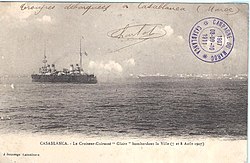
The Bombardment of Casablanca was a French naval attack that took place from 5 to 7 August 1907, destroying the Moroccan city of Casablanca. France used mainly artillery fire from armored cruisers to bomb the city and targets in the surrounding area, which caused an estimated 1,500 to 7,000 Moroccan deaths. The bombardment of Casablanca opened a western front to the French conquest of Morocco after Hubert Lyautey's occupation of Oujda in the east earlier that year.
The bombardment came after an attack of tribesmen of the Shawiya opposed to the terms of the Treaty of Algeciras of 1906 to the French presence in the customs house and to the construction of a railroad over a sanctuary, specifically on European employees of the Compagnie Marocaine operating a Decauville train from a quarry in Roches Noires to the Port of Casablanca on 30 July 1907. When the French cruiser Galilée disembarked a landing party of 75 soldiers on 5 August, an insurrection broke out in the city.
The Galilée and the Du Chayla bombarded the city with mélinite, an explosive substance containing picric acid that struck residential neighborhouods, particularly the Tnaker.

1.1 km
Casablanca is the largest city in Morocco and the country's economic and business centre. Located on the Atlantic coast of the Chaouia plain in the central-western part of Morocco, the city has a population of about 3.22 million in the urban area, and over 4.27 million in Greater Casablanca, making it the most populous city in the Maghreb region, and the ninth-largest in the Arab world.
Casablanca is Morocco's chief port, with the Port of Casablanca being one of the largest artificial ports in Africa, and the third-largest port in North Africa, after Tanger-Med and Port Said. Casablanca also hosts the primary naval base for the Royal Moroccan Navy.
Casablanca is a significant financial centre, ranking 54th globally in the September 2023 Global Financial Centres Index rankings, between Brussels and Rome. The Casablanca Stock Exchange is Africa's third-largest in terms of market capitalization, as of December 2022.
Major Moroccan companies and many of the largest American and European companies operating in the country have their headquarters and main industrial facilities in Casablanca. Recent industrial statistics show that Casablanca is the main industrial zone in the country.
Book your tour near
Mosquée d’Aïn Chock
Book Now
4.2
in partnership with
GetYourGuide.com