


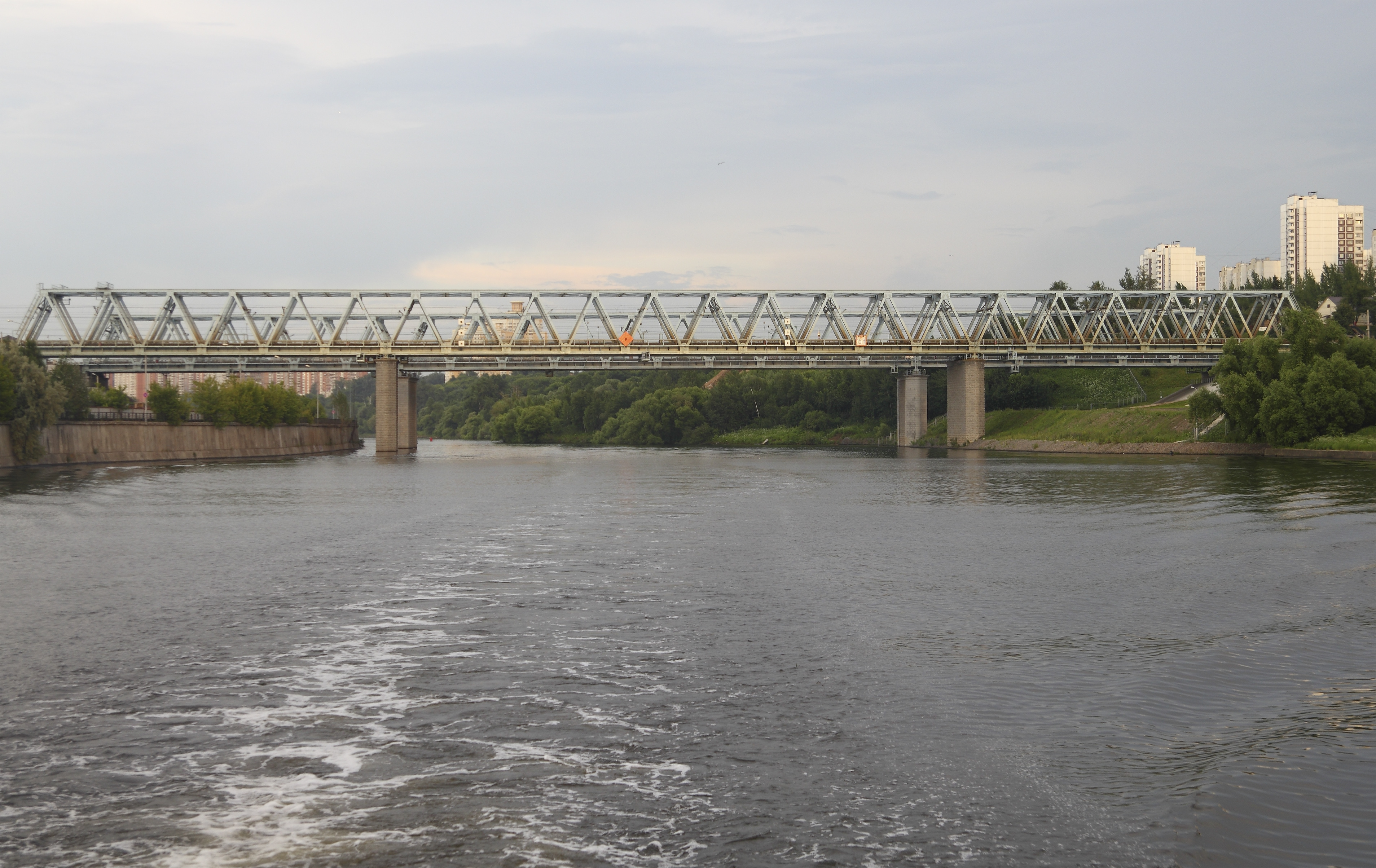
Saburovsky Rail Bridges (Russian: Cабуровские железнодорожные мосты) are two adjacent steel bridges that span Moskva River in southern Moskvorechye-Saburovo District of Moscow, Russia. They were completed in 1924 and 1953, when Saburovo was a remote suburb of Moscow.
Gallery

Sponsored
Location
1 explorer visited this place
576 m
Kashirskoye Highway or Kashira Highway is a major street in Moscow, Russia, continued as a highway beyond the city into Moscow Oblast as a backup route for highway M4. It was named in the 19th century after the old Kashira Road, which led to the town of Kashira. It was one of the sites of the Russian apartment bombings of 1999. Along the road, major landmarks include the Saburovo Church and the Orekhovo-Borisovo Cathedral.

872 m
Kuryanovo is a railway station of Moscow Railway's Kurskaya line as well as Line D2 of the Moscow Central Diameters in Moscow. It was opened in 2020.

1.8 km
NEVOD is a neutrino detector and cosmic ray experiment that attempts to detect Cherenkov radiation arising from interactions between water and charged particles. It represents the first attempt to perform such measurements at the Earth's surface; it is because of this surface deployment that the experiment is also able to investigate cosmic rays. NEVOD is situated at the Moscow Engineering Physics Institute.
The term NEVOD experimental complex is used of the experimental complex built around the original water Cherenkov detector for the study of cosmic rays; as of 2018, the experimental complex consists of: the Cherenkov water detector, a coordinate-tracking detector DECOR, an array of scintillation detectors forming the calibration telescopes system CTS, and PRISMA array of thermal neutron detectors. As of 2018, the experimental complex is being expanded by three new cosmic ray detectors: NEVOD-EAS, URAN and TREK. Part of the new detectors are under operation.
The experimental complex used to also have a muon hodoscope URAGAN which was operational in 2016 and years prior. Current status of URAGAN is unknown.

1.9 km
National Research Nuclear University MEPhI is a public technical university in Moscow, Russia. It was founded in 1942 as the Moscow Mechanical Institute of Munitions, but was soon renamed the Moscow Mechanical Institute. Its original mission was to train skilled personnel for the Soviet military and Soviet atomic bomb project. It was renamed the Moscow Engineering Physics Institute in 1953, which was its name until 2009.
By the Order of the Government of Russia on April 8, 2009 on behalf of Russian President's Decree of October 7, 2008 "On the pilot project launching on creating National Research Universities" MEPhI was granted this new status. The university was reorganized. The aim of the university existence is now preparing the specialists by giving them higher professional, post-graduation professional, secondary professional and additional professional education, as well as educational and scientific activities.
In 2022, QS World University rankings rated the university #308 in the world, World University Rankings by Times Higher Education ranked the university #401 in the world, and in 2023 U.S. News & World Report rated the university #483 in the world.
2.0 km
Southern Administrative Okrug, or Yuzhny Administrative Okrug, is one of the twelve high-level territorial divisions of the federal city of Moscow, Russia. As of the 2010 Census, its population was 1,716,808, up from 1,593,065 recorded during the 2002 Census.
