

 English
 Français

Firby (Hambleton)
Firby est un village et une paroisse civile du Yorkshire du Nord, en Angleterre.
Nearby Places View Menu

27 m
Firby, Bedale
Firby is a small village and civil parish in North Yorkshire, England. It lies 1-mile (1.5 km) south of Bedale. The population of the parish was estimated at 30 in 2015. At the 2011 Census the population was included with the civil parish of Bedale, and not counted separately.
The manor was owned by Auduid before the Norman Conquest. By 1086, it was held by Count Alan who had many lands in the area and owned the manor of Bedale. Count Alan and his family owned the parish for over two centuries and by the late 14th century, it was in a different family name.
Firby was a liberty of Richmondshire, and within the bounds of East Hang wapentake in the North Riding of Yorkshire. From 1974 to 2023 it was part of the district of Hambleton, it is now administered by the unitary North Yorkshire Council.
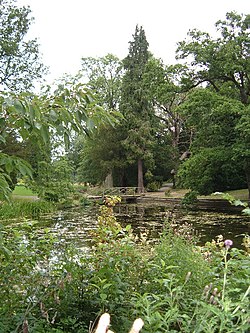
The gardens at Thorp Perrow lie just to the south of the village and are in the parish of Firby. Some names of places within Firby include: Firby Hall, Firby (Christ's) Hospital, John Clapham House, Firby Grange (a former subdivision of Jervaulx Abbey), Low Ash Bank and High Ash Bank, Mile House Farm and Manley Farm. Christ's Hospital was founded in 1608 and was originally four almshouses. The building is now Grade II listed.
Firby Hall, also Grade II listed, was built in 1788 by Colonel Thomas Coores who fought in the American War of Independence. He demolished much of the village to build the house and the 57-acre (23 ha) estate.
Firby was the origin of the surname Firby. The name of the village derives from a personal name (Frithi) and the suffix by, meaning village or farmstead.

278 m
Christ's Hospital, Firby
Christ's Hospital is a historic building in Firby, a village in North Yorkshire, in England.
The building was constructed in 1608 to serve as almshouses, with a central chapel. An inscription above the door commemorates the foundation. The stone slabs on the roof were partly replaced by stone slates, but the building was otherwise little altered. It was grade II listed in 1952. In the 1970s, the almshouses were converted into two houses.
The building is constructed of stone on a chamfered plinth, and has a stone slate roof with stone coping. It has seven bays with a single storey, other than the middle bay, which projects, and is gabled with two storeys. This contains a doorway with a chamfered surround and a four-centred arched lintel, over which is a cornice containing a plaque with a moulded surround and a Latin inscription. Above this is a mullioned and transomed window, and a cornice and a plaque with a moulded architrave, and on the apex of the gable is a bellcote. The outer bays contain doorways with chamfered surrounds, some with four-centred arched lintels, and the windows are chamfered with mullions. Prior to the conversion, the chapel contained a Jacobean dado, locker and hat rail, and four contemporary paintings. Each almshouse contained its original fireplace and a cupboard bed.
1.0 km
Thorp Perrow Arboretum
Thorp Perrow Arboretum is an 85-acre (34 ha) woodland garden arboretum near Bedale in North Yorkshire, England.

1.2 km
Thorp Perrow Hall
Thorp Perrow Hall is a historic building near Snape, North Yorkshire, a village in England.
The country house was built around 1715, on the site of an earlier manor house. The exterior was rebuilt in about 1800, to a design by John Foss. Walter Brierley undertook further work on the house in the early 20th century. The house has extensive grade II listed grounds, much of which now comprise Thorp Perrow Arboretum. The building was grade II* listed in 1966.
The house is built of rendered stone with a hipped stone slate roof. The main front has eleven bays, the middle nine with three storeys and the outer bays with two, and returns of five bays, the middle three bays bowed. To the rear right is a lower, single-storey wing. On the front is a porte cochère of two pillars and six fluted Ionic columns, and a doorway with pilasters and a moulded archivolt. Above it is a tripartite sash window with pilasters and columns carrying an entablature with a swagged frieze and a triangular pediment. The other windows are sashes in architraves, and on the outer bays are Venetian windows in arched recesses. Inside, there is early plasterwork in the ballroom, an early rear staircase, and original panelling and fireplaces in some of the bedrooms.
1.2 km
Bedale High School
Bedale High School is a coeducational comprehensive secondary school situated on Fitzalan Road, Bedale, North Yorkshire, England.
Its predecessor Bedale Grammar School dates to an endowment of 1588. Nicholas Carlisle in his 1818 survey of endowed grammar schools describes the school as 'ancient', evidencing the fact that the school received Crown funding following the Dissolution of the monasteries (1536-1540).
The School's 2004 Ofsted Inspection Report rated the school for overall effectiveness as Grade 2 (good); in 2007 again as Grade 2; and in 2010, as Grade 3 (satisfactory). In 2019, it was awarded a Grade 2 (good) rating.
In 2001, just before the 2001 General Election, Jonathan Dimbleby hosted a live broadcast of Any Questions? from the school. In 2017, the police were called to a disturbance on the school playing field. The protest by students was in regard to a restriction on toilet breaks, which one parent described as "humiliating". The police stated it was not a criminal matter.