

 English
 Français

Little Cumbrae
Little Cumbrae (Scottish Gaelic: Cumaradh Beag) is an island in the Firth of Clyde, in North Ayrshire, Scotland. It lies south of Great Cumbrae, its larger neighbour. The underlying geology is igneous with limited outcrops of sedimentary rock. Little Cumbrae House is of 20th century construction, although the island has no permanent inhabitation at present, its population having peaked at 23 in the late 19th century. There is a lighthouse on the western coast.
Nearby Places View Menu

835 m
Castle Island, Scotland
Castle Island (Scottish Gaelic: Eilean a' Chaisteil) or Allimturrail is a small tidal island, lying off the east coast of Little Cumbrae, and to the west of Trail Island, in the Firth of Clyde. It is joined to Little Cumbrae at low tide.
The castle which gives the island its name was built in 1527, and was destroyed by Cromwellian forces in 1650. It is a square keep, and is said to have been built originally to prevent deer poaching.

3.2 km
Glencallum Bay Lighthouse
Glencallum Bay Lighthouse is a lighthouse on a point on the northernmost side of Glencallum Bay on the Isle of Bute. Its Gaelic name is the Rubh' An Eun which means the point of the birds.
The lighthouse was built in 1911 by the Stevenson family business which built many of the lighthouses in Scotland.
It is on the West Island Way.
3.5 km
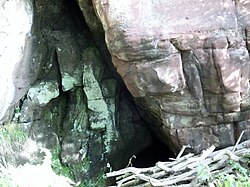
The Holy Cave, Hunterston
The Holy Cave at Hunterston in the Parish of West Kilbride is associated with Saint Mungo, also known as St Kentigern. It is often referred to as the Hawking Craig Cave; however two caves exist in the Hawking Craig Wood and 'Three Sisters' area of the cliffs, the other being Smith's Cave, better described as a rock shelter lying a short distance to the south. The main cave has been excavated, and the finds indicate three periods of occupation over many centuries.

3.5 km
The Eileans
The Eileans are two small, low-lying islands located in Newtown Bay, Millport on the island of Great Cumbrae, Scotland. (grid reference NS164545).
The name is an anglicisation of the Scottish Gaelic, eilean meaning "island". Unusually for the west coast of Scotland, the two islands appear to have no individual names of their own and as such are always referred to collectively. The islands were mined for stone in the Victorian times, during the busy expansion of Millport.
Today the islands are home to a small colony of harbour seals.
Three smaller rocks, the Leug (possibly Gaelic: gemstone), the Spoig (Gaelic: paw) and the Clach (Gaelic: stone) lie to the west.