

 English
 Français

George Square (Glasgow)
George Square est une place publique de Glasgow en Écosse. Située dans le centre de la ville, elle est nommée d'après le roi George III. Les bâtiments notables sur la place incluent les Glasgow City Chambers, l'ancien poste de la ville, qui devint les offices en 2007, et l'office de tourisme de Glasgow. Il y a de nombreuses statues sur la place. Les statues sont :
Walter Scott, en haut d'une colonne Robert Burns James Watt John Moore (militaire britannique) Robert Peel Albert de Saxe-Cobourg-Gotha (statue équestre) Victoria du Royaume-Uni (statue équestre) Aussi se trouve sur la place le monument de guerre de Glasgow.
Portail de l’architecture et de l’urbanisme Portail de Glasgow
Nearby Places View Menu

222 m
Bridle Works Building
Bridle Works Building is a 20-storey student accommodation 68m high tower located at 366 Cathedral Street in Scotland's largest city, Glasgow. It is situated within walking distance of the city centre and to two of the city's three main universities, Glasgow Caledonian University and the University of Strathclyde.
Housing 422 rooms, the building has its own tea lounge, glam room and rooftop terrace. The building was named in honour of Joan Eardley, a Glasgow School of Art graduate who had a studio in the area and who was famed for her paintings of oxen and horses. The building's aesthetic deliberately mimics elements of the 1960s Met Tower which stands diagonally opposite.
355 m
Glasgay! Festival
Glasgay! Festival was a gay, lesbian, bisexual and transgender arts festival in Glasgow, Scotland. From 1993 to 2014, it was part of the diversity of Glasgow's cultural scene, an annual Lesbian, Gay, Bisexual and Transgender Arts Festival held usually in October/November, formerly organised by GALA Scotland Ltd.
357 m
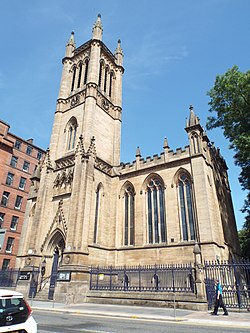
The Ramshorn
The Ramshorn (formerly St David's Parish Church), is a deconsecrated church building located on Ingram Street in the Merchant City area of Glasgow, Scotland. It is home to SCILT, Scotland's National Centre for Languages and the Confucius Institute for Scotland's Schools (CISS), both centres within the University of Strathclyde. The building is owned by the University, which bought the church in 1983 and used it as a theatre and performance space from 1992 until 2011.
The former church building sits within the Ramshorn Cemetery, one of Glasgow's oldest burial grounds.

361 m
Statue of Donald Dewar
A statue of the Scottish politician Donald Dewar stands on Buchanan Street in Glasgow city centre. The statue was unveiled on 7 May 2002 by the prime minister of the United Kingdom, Tony Blair. It was sculpted by Kenny Mackay. The statue is 9 feet in height. Dewar is depicted wearing spectacles and his "characteristic stoop and crumpled suit".
The statue was unveiled on 7 May 2002 by the prime minister of the United Kingdom, Tony Blair in front of a crowd of several hundred people.
At the unveiling of the statue Blair said that Dewar's " ... compassion, his fundamental decency and his deep sense of social justice defined his entire approach as a politician" and described him as a "transforming moderate". The former leader of Scottish Labour, Wendy Alexander, said that the statue was " ... magnificent, the setting and the angle of it ...It's wonderful but it's not what he was when he was at his most exhausted".
The statue was taken down in October 2005 to be cleaned, and was re-erected on 6-foot (1.8 m) high plinth in December in an effort to protect it from vandalism.

362 m
Ramshorn Cemetery
The Ramshorn Cemetery is a cemetery in Scotland and one of Glasgow's older burial grounds, located within the Merchant City district, and along with its accompanying church, is owned by the University of Strathclyde. It has had various names, both official and unofficial: North West Parish Kirkyard; St David's Kirkyard; and Ramshorn and Blackfriars. The latter name tells of its link to Blackfriars Church, linking in turn to the pre-Reformation connection to the Blackfriars Monastery in Glasgow.
The burial ground was used from 1719 to 1915. In the 20th century it was remodelled along the lines of the London Improvements Act, moving most stones to the perimeter to create a usable park area. Apart from some flat stones still remaining in-situ this has largely disconnected the stones to the actual spot of interment.
In 1813 the body of Janet McAlister was stolen from the graveyard, being found with 4 others in College Street Medical School.
In 1824 the church of St David was built on its southern side, designed in a fine Gothic style by the English architect Thomas Rickman, with modifications by local architect James Cleland.
The cemetery is effectively in three sections: the original cemetery; an enclosed central walled area where the old church stood; and two small walled sections flanking the new church. Unusually monuments adopt only two forms: wall monuments and flat slabs, other than a small row of small 18th-century stones upright but partly sunk into the ground, standing in a line to the north-east.
Despite its great simplicity, the majority of graves are to rich Glasgow merchants. The austere style reflects Scottish Calvinist views.
John Anderson, the founder of Anderson's Institute - which would evolve into the Royal College of Science and Technology and then ultimately the University of Strathclyde, is also interred in the site.