


La galerie Mennour est une galerie d'art parisienne spécialisée dans l'art contemporain fondé et dirigé par le galeriste français Kamel Mennour.
Book your tour near
Galerie Kamel Mennour
Book Now
4.4
in partnership with
GetYourGuide.com
Location
1 explorer visited this place

524 m
Mundolingua is a museum situated in the 6th arrondissement of Paris. Its purpose is to present information, objects and documents relating to language, linguistic diversity and linguistics to the general public.
559 m
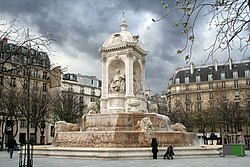
The Fontaine Saint-Sulpice is a monumental fountain located in Place Saint-Sulpice in the 6th arrondissement of Paris. It was constructed between 1843 and 1848 by the architect Louis Visconti, who also designed the tomb of Napoleon.
The four figures on the fountain represent four French religious figures of the 17th century famous for their eloquence.
Bossuet, North, statue by Jean-Jacques Feuchère
Fénelon, East, statue by François Lanno
Fléchier, West, statue by Louis Desprez
Massillon, South, statue by Jacques-Auguste Fauginet, completed by Fouquiet after the death of Fauginet.
In French the fountain is also called "La Fontaine des quatre points cardinaux", a pun which means the "Fountain of the four points of the compass" or, in the form "La Fontaine des quatre point cardinaux", which is pronounced in the same way) "Fountain of the four not cardinals". This name is also a pun, because "points cardinaux" in French is a play on words. The four bishops portrayed in the statues, while renowned, were never elevated to the rank of cardinal.

559 m
The Place Saint-Sulpice is a large public square, dominated on its eastern side by the Church of Saint-Sulpice. It was built in 1754 as a tranquil garden in the Latin Quarter of the 6th arrondissement of Paris.

596 m
The Senate is the upper house of the French Parliament, with the lower house being the National Assembly, the two houses constituting the legislature of France. It is made up of 348 senators elected by part of the country's local councillors in indirect elections. Senators have six-year terms, with half of the seats up for election every three years. They represent France's departments, overseas collectivities and citizens abroad.
Senators' mode of election varies upon their constituency's population size: in the less populated constituencies, they are elected individually, whereas in more populated ones, they are elected on lists. It is common for senators to hold dual mandates, such as in a regional council or departmental council.
The Senate enjoys less prominence than the National Assembly, which is elected on direct universal ballot and upon the majority of which the Government relies: in case of disagreement, the Assembly can in many cases have the last word, although the Senate keeps a role in some key procedures, such as constitutional amendments. However, following the 2024 snap legislative election and the ensuing political fragmentation in the Assembly, the newly-outed Barnier government held a working majority in the Senate but not in the Assembly, a first under the Fifth Republic, marking "a form of strengthening of the Senate".
Bicameralism was first introduced in France amid the French Revolution in 1795; as in many countries, it assigned the upper chamber with the role of moderating the lower, although for a long time as an ally of the executive. The present selection mode of the Senate dates back to the start of the Third Republic, when it was turned into what Léon Gambetta famously called a "grand council of the communes of France". Over time, it developed a sense of independence as a "guardian of the institutions" and "guardian of liberties", favoured by the fact that senators are on average older than deputies in the Assembly, joining the Senate in the later part of their career. Debates in the Senate tend to be less tense and generally receive less media coverage. As a result of its election relying on what is often summed up as rural mayors, it has had a right-wing majority since 1958, with only a three-year exception in 2011–2014.
The President of the Senate is to step in as acting President of France in case of an incapacitation or a vacancy, which last happened in 1974. The officeholder also appoints three members of the Constitutional Council. Since 2014, Gérard Larcher has been President of the Senate.
The Senate is housed inside the Luxembourg Palace in the 6th arrondissement of Paris. Like the National Assembly, it is guarded by Republican Guards. In front of the building lies the Senate's garden, the Jardin du Luxembourg, open to the public.

596 m
The Luxembourg Palace is at 15 Rue de Vaugirard in the 6th arrondissement of Paris, France. It was originally built to the designs of the French architect Salomon de Brosse to be the royal residence of the regent Marie de' Medici, mother of King Louis XIII. After the Revolution it was refashioned by Jean-François Chalgrin into a legislative building and subsequently greatly enlarged and remodeled by Alphonse de Gisors. The palace has been the seat of the upper houses of the various French national legislatures since the establishment of the Sénat conservateur during the Consulate; as such, it has been home to the Senate of the Fifth Republic since its establishment in 1958.
Immediately west of the palace on the Rue de Vaugirard is the Petit Luxembourg, now the residence of the Senate President; and slightly further west, the Musée du Luxembourg, in the former orangery. On the south side of the palace, the formal Luxembourg Garden presents a 25-hectare green parterre of gravel and lawn populated with statues and large basins of water where children sail model boats.
Book your tour near
Galerie Kamel Mennour
Book Now
4.4
in partnership with
GetYourGuide.com
