

 English
 Français

Sawley (Yorkshire du Nord)
Sawley est un village et une paroisse civile du Yorkshire du Nord, en Angleterre.
Nearby Places View Menu

2.3 km
Aldfield
Aldfield is a village and civil parish in the county of North Yorkshire, England, about three miles west of Ripon. It is the closest village to Fountains Abbey and became part of the abbey estate in 1356. The population of the parish was estimated at 80 in 2013. The parish now shares a grouped parish council with the civil parishes of Studley Roger and Lindrick with Studley Royal and Fountains, known as Fountains Abbey Parish Council.
St Lawrence's Church, Aldfield, is a grade II* listed building, dating from the 1780s.

2.4 km
Fountains Hall
Fountains Hall is a country house near Ripon in North Yorkshire, England, located within the World Heritage Site at Studley Royal Park which include the ruins of Fountains Abbey. It belongs to the National Trust and is a Grade I listed building.

2.5 km
St Lawrence's Church, Aldfield
St Lawrence's Church is the parish church of Aldfield, a village in North Yorkshire, in England.
The first church on the site was built in the 14th century. It was rebuilt in the 1780s. In 1878, St Mary's, Studley Royal was completed, and superseded St Lawrence as the parish church, but in 1969 St Lawrence was restored to the role. The church was Grade II* listed in 1967.
The church is built of gritstone rubble, with a slate roof. It has a three-bay nave, with a bellcote at the west end. There is a north transept with a vestry, and just a small east projection as a sanctuary. The building is in the Gothick style, with pointed windows, many of which have Y-shaped tracery. There is a sundial, which is inscribed "1696 Mr. A. SMITH R.W R.L." Inside, there is a three-decker pulpit, with a sounding board and original candlesticks, box pews throughout, and an organ at the west end.

2.5 km
Fountains Mill
Fountains Mill, sometimes known as Abbey Mill, is a historic building at Fountains Abbey, a World Heritage Site in North Yorkshire, in England.
The watermill was built in the 1130s or 1140s on a leet from the River Skell, as a corn mill for the abbey. It originally had a single wheel at the southern end, but it was rebuilt in the 1150s atop a dam, with a wheel at each end. In the 13th century, the upper storey was added, to serve as a granary. The Abbey closed in 1539 with the Dissolution of the Monasteries, following which the north end was demolished and replaced with a new single-storey section. The mill continued in use, and in 1840 was converted into a sawmill, the current waterwheel being installed at this time. In 1928 a turbine was installed to convert the building to the production of electricity. The mill closed in 1937, and the building then served various uses including refugee accommodation and a stonemason's workshop. It was restored in 1993 for use as a museum and exhibition space. It is the most substantial Cistercian mill to survive. The building has been grade I listed since 1986, and is also a scheduled monument.
The mill is built of gritstone with a stone slate roof, and has three stories and five bays, and a two-storey two-bay extension to the north. On the east front is a round-arched doorway, other round-arched openings and four stepped buttresses. The west front has similar openings and an attached wheelhouse. On the left return are external steps leading to a round-arched doorway with a chamfered surround, and in both returns are square-headed windows.
2.7 km
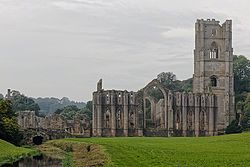
Fountains Abbey
Fountains Abbey is a ruined Cistercian monastery near Ripon in North Yorkshire, England. It was founded in 1132 under the direction of Thurstan, archbishop of York, and over the next four centuries became one of the wealthiest monasteries in England thanks to its large and diverse landholdings. The monastery was dissolved in 1539 as part of the English Reformation and its estates sold. Fountains Abbey is now within Studley Royal Park, a landscaped garden created in the eighteenth century.
Even in its current state, Fountains is described by Historic England as "the best preserved of English abbeys and [...] the finest picturesque ruin." The majority of the buildings were constructed in the Romanesque and Early English Gothic style between 1170 and 1247, with significant additions in the late fifteenth and early sixteenth centuries. The abbey church and many of the claustral buildings survive, including the chapter house, refectory, and lay brothers' dormitory, as well as ancillary structures such as the guest houses, abbey mill, and bridges.
The abbey is protected for its historic significance, having been designated a grade I listed building and a scheduled monument by Historic England. It also forms part of the Studley Royal including the ruins of Fountains Abbey World Heritage Site. It is owned by the National Trust and maintained by English Heritage, and is open to the public.