


Knaresborough railway station is a Grade II listed station serving the town of Knaresborough in North Yorkshire, England. It is located on the Harrogate Line 16.75 miles (27 km) west of York and is operated by Northern Trains, who provide all passenger train services.


Location
2 explorers visited this place


Location
The station is located at the north-eastern end of the Knaresborough Viaduct off Station Road to the north-west side of Knaresborough town centre. The station is within walking distance of the town centre and the western side of Knaresborough.
History
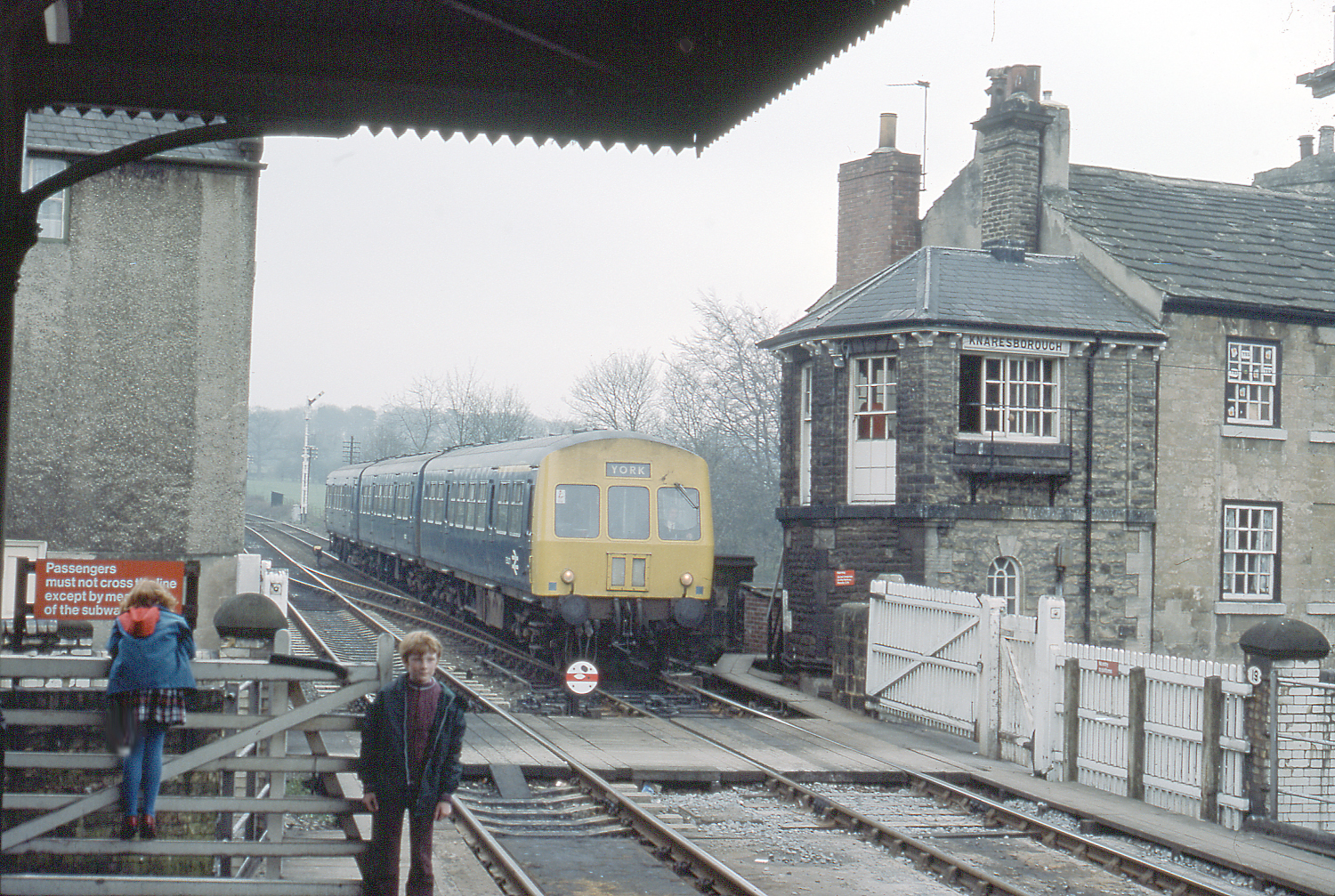
The East and West Yorkshire Junction Railway (E&WJR) was opened from York (Poppleton Junction) to a temporary terminus known as Hay Park Lane, Knaresborough on 30 October 1848. The E&WYJR was absorbed by the York and North Midland Railway on 1 July 1851. Three weeks later, with the completion of the stone viaduct crossing the River Nidd at Knaresborough on 21 July 1851, the temporary station was closed and a new Knaresborough station opened on the current site just beyond the stone viaduct. In 1865 the North Eastern Railway replaced the 1851 station with a new one designed by Thomas Prosser. The station was rebuilt c.1890. The 1851 water tower is still extant. Beyond the platforms eastbound is a tunnel which separated the station from the goods yard (now a bus depot) and the line's major junction. The Knaresborough to Boroughbridge branch (1875–1950 for passengers, 1964 for goods) diverged from the main line to York opposite the goods yard. This line continued north-east until it met the East Coast Main Line between York and Northallerton at Pilmoor. The tunnel is still extant with both north and south portals are now listed structures. The station signal box supervises the single line section eastwards to Cattal, an adjacent level crossing and a crossover that is used to reverse those trains from Leeds that terminate here. Built in 1890, it is unusual in that it was built onto the end of an adjoining row of terraced houses on Kirkgate. It is separately Grade II listed. It was damaged by a runaway vehicle in July 2025.
Facilities
The station is unstaffed, but has a single ticket machine available on platform 1. The station buildings on the eastbound platform are in private commercial use – one of these is a cafe (sited in the old booking office) that is open to the public. Both platforms have shelters and are linked by subway and the level crossing. Step-free access is via separate entrances to each platform. A long-line P.A. system and passenger information screens are in place to provide train running details.
Future
On 5 March 2015, the Harrogate Line, amongst others in the area including the Leeds-Bradford Interchange-Halifax Line, the Selby-Hull Line and the Northallerton-Middlesbrough Line, were named top priority for electrification; the estimated cost for the Harrogate Line was £93 million, with a projected cost-benefit ratio of 1/1.80. No implementation date has been set however. Money has been set aside for the doubling of the single line sections between Knaresborough and York. This will allow capacity improvements along the whole line. The projected completion date for this work is 2018.
Services
All week, there is a half-hourly service between Leeds and York (eastbound). Additional services run between Leeds and Knaresborough during weekday peak periods. During evenings, there is an hourly service in each direction.
See also
Listed buildings in Knaresborough