


Pleasant City is a neighborhood in West Palm Beach, Florida north of 15th Street, and east of Dunbar Village and the Florida East Coast Railway. Established in 1905 and incorporated into the city limits in 1912, it was developed for African-American workers who were employed at area hotels and other businesses.
Location
1 explorer visited this place

540 m
Dunbar Village is a 246-unit public housing community located within the North Tamarind neighborhood of West Palm Beach, Florida, United States. The community is directly east of North Tamarind Avenue, and borders the neighborhoods of Pleasant City and Northwood Pines. It is named after the late 19th- and early 20th-century poet, Paul Laurence Dunbar. The community was built from 1939 to 1940 for African Americans, and is alike to Liberty Square and Edison Courts in Miami for its "army barracks" configuration. Constructed shortly after the passage of the Housing Act of 1937, the community is one of the first public housing in the state of Florida.
The community had received significant attention after an assault and rape within the premises that occurred on June 18, 2007. According to The Palm Beach Post and Associated Press, up to ten men had gang-raped a thirty-five-year-old woman for three hours and then forced her to perform oral sex on her twelve-year-old son, who was also beaten and doused with household chemicals. As of September 3, police had arrested four suspects, ranging in age from 14 to 18.
However, the community reverted to its rather peaceful state months into the investigation. A security gate has been installed and numerous housing blocks have been boarded-up, awaiting demolition for upcoming redevelopment. When completed, the redeveloped community will have both mixed-income rentals and renovations to the current, historical housing blocks.
694 m
Good Samaritan Medical Center or Good Samaritan Hospital is a 333-bed acute care hospital located in West Palm Beach, Florida.
853 m
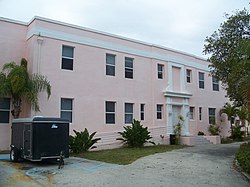
The Pine Ridge Hospital is a historic hospital in West Palm Beach, Florida, that served as a hospital between 1923 and 1956. It is located at 1401 Division Avenue.
The hospital was designed by West Palm Beach architects Harvey & Clarke and is not special architecturally.
The hospital building was deemed historically significant at a local level for its role as the sole hospital serving African-Americans in West Palm Beach in the period up to the ending of segregation in the 1960s. It "was a well-known institution among blacks throughout the South" during the 1920s and 1930s.
On 26 January 2001, it was added to the U.S. National Register of Historic Places.
It is included in the Northwest Historic District.

935 m
The Hurricane of 1928 African-American Mass Burial Site is a pauper's cemetery and mass grave in West Palm Beach, Florida. It is listed on the U.S. National Register of Historic Places. The cemetery is situated near the junction of 25th Street and Tamarind Avenue between I-95 and U.S. Route 1. The site is the location in which 674 bodies of African Americans or those of an unknown race were buried following the 1928 Okeechobee hurricane, while most of the white victims of the storm received a proper burial at Woodlawn Cemetery due to segregation laws.
Established in 1913, the property of the pauper's cemetery currently includes approximately 1.03 acres of land. Although the site is located at the southwest corner of 25th Street and Tamarind Avenue, 25th Street was paved above the northern portion of the mass grave in the 1950s, unearthing a number of bodies in the process.
After the 1928 hurricane, the bodies buried at that location became mostly forgotten by the public. The city of West Palm Beach sold the land and it changed ownership several times into the 1980s. Beginning in 1991, a movement to convince the city of West Palm Beach to repurchase the property began, which succeeded in December 2000. On September 12, 2002, it was added to the US National Register of Historic Places.

1.1 km
Sunset Lounge is an American historic music venue in West Palm Beach, Florida. It is in a section of the city that was once segregated. It is in the Northwest Historic District. It has been renovated and is set to reopen.
Performers included Louis Armstrong, Ella Fitzgerald, James Brown, Sam Cooke and Count Basie. A legal dispute between the city and company chosen to manage the venue delayed its reopening.
The venue is located in the city's historically black Northwest Neighborhood. It was acquired by the city's Community Redevelopment Agency in 2015. It closed in 2018. The city spent $20 million acquiring and renovating the building, part of the city's efforts to revitalize the neighborhood under the direction of its mayor Keith W. James. Legal fees and delays have added additional costs.