

 English
 Français

Stonebyres Falls
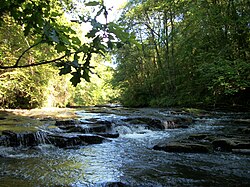
Stonebyres Falls is a waterfall of the River Clyde in Scotland. It is located on the former Stonebyres estate at the site of Stonebyres Castle.
Nearby Places View Menu
1.2 km
Stonebyres
Stonebyres was an estate and country house in Lanarkshire, Scotland, belonging to the Weir, or de Vere, family from earliest recorded history. The Weir-de Veres were a cadet branch of the Weir family of Blackwood but were a powerful and sometimes rival branch of the laird of Blackwood, head of Clan Weir. The laird of Stonebyres was often styled Baron Stonebyres.
Stonebyres Castle stood by the Linn Burn, a tributary of the River Clyde, around 4 kilometres (2.5 mi) west of Lanark. The keep, which was extant in the 15th century, measured 10 by 8.8 metres (33 by 29 ft). It was later extended to more than twice this size, and in 1850 it was remodelled as a Scots Baronial-style mansion. It was demolished in 1934, though some ruined walls survive. The coach house and a walled garden also remain nearby. Thomas de Vere is said to have been the laird of Stonebyres Castle in the 13th century.
A second structure, Cairnie Castle, was near the cliffs above Stonebyres Falls on the Clyde. The remains of this structure were recorded in 1794, but nothing remains today. Stonebyres Falls is now the site of a hydroelectric power station.
James Vere of Stonebyres (c.1715–1759) served as Member of Parliament for Lanarkshire from 1754 until his death. An extravagant spendthrift, he was obliged to sell part of the family estates, as was his successor who inherited his debts.
Mrs. Vere of Stonebyres is a painting by Sir Henry Raeburn (1756–1823), circa 1805. The subject was the wife of Daniel Vere of Stonebyres, sheriff of Lanarkshire, and was the former Jacobina Leslie, daughter of James, Count Leslie. She was Raeburn's step-daughter, following his marriage to Leslie's widow Anne. Mrs. Vere died 13 December 1820.
Stonebyres was purchased in 1842 by James Monteath for £25,600. He extended the house, spending additional £25,999 to do so. The purchase price had come from money inherited from Major Archibald James Douglas Monteath, who reputedly had made his fortune in India with treasure looted from a Maharaja's treasure elephant.
James later succeed to the Douglas family's Douglas Support estate when he assumed the surname of Douglas. James Monteath Douglas died unmarried in 1850 and was succeeded by his cousin, General Sir Thomas Monteath Douglas, who died at Stonebyres in 1868.
Stonebyres was then leased out for the remainder of the century as James's only surviving daughter Amelia, having married Sir William Monteath Scott of Ancrum made that her home.
Dame Amelia's daughter, Constance acquired the estate from her mother and in turn sold it to James Noble Graham, of Carfin, in 1906. However, having spent £60,000 on Stonebyres, he became bankrupt and Constance regained ownership in 1924.
Constance died in 1933, and the house passed to the Department of Agriculture which created small holdings for unemployed men from Auchenheath. The house was demolished in 1934, though elements of the estate remain.
1.3 km
Mouse Water
Mouse Water is a river in South Lanarkshire which is a tributary of the River Clyde. It is popular with canoeists. In the past, the fast flowing river was used to power mills and factories along its route and is still used today to produce hydroelectricity.

1.4 km
Kirkfieldbank
Kirkfieldbank is a small village and parish in Scotland, on the banks of the River Clyde. It is close to the town of Lanark and is part of the current South Lanarkshire local authority. The village of New Lanark is also close by, some ten minutes drive upstream.
The fertile Clyde Valley lands surrounding Kirkfieldbank are noted for their fruit farms, many with greenhouses specialising in tomatoes. One of these, Linmill Farm, which in former times specialised in soft fruit, was the birthplace of the dramatist and writer Robert McLellan (1907-1985). His Linmill Stories, a cycle of short stories written in homage to the summers he spent there as a child, strongly evokes the places and people in and around Kirkfieldbank in the period immediately before the First World War, as well as skilfully employing the rich, evocative Lanarkshire Scots spoken in the area at the time.
Kirkfieldbank has a school, a kirk, and two bridge crossings; the old brig, built in 1699, designed by James Lockhart, and a newer one constructed to carry modern traffic. The views from the bridges are picturesque. A caravan park is situated nearby.
1.6 km
Mousemill Bridge
Mousemill Bridge is a crossing of the Mouse Water on Mousemill Road, just north of Kirkfieldbank. There are two bridges at the site, the present day road bridge and the old Mousemill Bridge which previously formed part of the road between Lanark and Hamilton through Kirkfieldbank but is today solely used by pedestrians.