


The Powwow River is a 22.8-mile-long (36.7 km) river located in New Hampshire and Massachusetts in the United States. It is a tributary of the Merrimack River, part of the Gulf of Maine watershed.
Location
1 explorer visited this place

132 m
The Union Congregational Church is a historic church facility at 350-354 Main Street in the Salisbury Point section of Amesbury, Massachusetts. It is a two-story structure, set on a granite foundation, with a gable roof and a tower. The main facade has two symmetrically placed entrances, each flanked by sidelight windows and pilasters, and topped by an entablature. Palladian windows are located above each entry on the second level, and there is a small lunette in the gable end. The tower rises in stepped stages, starting with a square section, followed by an open belfry with round-arch openings and pilastered supports. Above the belfry is an octagonal section topped by a rounded cupola. The building, built in 1835, supposedly by local shipwrights, is an excellent local example of Greek Revival style. To its west is a vestry building, constructed in 1854, which was joined to the church in 1892 by adapting an old horse shed as a connector.
The building was added to the National Register of Historic Places in 2014.

557 m
The Bartlett Museum is a nonprofit museum located at 270 Main Street, Amesbury, Massachusetts. It is named after Josiah Bartlett, a Founding Father of the United States who was born in Amesbury and later signed the United States Declaration of Independence.
726 m
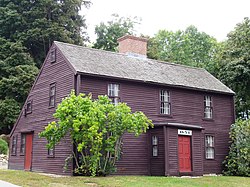
The Macy–Colby House is a historically significant saltbox house at 257 Main Street in Amesbury, Massachusetts. It is a historic house museum and has been listed on the National Register of Historic Places since 2008. In addition to its great age, it is notable for its association with Thomas Macy, an early settler of Nantucket and the subject of a poem by John Greenleaf Whittier, and for its long association with the locally significant Colby family.

836 m
Lowell's Boat Shop is a National Historic Landmark at 459 Main Street in Amesbury, Massachusetts.
The shop was built in 1793 by Simeon Lowell. The building was added to the National Register of Historic Places in 1988.
Located on the banks of the Merrimack River, Lowell's Boat Shop is considered to be the birthplace of the legendary New England fishing dory, originated by Simeon Lowell. His grandson, Hiram, further developed the dory into the simplified Banks dory design that became a mainstay of New England's fishing fleets. An historian remarked, "A Lowell's dory to a fisherman was like a hammer to a carpenter". Hiram also created a seminal form of assembly line production that made Lowell's the world's preeminent dory manufacturer of its day. It is said to have greatly influenced Henry Ford's mass production processes. Within the boat shop's buildings remain such interesting historic features as ancient ship's knees and heavily worn floorboards, and two centuries of accumulated paint coat the floors. The oldest buildings remaining on the site are combined Greek Revival structures that were built in the 1860s. A cross-beam features annual production figures, branded into the wood from 1897 through 1919, reveal that 2,029 boats were built here, by hand, in the single year of 1911. Lowell's Boat Shop is also a rare survivor of the many various industries for which the Merrimack River Valley region was known.
By the early 1990s, it was decided that the boat shop had to function as a charitable institution to insure its continued operation. To facilitate this transition, The Trust for Public Land helped form the Lowell's Boat Shop Trust and purchased the property. In 1994, the Trust for Public Land granted a preservation easement over the property to the National Trust for Historic Preservation. The Newburyport Maritime assumed ownership of the shop in 1994.
Today, Lowell's Boat Shop is a working boat shop and living museum. The shop continues to build dories and skiffs in the tradition of the seven generations of the Lowell family. Its rich history is conveyed through boat building classes, model dory classes, apprenticeships, onsite programs for scouts, local schools and at-risk youth. Lowell's Boat Shop actively encourages boat building, tourism and maritime fine arts with affiliations with a variety of government agencies and non-profit organizations. During the boating season, members are able to row Lowell's dories as a part of the Members Open Waterfront Program. The Boat Shop is fully accessible to the handicapped and guided tours are offered by appointment.
In 2012, Lowell's Boat Shop was chosen to participate in an historic project for America's last extant whale ship, the Charles W. Morgan. A group of local high school apprentices have assisted in the construction of an historically accurate Beetle-design whaleboat replica, which will accompany the Charles W. Morgan when her restoration is complete.
1.2 km
Fort Nichols was a fort that existed in 1775 in Amesbury, Massachusetts during the American Revolutionary War. It was also known as Fort Merrimac during its existence. Two possible locations for the fort exist. One is a location named Salisbury Point on modern topographic maps, where Interstate 95 crosses the Merrimack River; this is the location of the coordinates given. Another possibility is the mouth of the Merrimack at Salisbury Beach in Salisbury. One source states that the American Civil War Fort at Salisbury Point was built at the same location as Fort Nichols, which is given as "at Salisbury Point, opposite Newburyport". The Civil War fort was sometimes referred to as Fort Nichols by local civilians.
Book your tour near
Powwow River
→