


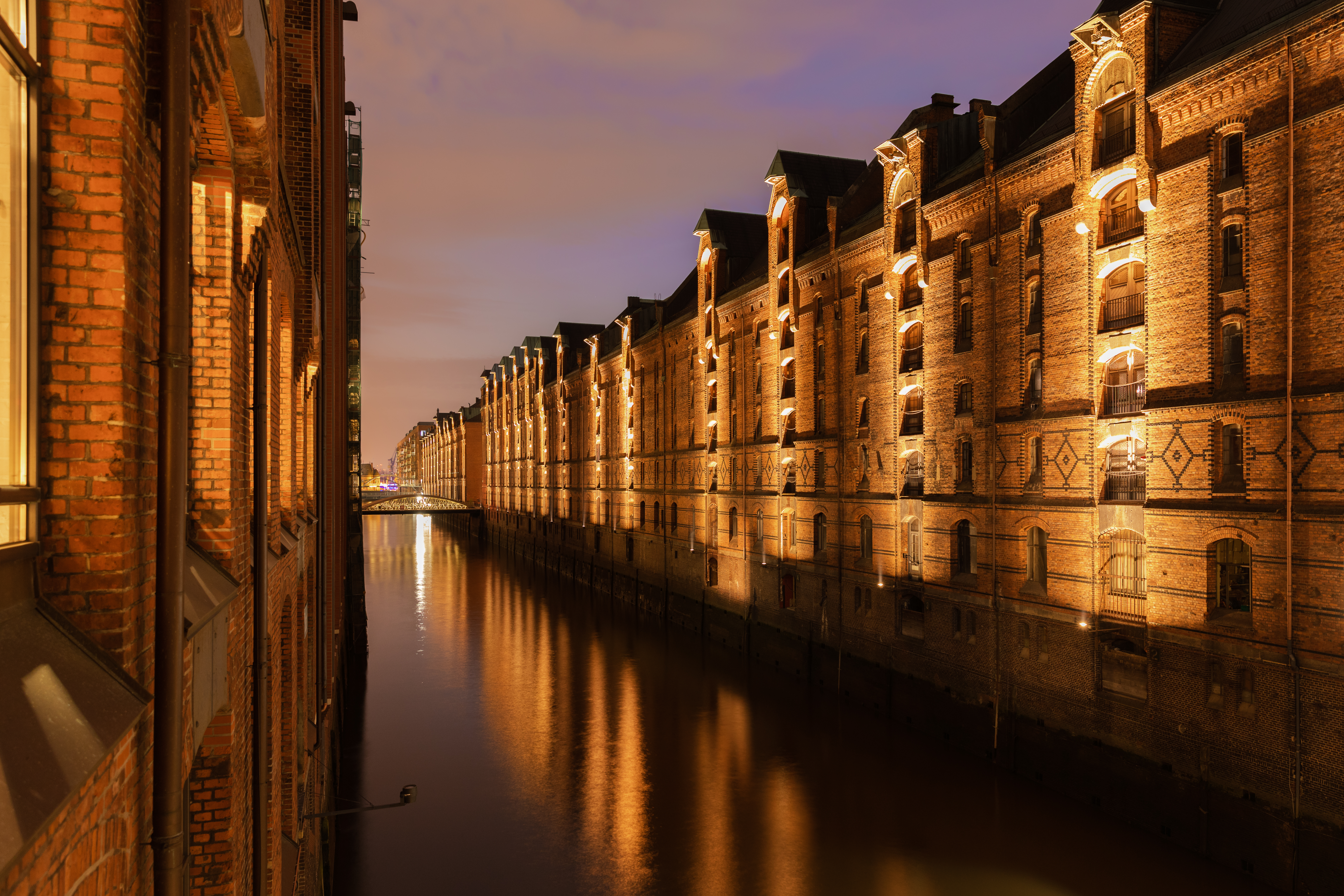
La Speicherstadt (prononciation allemande: API :/ˈʃpaɪ̯çɐˌʃtat/, ? Écouter [Fiche]; littéralement « ville des entrepôts ») est une zone d'entrepôts à Hambourg en Allemagne.
Gallery



Sponsored
Location

0 m
The Speicherstadt in Hamburg, Germany, is the largest warehouse district in the world where the buildings stand on timber-pile foundations—oak logs, in this particular case. It is located in the port of Hamburg, in the HafenCity quarter, and was built from 1883 to 1927.
The district was built as a free zone to transfer goods without paying customs. The district and the surrounding area have been under redevelopment for many years as the port industry has evolved. As an exceptional example of Neo-Gothic and modernist architecture, and for its testimony to the development of international maritime trade, the Speicherstadt was awarded the status of UNESCO World Heritage Site on 5 July 2015, along with the Kontorhaus District.
165 m
The Afghan Museum was private museum of culture and cultural history of Afghanistan, situated in the historic and picturesque Speicherstadt of Hamburg, Germany. The museum's mandate was to bring the authentic and traditional aspects of Afghan culture to life.
207 m
HafenCity is a quarter in the borough of Hamburg-Mitte, Hamburg, Germany. It is located on the Elbe river island Grasbrook, on the former Port of Hamburg area. It was formally established in 2008 and also includes the historical Speicherstadt area, which since 2015 is an UNESCO World Heritage Site with the adjacent Kontorhausviertel. The main landmark of the HafenCity is the Elbphilharmonie concert hall.
In a narrower sense, HafenCity Hamburg is a project of urban regeneration where the "greater Grasbrook" area of the former Hamburg free port is being revitalised with new hotels, shops, office buildings, and residential areas. The project is considered the largest urban redevelopment project in Europe by landmass, at approximately 2.2 square kilometres. With the diminished economic importance of free ports in an era of European Union free trade, large container ships, and increased border security, the Hamburg free port was downsized, relieving the current HafenCity area of its restrictions. The ground-breaking ceremony was held on 20 June 2001, with the first quarter called "Am Dalmannkai/Sandtorkai", neighboring the Elbphilharmonie, completed in 2009.
When completely developed, the HafenCity area is projected to be home to about 12,000 people and the workplace of 40,000 people.

208 m
Built in 2000, the Hamburg Dungeon is a tourist attraction from a chain including the London Dungeon and Berlin Dungeon. It is the first of this brand to be built in mainland Europe. It provides a journey through Hamburg’s dark history in an actor led, interactive experience.

211 m
The Miniatur Wunderland is, according to Guinness World Records, the largest model railway system in the world. It is located at the historic Speicherstadt in Hamburg and is one of the most popular and most visited sights in Germany.
The exhibition includes around 1,230 digitally controlled trains with more than 12,000 wagons. The Wonderland is also designed with around 5,280 houses and bridges, more than 11,800 vehicles – of which around 350 drive independently on the installation – 52 airplanes and around 290,000 figures. The system features a recurring day-night lighting cycle and almost 500,000 built-in LED lights. Of the 10,000 m2 of floorspace, the models occupies 1,694 m2.
As of May 2025, the railway consisted of 16,491 m of track in H0 scale with 3,600 switches and 1,400 signals, divided into twelve sections: Harz mountains, the fictitious town of Knuffingen, the Alps and Austria, Hamburg, America, Scandinavia, Switzerland, a replica of Hamburg Airport, Italy, Rio de Janeiro, Patagonia and Monaco/Provence. Planning is also in progress for the construction of sections for Central America and the Caribbean and perhaps Great Britain.
