


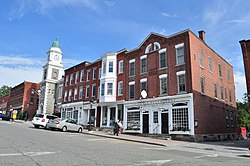
Litchfield Historic District, in Litchfield, Connecticut, is a National Historic Landmark District designated in 1968 as a notable and well-preserved example of a typical late 18th century New England village. As a National Historic Landmark, it is listed on the National Register of Historic Places (NRHP). It is the core area of a larger NRHP-listed historic district that includes the entire borough of Litchfield and was designated a state historic district in 1959.
Book your tour near
Litchfield Historic District
Book Now
4.2
in partnership with
GetYourGuide.com
Gallery


Sponsored
Location
1 explorer visited this place
39 m
Litchfield is a town in and former county seat of Litchfield County, Connecticut, United States. The population was 8,192 at the 2020 census. The town is part of the Northwest Hills Planning Region. The boroughs of Bantam and Litchfield are located within the town. There are also three unincorporated villages: East Litchfield, Milton, and Northfield. Northfield, located in the southeastern corner of Litchfield, is home to a high percentage of the Litchfield population.

163 m
The First Congregational Church of Litchfield is a congregation of the United Church of Christ in Litchfield, Connecticut, USA, occupying a historic building on the Litchfield green.
173 m
Litchfield is a borough in, and the village center of, the town of Litchfield in Litchfield County, Connecticut, United States. The population was 1,258 at the 2010 census. The entire borough was designated a Connecticut historic district in 1959 by special act of the state General Assembly and is listed on the National Register of Historic Places. Part of the borough is also a National Historic Landmark, the Litchfield Historic District.

406 m
The Litchfield Law School was a law school in Litchfield, Connecticut, that operated from 1774 to 1833. Litchfield was the first independent law school established in America for reading law. Founded and led by lawyer Tapping Reeve, the proprietary school was unaffiliated with any college or university. While Litchfield was independent, a long-term debate resulted in the 1966 recognition of William & Mary Law School as the first law school to have been affiliated with a university.
Reeve began teaching his first student in 1774, and by 1784 was teaching by lecture. He later became the Chief Justice of the Connecticut Supreme Court. The school closed in 1833, having educated over 1,100 students, including Aaron Burr and John C. Calhoun. The law school, including Reeve's house, was declared a National Historic Landmark in 1965 as the Tapping Reeve House and Law School, which is owned and operated by the Litchfield Historical Society as a museum displaying life in a 19th-century period school. The Society also operates the Litchfield History Museum.

492 m
The Oliver Wolcott House is a historic colonial home at South Street near Wolcott Avenue in Litchfield, Connecticut. It was built in 1753 by Founding Father Oliver Wolcott Sr., a signer of the Declaration of Independence and the Articles of Confederation, and a state militia leader in the American Revolutionary War. It is the oldest house in the borough. It was the home of Oliver Wolcott Sr., and is where his son Oliver Wolcott Jr., was born. Many distinguished guests visited the Wolcott House, including Lafayette and George Washington, who stayed there in 1780 during his first visit to Litchfield. The house was declared a National Historic Landmark in 1971. It is located on South Street, nearly opposite to Wolcott Avenue. The house is not open to the public.
This residential district is anchored by the Litchfield meetinghouse (1829) and is predominantly Georgian with clapboarding, gables and hipped roofs.
Book your tour near
Litchfield Historic District
Book Now
4.2
in partnership with
GetYourGuide.com