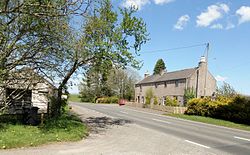
Brownhill Inn, now just called Brownhill (NX 902 911), was an inn approximately 1 mile (1.6 km) mile south of Closeburn, on the A76, which itself is about 2 miles (3.2 km) south of Thornhill, in Dumfries and Galloway, Scotland. Built in approximately 1790, this old coaching inn has undergone extensive changes, and the south side of the original property appears little changed whilst part of the inn has been demolished. The inns facilities used to include the once-extensive 12 stall livery stables on the west side of the road, but these have been sold and converted to farm buildings after the inn closed. The inn was the first changing place for horses hauling coaches from Dumfries and closed in 1850. In 1789 an Act of Parliament had been passed that enabled the building of a Turnpike from Auldgirth Bridge to Sanquhar through Closeburn Parish and the inn was built to serve the patrons of this new road. The toll road supplanted the original post road that ran via Stepends, Gateside and Shaw that may have been of Roman origins.

Nearby Places View Menu
Location Image
1.2 km

Closeburn Castle

Closeburn Castle is a privately owned tower house, probably of the 14th century, but possibly older, and is one of the oldest continually inhabited houses in Scotland. The castle is located 1 km east of the village of Closeburn, in the historical county of Dumfriesshire, 2 km south-east of Thornhill, in Dumfries and Galloway, Scotland.
Location Image
1.2 km

Closeburn, Dumfries and Galloway

Closeburn (Scottish Gaelic: Cill Osbairn) is a village and civil parish in Dumfries and Galloway, Scotland. The village is on the A76 road 2+1⁄2 miles (4 km) south of Thornhill. In the 2001 census, Closeburn had a population of 1,119. Closeburn is recorded as Killosbern in 1185. The first element of the name is Gaelic cill 'cell or church'. The second element is a saint's name, but none has definitely been identified. Between 1849 and 1961 the village had a railway station. Although Closeburn railway station is now closed, the Glasgow South Western Line still runs through the village. The nearest stations are at Sanquhar and Dumfries. The village is the former location of Wallace Hall, founded in 1723 and now based in Thornhill. The former schoolhouse, built in 1795 and incorporating the original buildings from the 1720s, is a Category A listed building. Situated two-thirds of a mile (1.1 km) east of the village is Closeburn Castle, a Category B listed tower house that was until 1783 the family seat of the Kirkpatrick family. The River Nith is on the western boundary of the parish of Closeburn. The eastern part of the parish contains several hills, including the 2,286 feet (697 m) Queensberry, at the southern end of the Lowther Hills, part of the Southern Uplands. Several streams flow through the area, and the gorge and waterfall at Crichope Linn, 3+1⁄2 miles (6 km) north-north-east of Closeburn was chosen by Walter Scott in his novel Old Mortality as the lair of John Balfour of Burley. The hamlet of Gatelawbridge, 2+1⁄2 miles (4 km) east of Thornhill, is on the boundary of Closeburn and Morton parishes near Crichope Linn. The nearby Brownhill Inn was a favourite haunt of the poet Robert Burns whilst he was working at an excise man or gauger in the area and was the site of inspirational events that led to the bard writing several poems, odes, etc. John Bacon was the landlord immortalised in verse by Burns and his wife was Catherine Stewart whose parents had run the Closeburn Kirk Brig Inn. Her brother was Willie Stewart who was the factor or grieve of the Closeburn Castle estate.
Location Image
1.3 km

Closeburn railway station

Closeburn railway station was a railway station in Dumfries and Galloway north of Dumfries, serving a rural community with Wallace Hall and Closeburn Castle nearby. Its OS NGR is NX 8970 9234.
2.7 km

Barjarg Tower

Barjarg Tower is an L-plan tower house probably dating from 1680, four miles south-east of Penpont, Dumfriesshire, Scotland. It is attached to a 19th-century mansion.