


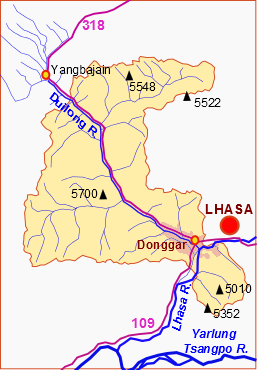
The Duilong River, or Duilong Qu (Toelung, Tibetan: སྟོད་ལུང་ཆུ, Wylie: stod lung chu; Chinese: 堆龙河), is a right tributary of the Lhasa River, which it enters just below the city of Lhasa, Tibet, China. The river is about 137 kilometres (85 mi) in length. Water quality may be compromised by dissolved substances including arsenic from geothermal springs.
Location
1 explorer visited this place

3.5 km
Doilungdêqên District is a district in Lhasa, north-west of the main center of Chengguan, Tibet Autonomous Region. It is largely agricultural or pastoral, but contains the western suburbs of the city of Lhasa. The Duilong River runs southeast through the district to the Lhasa River. A prehistoric site appears to be 3600–3000 years old. The district is home to the Tsurphu Monastery and the 17th century Nechung monastery.
3.7 km
Donggar is a subdistrict in Doilungdêqên District in the Tibet Autonomous Region of China, northwest of Lhasa. It lies at an altitude of 3,828 metres. The subdistrict has a population of about 4,000 people with 9,359 people in the township.
It lies approximately 17.8 miles south of Dobjoi and is near Cha'gyungoinba.
In 1962 Donggar became an administrative township, covering an area of 85 square kilometers. Donggar Township has three village committees and 17 villages. The economy is dominated by agriculture, animal husbandry with an area of 8,636 mu of cultivated land, including barley, wheat, rapeseed and vegetables. Livestock breeding includes yaks, sheep, goats, etc. China National Highway 318 runs through this territory.
4.8 km
Lhasa Donggar Wholesale Market, or Lhasa Donggar Agricultural Products Wholesale Market, is a large-scale agricultural products wholesale market in Lhasa, Tibet Autonomous Region of China, located in Sangmu Village, Donggar Subdistrict, Doilungdêqên, Lhasa, and is one of the large-scale agricultural products wholesale markets at the national level in the People's Republic of China.
5.0 km
Lhasa West railway station is a railway station in Lhasa, Tibet, China. It underwent renovations from 2016 to 2018.
This is a cargo station so no passenger trains stop at here as of November 2023.

5.1 km
The Jokhang, historically known as the Rasa Trulnang or Qoikang Monastery or Zuglagkang, is considered the "heart of Lhasa". The Jokhang consists of a Tibetan Buddhist temple, its temple complex, and a Gelug school monastery. Located in Barkhor Square, it was built in c.640 by King Songsten Gampo to house the Jowo Mikyo Dorje, a statue of Akshobhya Buddha, brought to Tibet by his Nepalese queen, Bhrikuti. Another statue, the Jowo Shakyamuni, brought by his Tang Chinese queen Wencheng, is currently housed in the temple and the Jowo Mikyo Dorje is housed in the Ramoche, in Lhasa.
Many Nepalese and Indian artists and craftsmen worked on the temple's original design and construction. Around the 14th century, the temple was associated with the Vajrasana in India. In the 18th century the Qianlong Emperor of the Qing dynasty, following the Nepalese Gorkha invasion of Tibet in 1792, did not allow the Nepalese to visit this temple and it became an exclusive place of worship for the Tibetans. Early into the Cultural Revolution, the Red Guards attacked the Jokhang temple in 1966 and for a decade there was no worship. Renovation of the Jokhang took place from 1972 to 1980. In 2000, the Jokhang became a UNESCO World Heritage Site as an extension of the Potala Palace, which has been a World Heritage Site since 1994. After its UNESCO status was conferred, PRC China redeveloped parts of the World Heritage Sites in Lhasa, and the Barkhor Square in front of the temple was partially demolished and encroached upon.
Book your tour near
Duilong River
Book Now
4.0
in partnership with
GetYourGuide.com