


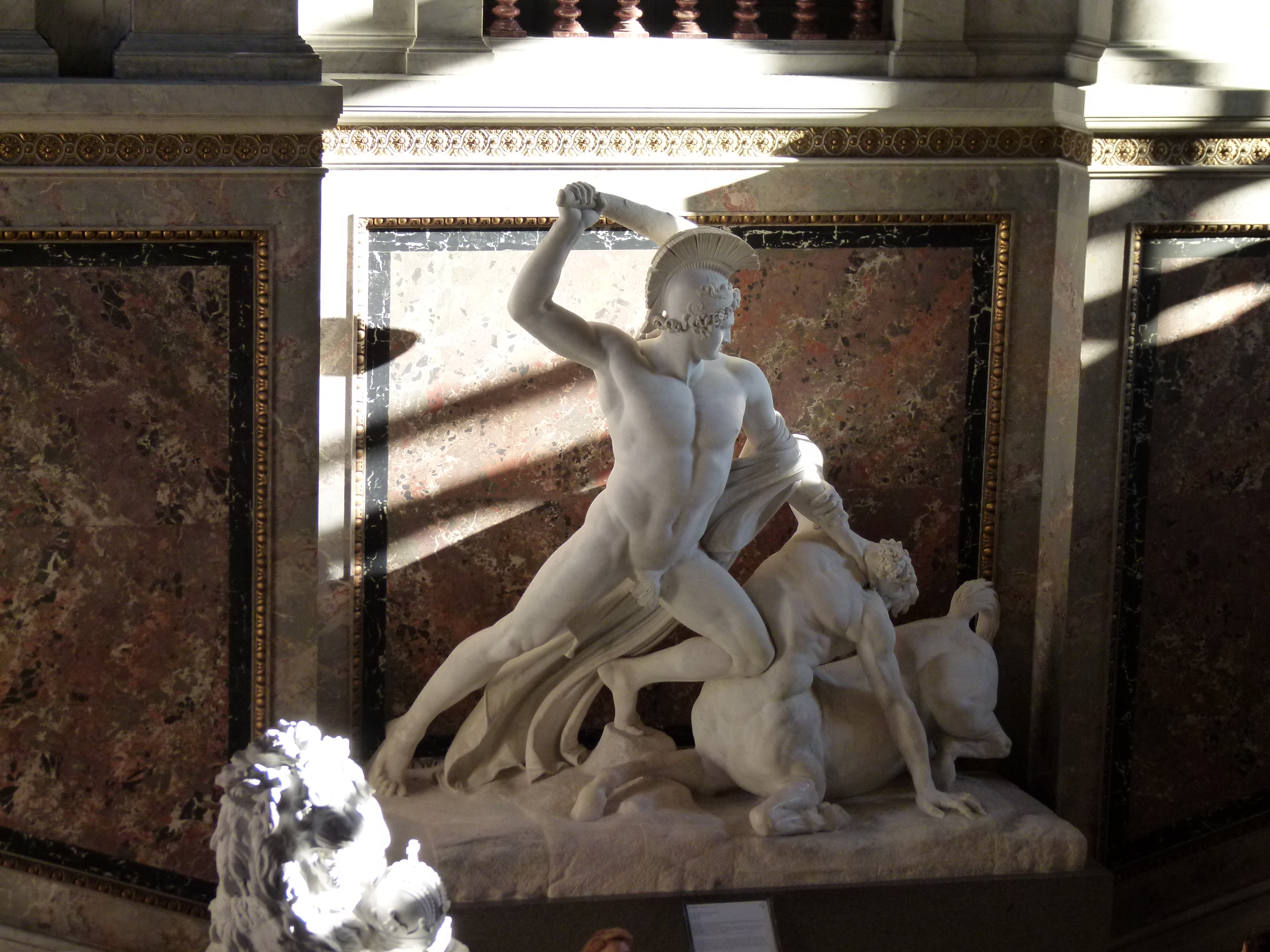
Le temple de Thésée est un bâtiment néo-classique situé dans le parc Volksgarten dans le centre-ville de Vienne.
Gallery



Sponsored
Location

58 m
The Volksgarten is a public park in the Innere Stadt, the first district of Vienna, Austria. Opened in 1823, it was Vienna's first public park.

134 m
The Memorial for the Victims of Nazi Military Justice is located at the Ballhausplatz in the centre of Vienna, opposite the President's office and the Austrian Chancellory. The monument was created by German conceptual artist Olaf Nicolai. The inscription atop the three-step sculpture features the poem by Scottish poet Ian Hamilton Finlay consisting of just two words: all alone.

156 m
The Congress of Vienna of 1814–1815 was a series of international diplomatic meetings to discuss and agree upon a possible new layout of the European political and constitutional order after the downfall of the French Emperor Napoleon Bonaparte. Participants were representatives of all European powers and other stakeholders. The Congress was chaired by Austrian statesman Klemens von Metternich and was held in Vienna from September 1814 to June 1815.
The objective of the Congress was to provide a long-term peace plan for Europe by settling critical issues arising from the French Revolutionary Wars and the Napoleonic Wars through negotiation. The goal was not simply to restore old boundaries, but to resize the main powers so they could balance each other and remain at peace, being at the same time shepherds for the smaller powers. More generally, conservative leaders like Metternich also sought to restrain or eliminate Bonapartist, republican, liberal, and revolutionary movements which, from their point of view, had upended the constitutional order of the European ancien régime.
At the negotiation table, the position of France was weak in relation to that of Britain, Prussia, Austria, and Russia, partly due to the military strategy of its leader, Napoleon Bonaparte, over the previous two decades, and his recent defeat. In the settlement the parties did reach, France had to give up all recent conquests, while the other three main powers made major territorial gains around the world. Prussia added territory from smaller states: Swedish Pomerania, most of the Kingdom of Saxony, and the western part of the former Duchy of Warsaw. Austria gained much of northern Italy. Russia added the central and eastern parts of the Duchy of Warsaw. All agreed upon ratifying the creation of the new Kingdom of the Netherlands, which had been created just months before from the former Dutch Seven Provinces together with formerly Austrian territory, and was meant to serve as a buffer between the German Confederation and France.
The immediate background was Napoleonic France's defeat and surrender in May 1814, which brought an end to 23 years of nearly continuous war. Remarkably, negotiations continued unaffected despite the outbreak of fighting triggered by Napoleon's return from exile and resumption of power in France during the Hundred Days of March to July 1815. The Congress's agreement was signed nine days before Napoleon's final defeat at Waterloo on 18 June 1815.
Some historians have criticised the outcomes of the Congress for causing the subsequent suppression of national, democratic, and liberal movements, and it has been seen as a reactionary settlement for the benefit of traditional monarchs. Others have praised the Congress for protecting Europe from large and widespread wars for almost a century.

162 m
The Federal Chancellery of Austria is the ministry led by the chancellor of Austria.
Since the establishment of the First Austrian Republic in 1918, the Chancellery building has served as the venue for the sessions of the Austrian cabinet.
It is located on the Ballhausplatz in the centre of Vienna, vis-à-vis the Hofburg Imperial Palace. Like Downing Street, Quai d'Orsay or – formerly – Wilhelmstrasse, the address has become a synecdoche for governmental power.

176 m
Ballhausplatz is a square in central Vienna containing the building that for over two hundred years has been the official residence of the most senior Austrian Cabinet Minister, the State Chancellor, today the Chancellor of Austria. As a result, Ballhausplatz is often used as shorthand for the Austrian Federal Chancellery. Until 1918 the Foreign Ministry of Austria-Hungary was also housed here. Similar to Downing Street or the Hotel Matignon, the word Ballhausplatz is a synecdoche for the seat of power.
Ballhausplatz is located in the first district Innere Stadt in central Vienna, a few minutes' walk from the Austrian Parliament Building and on the edge of the grounds of Hofburg Imperial Palace. Until 1754 the square itself did not exist, as an imperial hospital was located there. Ferdinand I, Holy Roman Emperor, erected a real tennis house there, the Ballhaus. Later the building was used for the Imperial Court Construction Office. At the end of the 18th century, the Ballhaus was ripped down.