

 English
 Français

Uckerby
Uckerby is a hamlet and civil parish in the county of North Yorkshire, England. It situated at a crossroads on the road between Scorton and Moulton. The hamlet lies 9.2 miles (14.8 km) north west of the county town of Northallerton.
Nearby Places View Menu

928 m
Scorton railway station
Scorton railway station (North Yorkshire) was a railway station in North Yorkshire, England. The village of Scorton is situated around 1⁄2 mile (0.8 km) south from the site of the station.
1.6 km
RAF Scorton
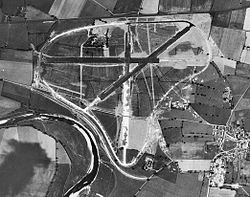
Royal Air Force Scorton or more simply RAF Scorton is a former Royal Air Force satellite station located next to the village of Scorton in North Yorkshire, England. The base was opened in October 1939 as part of 13 Group RAF Fighter Command and a satellite station of RAF Catterick. It was used by the Royal Air Force, the Royal Canadian Air Force, and the United States Army Air Forces Ninth Air Force during the war.
The famous No. 56 Squadron RAF flew Supermarine Spitfires from Scorton during the Second World War. Also the USAAF 422d and 425th Night Fighter Squadrons were stationed at Scorton flying the Northrop P-61 Black Widow fighter.
After the war, it was kept for a while as a Maintenance Unit base, then disposed of in the 1950s. It is now a site of gravel extraction.

1.7 km
Moulton Hall
Moulton Hall is a grade I listed 17th-century manor house in Moulton near Richmond, North Yorkshire, England.
The hall is built to a rectangular plan in three storeys with cellar and attics of ashlar and rubble with Westmorland slate roofs. The frontage has five bays surmounted by three unusual curved gables and the sides two bays.
The house is surrounded by approximately 25 acres (10 ha) of grounds.

1.8 km
Moulton Manor
Moulton Manor is a historic building in Moulton, North Yorkshire, a village in England.
The manor house was rebuilt in about 1570, and was slightly altered in the 17th century. A local tradition states that James VI and I spent a night in the house. By the early 20th century, it served as a farmhouse, but it was restored, extended and altered in 1938. The building was grade I listed in 1951.
The house is built of stone on plinths, with chamfered rusticated quoins, and pantile roofs with shaped kneelers and stone copings. It has three storeys and a part basement, and an H-shaped plan, with a middle range of three bays, and two-bay gabled cross-wings. Five steps with side parapets lead up to the central doorway with a decorated architrave, a moulded frieze and a stepped hood mould. Most of the windows are cross windows, some with pediments. Above the doorway is a semicircular window with keystones, and above the central range and return is a parapet and a balustrade with pedestals.
Inside the house, the entrance hall has 17th-century panelling and a stone architrave around the fireplace. The room to the left has early panelling, with pilasters between, the capitals of which depict carpenters' tools, and a cornice with frieze below. The kitchen has a large fireplace and chimney, with a possible priest hole. There is a 17th-century staircase with barleytwist balusters, above which is a moulded ceiling. On the first floor is a room with an elaborate fireplace with a frieze above, while all the rooms have early doorways and original fireplaces.