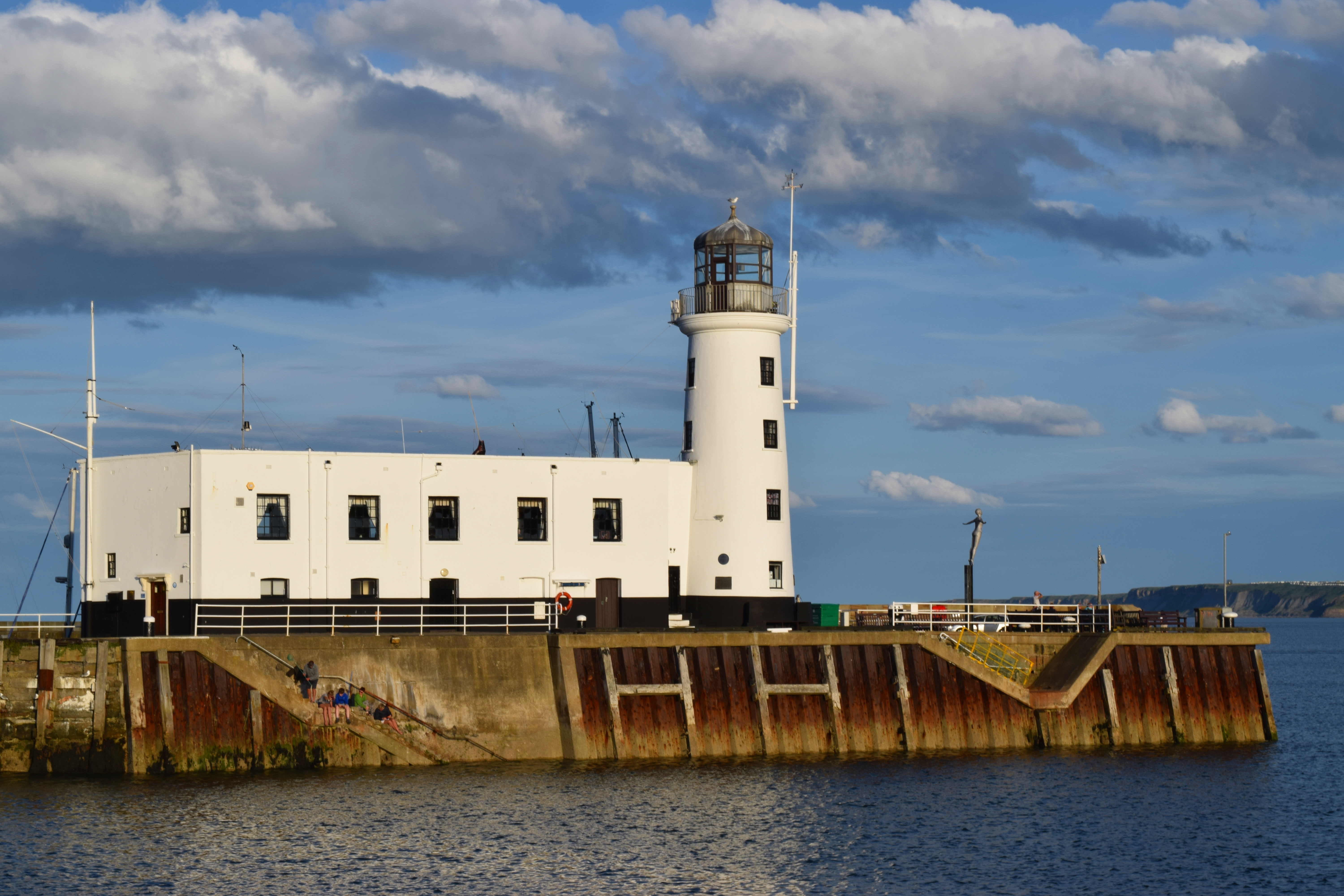
Le phare de Scarborough est un phare situé sur une jetée du vieux port de Scarborough, dans le comté du Yorkshire du Nord en Angleterre. Ce phare est géré par l'autorité portuaire de Scarborough. Il est maintenant protégé en tant que monument classé du Royaume-Uni de Grade II.
Nearby Places View Menu
124 m
Scarborough Harbour
Scarborough Harbour is a sheltered area of water in the town of Scarborough, North Yorkshire, in England.
Scarborough Castle was built in the 12th century, and this spurred the development of the town of Scarborough. In the second half of the 13th century, what is now the Old Pier was built, to provide shelter for the Old Harbour. This became the most important harbour between the River Tees and the Humber Estuary, on the east coast of England. The Inner Island Pier was constructed to the west of the Old Pier, around 1325. While the shoreline of the harbour was initially on Quay Street, the harbour gradually sanded up, and Sandside was built on the new shoreline. By 1565/1566 the pier was in ruins, when Elizabeth I of England funded its rebuilding. Soon after 1732, Vincent's Pier was built, extending the line of the Old Pier and thereby enlarging the harbour, although it was only attached to the Old Pier by a drawbridge. It is named after William Vincent, who designed the structure. In 1800, the Scarborough Pier Lighthouse was erected on Vincent's Pier.
The East Pier was constructed between 1790 and 1812, creating the East Harbour between it and the existing piers. John Smeaton acted as a consultant on the construction. It is 1,380 feet (420 m) long. In 1817, the Inner Island Pier was demolished, and replaced by the West Pier, more fully enclosing the Old Harbour. Later in the 19th century, buildings were constructed on the West Pier, including the harbour master's office, and fish sheds. In 1940, Scarborough Lifeboat Station was erected next to the pier. The piers have been regularly repaired, and in 2025, £1.8 million was allocated for repairs to the West Pier. There are plans to upgrade facilities on the pier, at a cost of £20 million.
The two older piers are built from stone rubble with timber shearings. The East and West piers are built of massive stone blocks, the largest weighing up to 30 tons. The East Pier is built in a curve. The piers are collectively grade II listed.
In the early 19th century, shipbuilding took place in the Old Harbour. Today, the East Harbour is used for mooring pleasure craft, while the Old Harbour is largely used by commercial vessels, including the town's fishing fleet. It also has a slipway providing access from Sandside. From 2020 until 2025, SeaGrown's "Southern Star" was moored in the harbour, with a visitor centre, cafe, and seaweed hatchery. There is a sculpture of seaweed on the East Pier, and one entitled "Diving Belle" on Vincent's Pier.
255 m
Scarborough Lifeboat Station
Scarborough Lifeboat Station is located at West Pier on Foreshore Road in Scarborough, a seaside resort and port on the east coast of North Yorkshire, England.
A lifeboat was established at Scarborough in 1801, which makes it the third oldest operational lifeboat station in the United Kingdom (after Montrose and Sunderland). Management of the station was transferred to the Royal National Lifeboat Institution (RNLI) in 1861.
The station currently operates 13-15 Frederick William Plaxton (ON 1322), a Shannon-class All-weather lifeboat, on station since 2016, and the John Wesley Hillard IV (D-856), an Inshore D-class lifeboat, on station since 2021.
271 m
Futurist Theatre
The Futurist Theatre was a theatre and cinema in Scarborough, North Yorkshire, England. It was located on Foreshore Road, on the sea front of the South Bay.
The Futurist Theatre was built to the design of Scarborough architect Frank A. Tugwell and opened on 27 June 1921 as a cine-variety theatre operated by William Catlin (Catlin Entertainments Ltd). The Futurist could seat 2,393.
Originally it boasted a grandiose, ornate façade of robust, self-cleaning white glazed Carraraware tiles, the design of Henry Doulton, although this was later obscured during spring 1968 by a 'facelift' of rectangular plain yellow cladding. However, once the cladding was removed (under cover) around 2018, the tiles were judged to still be in a reasonable condition for their age.
Its fitting out included an Abbott and Smith 3 Manual 45 stop organ, played by Horace Shepherd. By the end of 1929, a Western Electric sound system had been installed to the cinema, and 1954 saw the addition of a CinemaScope and 38-feet wide screen.
Plans for a radical stage redesign by Captain J. H. Ritson were approved in early November 1957, stretching it a further four feet into the auditorium. Extra dressing rooms were to be positioned on the roof of the Arcadia/Palladium next door and the organ removed. This was undertaken from September 1958 once the twice nightly 'The Cyril Stapleton Band Show' had finished and although Plaxtons Builders kept at it 24 hours a day in the final weeks, they still overran – allowing the next summer production a single stage rehearsal before its opening night! During this redevelopment, film showings ceased.
Another dramatic change came about during late 1966/early 1967, courtesy of architects Cassidy, Farrington & Dennys, when the stage was lengthened 15 feet backward into the former Arcadia/Palladium auditorium, which also added a stage tower.
The Beatles performed there twice, on 11 December 1963 and on 9 August 1964. The popular The Black and White Minstrel Show performed there many times when it was owned (between 1966 and 1974) by Robert Luff, the producer of the stage version. The extension to the stage meant the closure of the adjacent Arcadia Theatre, which became a lounge.
A new Todd-AO system integrated in May 1968 allowed the Futurist to begin showing films again.
Around the same time, a balcony was mounted above the circle allowing the theatre to accommodate 2,155 seats. The Futurist had the twelfth-largest capacity of a theatre in the country, and the fifth-largest outside London.
During the 1980s, Scarborough Borough Council took over the property and leased the theatre to Apollo Leisure Ltd (UK), which ran it until September 2002.
In December 2002, Barrie C. Stead, who also runs the Hollywood Plaza cinema, took over the Futurist and refurbished the theatre and cinema, installing new projectors, DTS sound system and a new CinemaScope screen.
Annually, the theatre predominately maintained consistent acts throughout the months of July and August.
In the winter of 2011, the Futurist managed to attract over 16,000 people during eight sell-out performances of Calendar Girls produced by Dafydd Rogers and David Pugh.
The theatre closed on 6 January 2014 after the operator's lease expired. On 9 January 2017, Scarborough Borough Council voted to demolish the theatre, by the narrowest of margins (22–21). The decision was a controversial one, as not all the councillors voted, and many locals and visitors alike, would have preferred the venue to be saved, restored and modernised. The building was demolished by August 2018. The fate of the site is uncertain. However, interest has been shown from the Flamingoland group, who gave a large donation to the incumbent conservative party prior to the ramping up of the parties campaign to demolish the building. Demolition of the building began in June 2018 and was completed in August 2018. The demolition and associated land works cost local taxpayers £3.91 million.
Plans for a new FlamingoLand attraction on the site were revealed in February 2019. Gordon Gibb, Chief Executive of Flamingoland, announced in January 2022 that the company had reluctantly withdrawn its interest in the site, due to differences in development plans between the company and the local council.
285 m
2 Quay Street
2 Quay Street is a historic building in Scarborough, North Yorkshire, a town in England.
Quay Street was probably laid out in the 13th century, to provide access to the town's new harbour. 2 Quay Street was probably constructed in the late 15th century, where the road meets Whitehead Hill. In the 18th century, sash windows were installed. The building was originally three storeys high, but in the 20th century, the top floor was removed. The building was restored in 1965, at which time the windows were replaced, and the external plasterwork was removed to reveal timber framing. The building has been grade II* listed since 1953.
The house is timber framed with roughcast infill, probably sitting on a stone base, and has a pantile roof. It has two storeys and an attic. The gable end faces the street, and the attic is jettied on curved brackets. On the ground floor is a doorway and to the right is a bow window with a frieze and a cornice. Above it are two modern windows, and on the attic and left return are casement windows.
287 m
Newcastle Packet
The Newcastle Packet is a historic pub in Scarborough, North Yorkshire, a town in England.
A large timber-framed house was built on Sandside in about 1500. The building included a canopy with Gothic carvings, the word "Justicia", and battlements. A fragment of wall in the cellar was supposed to have been part of the Scarborough Town Wall. In about 1725 the centre and west wing were refronted, while serving as the post office. In about 1830 the east wing was refronted and converted into a shop, while the remainder became the Newcastle Packet inn. The centre and west wings of the building were demolished in the late 19th century, and a new pub was constructed between 1898 and 1899, to a design by Frank Tugwell. The new structure reuses some of the 16th-century timber, which may have originally been salvaged from ships. The east wing was rebuilt in about 1920, and incorporated into the pub. The building was grade II listed in 1953. Parts of the 2019 BBC television series Scarborough were filmed in the pub.
The left side of the pub incorporates carved timber framing dating from about 1500. The rest of the building is built of brick and stucco with applied modern timber framing, and has a tile roof. It has two storeys and an irregular plan, with a front of two gabled bays. The ground floor has a central doorway and is almost completely glazed. The windows on the upper floor have four lights, the middle two lights being slightly bowed on a timber bracket. The extension to the right has a splayed gable. The interior has been redesigned.
English
Français