

 English
 Français

Elvet
Elvet est un quartier de la ville de Durham, en Angleterre. Il forme le sud-est du centre-ville, de l'autre côté de la Wear par rapport à la cathédrale de Durham.
Nearby Places View Menu
5 m
Elvet
Elvet is an area of the city of Durham, in County Durham, England. It is situated on the opposite side of the River Wear from Durham Cathedral and forms the south-eastern part of central Durham.
64 m
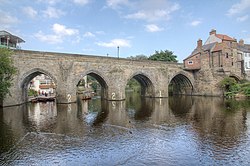
Elvet Bridge
Elvet Bridge is a medieval masonry arch bridge across the River Wear in the city of Durham, in County Durham, England. It links the peninsula in central Durham and the Elvet area of the city, and is a Grade I listed building.

69 m
Durham, England
Durham ( DURR-əm, locally ) is a cathedral city and civil parish in County Durham, England. It is the county town and contains the headquarters of Durham County Council, the unitary authority which governs the district of County Durham. The built-up area had a population of 50,510 at the 2021 Census.
The city was built on a meander of the River Wear, which surrounds the centre on three sides and creates a narrow neck on the fourth. The surrounding land is hilly, except along the Wear's floodplain to the north and southeast.
Durham was founded in 995 by Anglo-Saxon monks seeking a place safe from Viking raids to house the relics of St Cuthbert. The church the monks built lasted only a century, as it was replaced by the present Durham Cathedral after the Norman Conquest; together with Durham Castle, it is a UNESCO World Heritage Site. From the 1070s until 1836 the city was part of the County Palatine of Durham, a semi-independent jurisdiction ruled by the prince bishops of Durham which acted as a geopolitical buffer between the kingdoms of England and Scotland. In 1346, the Battle of Neville's Cross was fought half a mile west of the city, resulting in an English victory. In 1650, the cathedral was used to house Scottish prisoners after their defeat at the Battle of Dunbar. During the Industrial Revolution, the Durham coalfield was heavily exploited, with dozens of collieries operating around the city and in nearby villages. Although these coal pits have now closed, the annual Durham Miners' Gala continues and is a major event for the city and region. Historically, Durham was also known for the manufacture of hosiery, carpets, and mustard.
The city is the home of Durham University, which was founded in 1832 and therefore has a claim to be the third-oldest university in England. The university is a significant employer in the region, alongside the local council and national government at the land registry and passport office. The University Hospital of North Durham and HM Prison Durham are also located close to the city centre. The city also has significant tourism and hospitality sectors.
85 m
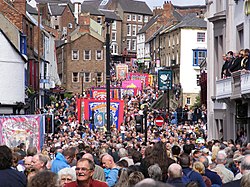
Durham Miners' Gala
The Durham Miners' Gala is a large annual gathering and labour festival held on the second Saturday in July in the city of Durham, England. It is associated with the coal mining heritage (and particularly that of miners' trade unionism) of the Durham Coalfield, which stretched throughout the traditional County of Durham. It is also locally called "The Big Meeting" or "Durham Big Meeting". In the context of the Durham Miners' Gala, "gala" is usually pronounced /ˈgeɪlə/ rather than the more common pronunciation /ˈgɑːlə/.
Its highlight consists of a parade of banners, each typically accompanied by a brass band, which are marched to the old Racecourse, where political speeches are delivered. In the afternoon a miners' service is held in Durham Cathedral, which may include the blessing of any new banners.

94 m
Durham Law School
Durham Law School is the law school of Durham University in Durham, England. It has research centres in biolaw and medical law, Chinese law, commercial and corporate law, criminal law, European law, human rights and public law, international law, and sustainable development.