

 English
 Français

Gisborough Hall
Gisborough Hall est un manoir du XIXe siècle, aujourd'hui un hôtel, à Guisborough, Redcar et Cleveland, en Angleterre. Il s'agit d'un bâtiment classé Grade II.
Nearby Places View Menu

32 m
Gisborough Hall
Gisborough Hall is a 19th-century mansion house, now a hotel, at Guisborough, Redcar and Cleveland, England. It is a Grade II listed building.
The manor of Gisborough and the site of the dissolved Priory of Gisborough were acquired after the Dissolution of the Monasteries by Sir Thomas Chaloner in about 1558. He built a new manor house adjacent to the Priory ruins. His grandson was Sir William Chaloner, Bt.
The manor house was demolished in the early 19th century when the family moved to Long Hull. In 1842 Admiral Thomas Chaloner inherited the estate and in 1856 created the present mansion house. The design of the hall is attributed to William Milford Teulon by Historic England, though his elder brother, Samuel Sanders Teulon is listed as the architect by the 1966 North Yorkshire edition of the Pevsner Architectural Guides.
The house, in Jacobean style, presents a main south front of two stories and attics behind balustrades, with seven bays, the central and two end bays being canted and gabled.
On his death without issue, the Admiral left the estate to his great-nephew Richard Godolphin Walmesley Long (younger brother of Viscount Long) who in 1888 changed his surname to Chaloner. He was created Baron Gisborough in 1917 and died at the Hall in 1938.
The family lived in the Hall until the Second World War when it was requisitioned by the Army. After the war, it was leased to North Riding Council as a nursing home. In 1972 it became a non-residential banqueting house and restaurant.
In 2002, it was refurbished and extended by the family and now operates as a privately owned four-star Country House Hotel and wedding and conference venue with 71 bedrooms, the award-winning Chaloner's restaurant, De Brus Bar & Grill.
The hall is Grade II listed on the National Heritage List for England as is the former stable block and its adjoining screen wall and gate piers to the west of the hall. The North and South lodges of the hall are also Grade II listed, as are the entrance gates and boundary walls to the south of the south lodge.
701 m
Laurence Jackson School
Laurence Jackson School is a coeducational secondary school located in Guisborough, North Yorkshire, England. It has a capacity of 1,250 pupils.
The school's headteacher is Catherine Juckes.
A 2019 Ofsted inspection judged Laurence Jackson School as inadequate in all aspects, including achievement, teaching, behaviour of pupils, leadership and overall effectiveness. As of 2024 the school's Ofsted rating has improved to "Good" in all areas. Laurence Jackson School joined the Vision Academy Trust in 2020.
774 m
Gisborough Priory
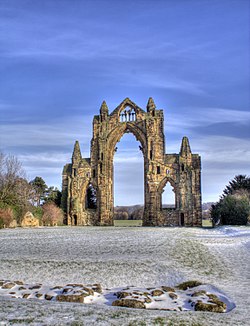
Gisborough Priory is a ruined Augustinian priory in Guisborough in the borough of Redcar and Cleveland, North Yorkshire, England. It was founded in 1119 as the Priory of St Mary by the Norman feudal magnate Robert de Brus, an ancestor of the Scottish king, Robert the Bruce. It became one of the richest monastic foundations in England with grants from the crown and bequests from de Brus, other nobles and gentry and local people of more modest means. Much of the Romanesque Norman priory was destroyed in a fire in 1289. It was rebuilt in the Gothic style on a grander scale over the following century. Its remains are regarded as among the finest surviving examples of early Gothic architecture in England.
The priory prospered until the Dissolution of the Monasteries in 1540, when it was abolished along with England's other monastic communities. The priory buildings were demolished and the stone re-used in other buildings in Guisborough. The east end of the priory church was left standing with its great window forming a distinctive arch, a well-known landmark used as a symbol for Guisborough. It became part of the estate of the Chaloner family, who acquired it in 1550. The east window was preserved by them as part of a Romantic vista adjoining their seat, Gisborough Hall, from which the priory takes its idiosyncratically spelled name. It is owned by the Chaloners but is in the care of English Heritage as a scheduled monument.
Since the 19th century archaeological excavations have taken place in the priory grounds, though a substantial part of the site has not yet been investigated. In addition to the east window, surviving visible fragments of the complex include the lower courses of the west range, a vaulted undercroft, a gateway and a 14th-century dovecote still in use today. The adjoining Priory Gardens, laid out by the Chaloners in the 18th century, have been used to cultivate cut flowers since 1962. The priory ruins are open to the public between March and November. The Gardens are open on occasional days through the summer for visitors to pick their own flowers.

992 m
Guisborough railway station
Guisborough railway station was the terminus of the Middlesbrough and Guisborough Railway. It served the town of Guisborough in North Yorkshire, England. The station was opened to goods in November 1853, and to passenger traffic on 25 February 1854. The station was closed to passengers, along with the entire Nunthorpe–Guisborough branch, on 2 March 1964, with freight being withdrawn in August 1964.
998 m
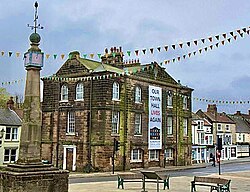
Guisborough Town Hall
Guisborough Town Hall is a municipal building on Westgate in Guisborough, North Yorkshire, England. The structure, which has mainly been used as a venue for magistrates' court hearings, is a Grade II listed building.