


La rue du Camas est une voie de Marseille.
Location

82 m
The Boulevard Chave is a major boulevard in Marseille, France. Built in 1842 and named in honor of landowner André Chave, it has had a tramline since 1892.
488 m
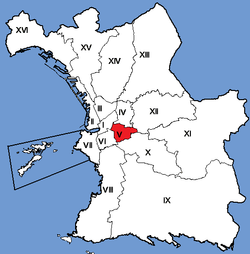
The 5th arrondissement of Marseille is one of the 16 arrondissements of Marseille. It is governed locally together with the 4th arrondissement, with which it forms the 3rd sector of Marseille.

768 m
The Place Jean-Jaurès, also known as La Plaine, is a historic square in Marseille, France. As early as the 13th century, it was a camping ground for Christian Crusaders on their way to the Holy Land. It later became a meeting place to welcome dignitaries and members of the French royal family. It is now home to a farmers' market. It is named after politician Jean Jaurès.

847 m
The Musée Grobet-Labadié is a museum in Marseille, housed in a 19th-century hôtel particulier owned by the family whose collection it displays.
In 1919, Marie Grobet, daughter of the Marseille businessman and politician Alexandre Labadié, gave the family art collection and hôtel particulier to the city.
The museum was inaugurated on November 3, 1925 by Mayor Siméon Flaissières and finally opened its doors to the public in January 1926.
The museum obtained the "Musée de France" label in 2003 and was listed as a historical monument by order of June 15, 2022.

860 m
Marseille-Blancarde station is a French railway station located in the city of Marseille, in the Bouches-du-Rhône department in the Provence-Alpes-Côte d'Azur region. It is also a station on Line 1 of the Marseille Metro.
Located on the tripoint border between the 4th, 5th and 12th arrondissement of Marseille, it is owned by France's national state-owned railway company SNCF and served by TER Provence-Alpes-Côte-d'Azur regional trains. According to the SNCF, 424,347 passengers travelled through the station in 2018.
Situation et accès
Cette rue située dans le 5e arrondissement de Marseille, va de la rue Saint-Pierre jusqu'à la rue Monte-Cristo.
Origine du nom
Par le passé, les terres agricoles situées à cet endroit appartenaient à la famille Camas. L'un des membres, Jean Camas est connu pour s'être consacré aux soins des pestiférés au XVIIe siècle.
Notes et références
Cet article est partiellement ou en totalité issu de l'article intitulé « Le Camas » (voir la liste des auteurs).
Portail des routes Portail de Marseille