

 English
 Français

Wakefield Town Hall
Wakefield Town Hall is a municipal building in Wood Street in Wakefield, West Yorkshire, England. It remains a venue for weddings and civil partnerships but is no longer the headquarters of Wakefield Council which is now based at County Hall. The town hall is a Grade I listed building.
Lieux à Proximité Voir Menu

40 m
Wakefield Mechanics' Institute
Wakefield Mechanics' Institute is a historic building in the city centre of Wakefield, in West Yorkshire, in England.
The building was constructed between 1820 and 1821, to serve as public rooms, with a music saloon on the first floor. The saloon opened in 1823, and the building soon also housed a subscription library, a newsroom, a savings bank, and a public dispensary, which was in the basement. The dispensary closed in 1832 following the death of the apothecary, who was living in the damp basement. Public baths were instead installed in the basement. From 1828, the saloon housed the town's annual charity ball, its most prominent social event.
In 1838, a corn exchange was opened on Westgate, and events were instead held in its assembly room. In 1842, the saloon became a mechanics' institute. In 1897, the National Federation of SubPostmasters was founded at a meeting at the institute. In 1910, the building was renamed as the Institute of Literature and Science, but it declined in popularity, and closed in 1935. It was taken over by Wakefield Council, which let rooms out to various organisations, while allowing the saloon to be used for events.
In 1955, the building became Wakefield Museum, which remained there until 2012. It was Grade II* listed in 1971.
The building is two storeys high and five bays wide. It is built of sandstone, with rustication on the ground floor; the roof is covered in Welsh slate. The upper floors feature Ionic order pilasters, sash windows, and above them a frieze in which is inscribed "MECHANICS' INSTITUTION". The rear elevation is stuccoed and includes windows to the basement. There are wrought iron railings, with some finials in the form of urns.

62 m
Wakefield Court House
Wakefield Court House is a historic building in the city centre of Wakefield, a city in West Yorkshire, in England.
The building was constructed in 1810, to house the court of quarter sessions. It was extended between 1849 and 1850, and in the 1880s. It later served as the Crown Court and as a County Court, but closed in 1992. It was sold for redevelopment, but little work was undertaken, and the building fell into disrepair. It was purchased by Wakefield Council in 2018, with plans to convert it into a performance space, but in 2023 the council decided that the plan was unviable, and instead sold it to a private developer, Rushbond.
The building is in the Greek Revival style. It is built of sandstone, and is two storeys high. It has a large Doric order portico. There are single-storey side wings, and there is a two-storey section to the left, set further back.
The building has been Grade II* listed since 1971.
72 m
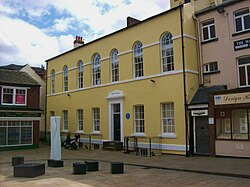
Old Town Hall, Wakefield
Wakefield Old Town Hall, also known as No. 5 Crown Court, is a historic building in the city centre of Wakefield, in West Yorkshire, in England. After operating as a town hall from 1861 to 1880, it served as an organ factory and then as commercial offices, before being adapted for residential use.

94 m
County Hall, Wakefield
County Hall or West Riding County Hall stands at the corner of Bond Street and Cliff Parade in Wakefield, West Yorkshire, England. It was opened in 1898 as the headquarters of the West Riding County Council, and on the abolition of that body in 1974 became the headquarters of West Yorkshire County Council. When that council was in turn abolished in 1986 the building became the primary headquarters of Wakefield Metropolitan District Council. It is a Grade I listed building.