


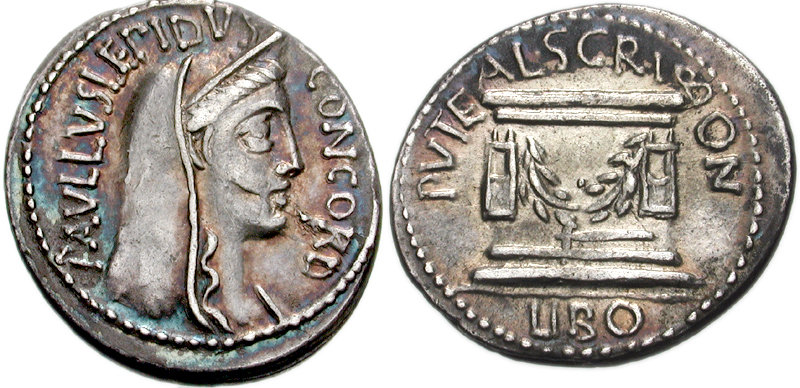
Le Puteal Scribonianum ou Puteal Libonis est un bidental en forme de puits situé sur le Forum Romain.
Gallery


Sponsored
Location
1 explorer visited this place

4 m
The Puteal Scribonianum or Puteal Libonis was a structure in the Forum Romanum in Ancient Rome. A puteal was a classical wellhead, round or sometimes square, placed atop a well opening to keep people from falling in.
The Scribonian Puteal was dedicated or restored by a member of the Libo family, perhaps the praetor of 204 BC, or the tribune of the people in 149 BC. The praetor's tribunal was convened nearby, having been removed from the comitium in the 2nd century BC. It thus became a place where litigants, money-lenders and business people congregated.
According to ancient sources, the Scribonian Puteal was a bidental—a spot that had been struck by lightning. It took its name from its resemblance to the stone curb or low enclosure around a well that was between the Temple of Castor and Pollux and the Temple of Vesta, near the Porticus Julia and the Arcus Fabiorum. No remains of this puteal, however, have been discovered. It was once thought that an irregular circle of travertine blocks found near the Temple of Castor formed part of the puteal, but this idea was abandoned in the early 20th century.
A coin issued in 62 BC by Lucius Scribonius Libo depicts this puteal, which he had renovated. It resembles a cippus or an altar, with laurel wreaths, two lyres and a pair of pincers or tongs below the wreaths. The tongs may be those of Vulcan, emblematic of him as a forger of lightning.

8 m
The Temple of Castor and Pollux was an ancient temple in the Roman Forum, Rome, Central Italy. It was originally built in gratitude for victory at the Battle of Lake Regillus. Castor and Pollux were the Dioscuri, the "twins" of Gemini, the twin sons of Zeus and Leda. Their cult came to Rome from Greece via Magna Graecia and the Greek culture of Southern Italy.
The Roman temple is one of a number of known Dioscuri temples remaining from antiquity.

32 m
The Lacus Iuturnae, or Lacus Juturnae or Spring of Juturna, is the name of a formal pool built by the Romans near a spring or well in the Roman Forum. The pool was part of a shrine dedicated to the water nymph Juturna, and the name Lacus Iuturnae is also used for the spring and the shrine, both next to the pool.
The site was initially excavated by Giacomo Boni in the early twentieth century. Excavations from the 1980s onwards were supervised by Eva Margareta Steinby.

37 m
The Arch of Augustus was the triumphal arch of Augustus, located in the Roman Forum. It spanned the Via Sacra, between the Temple of Castor and Pollux and the Temple of Caesar, near the Temple of Vesta, closing off the eastern end of the Forum. It can be regarded as the first permanent three-bayed arch ever built in Rome.
The archaeological evidence shows the existence of a three-bayed arch measuring 17,75 x 5.25 meters between the Temple of Caesar and the Temple of Castor and Pollux, although only the travertine foundations of the structure remain.
Ancient sources mention arches erected in honor of Augustus in the Forum on two occasions: the victory over Antony and Cleopatra in 31 BC, and the
recovery of the standards lost to the Parthians in 20 BC.

44 m
The sacred fire of Vesta was an eternal flame in ancient Rome dedicated to the goddess Vesta, protector of the hearth, home, and family.
The institution of the sacred fire was traditionally attributed to the legendary king Numa Pompilius in the 7th century BC.