


Le phare de Sumburgh Head (en vieux norrois : Dunrøstar høfdi) est un phare situé au bout du cap nommé Sumburgh Head, à l'extrême nord du Mainland, l'une des îles de l'archipel des Shetland au nord des Orcades en Écosse. Ce phare est géré par le Northern Lighthouse Board (NLB) à Édimbourg, l'organisation de l'aide maritime des côtes de l'Écosse.
Gallery


Sponsored
Location
1 explorer visited this place

0 m
Sumburgh Head Lighthouse is a lighthouse on Sumburgh Head at the southern tip of the Mainland of Shetland.

41 m
Sumburgh Head is a headland located at the southern tip of the main island of the Shetland Archipelago, in northern Scotland. The head consists of a 100 m high rocky spur and topped by the Sumburgh Head Lighthouse. In the Old Norse language, Sumburgh Head was called Dunrøstar høfdi, it means "The Head onto the loud tide-race", referring to the noise of Sumburgh Roost. Robert Stevenson was the engineer in charge of building the Sumburgh Head lighthouse. Work started on the building in 1819, and the light was first lit in 1821.

1.5 km
Sumburgh is a small settlement in the Shetland Islands, Scotland, within the parish of Dunrossness.
Sumburgh is located at the south end of the Mainland on Sumburgh Head. Shetland's commercial airport, Sumburgh Airport is located just outside the village to the north. The settlement has a population of approximately 100.
The archaeological site of Jarlshof is situated to the west of Sumburgh, adjacent to Sumburgh Hotel.

1.8 km
The West Voe of Sumburgh,, is the most southerly bay on the Shetland Mainland, located between Sumburgh Head, and the point of Scat Ness.
On the west side of the voe is the settlement of Scatness, while on the east side is the famous Jarlshof archaeological site. There are Late Mesolithic and Early Neolithic remains at West Voe.
Across the opening of the voe, past Sumburgh Head, is the tidal stream known as the Sumburgh Roost.
1.9 km
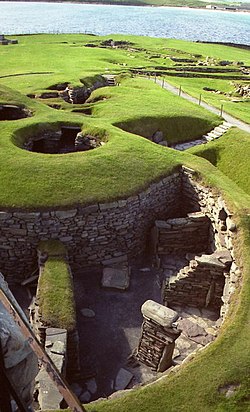
Jarlshof is the best-known prehistoric archaeological site in Shetland, Scotland. It lies in Sumburgh, Mainland, Shetland and has been described as "one of the most remarkable archaeological sites ever excavated in the British Isles". It contains remains dating from 2500 BC up to the 17th century AD.
The Bronze Age settlers left evidence of several small oval houses with thick stone walls and various artefacts including a decorated bone object. The Iron Age ruins include several different types of structures, including a broch and a defensive wall around the site. The Pictish period provides various works of art including a painted pebble and a symbol stone. The Viking Age ruins make up the largest such site visible anywhere in Britain and include a longhouse; excavations provided numerous tools and a detailed insight into life in Shetland at this time. The most visible structures on the site are the walls of the Scottish period fortified manor house, which inspired the name "Jarlshof" that first appears in an 1821 novel by Walter Scott.
The site is in the care of Historic Scotland and is open year-round, with longer opening hours during April to September. In 2012, Jarlshof, Mousa and Old Scatness were added to the UK's tentative list of proposed World Heritage Sites in a combination called the "Zenith of Iron Age Shetland."
Il est protégé en tant que monument classé du Royaume-Uni de catégorie A.
