


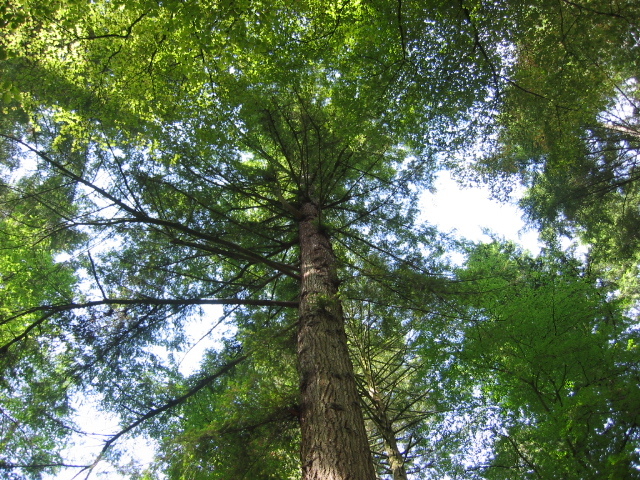
The Hermitage Douglas-fir (also known as Ossian's Douglas-fir) was a Douglas-fir tree which stood in The Hermitage pleasure ground, in Dunkeld, Scotland, between c. 1887 and 2017. It was the second tree (after a grand fir in Argyll) in Britain to reach 200 feet (61 m) in height, in 1980. It eventually reached a height of 63 metres (207 ft) in 2009 before it was blown over due to high winds in the early hours of 13 January 2017.
Gallery

Sponsored
Location
2 explorers visited this place

0 m
The Hermitage is a National Trust for Scotland-protected site in Dunkeld, Perth and Kinross. Located just to the west of the A9, it sits on the banks of the River Braan in Craigvinean Forest. It was created by John Murray, the third Duke of Atholl, who lived in nearby Dunkeld House, in the 18th century to honour the blind bard Ossian. It is home to the Georgian follies Ossian's Hall of Mirrors and Ossian's Cave. The hermit's cave was built around 1760 for the third Earl of Breadalbane, who unsuccessfully advertised for a permanent eremite. The guide in 1869, Donald Anderson, dressed up with a long beard of lichens and clothes of animal skins.
Also in its grounds are several Douglas-fir trees, one of which was the second tree in Britain to reach 200 feet in height, in 1980. Known as the Hermitage Douglas-fir, it eventually reached a height of 63 metres in 2009 before it was blown over due to high winds in the early hours of 13 January 2017. It was a self-sown tree, growing from seed blown from one of three older trees at the Hermitage, and was found by increment boring to have germinated around 1887.
Visitors to the site can undertake various walks. The most popular walk is the 0.6 miles-long journey to Ossian's Hall. Wheelchairs are accommodated via a pass-for-all route. There is also a link to a thirty-mile network of footpaths beyond The Hermitage to various parts of Dunkeld. These paths date back to the 18th century.
Originally, the popular riverside path purposely deviated away from the river at about a half-mile from the car park. This was to build up the visitors' anticipation for the waterfall that is to be found a short distance ahead. Another path, running parallel to the riverside path, is wider, the purpose for which, it is believed, was to accommodate horse-drawn carriages. Hermitage Bridge, dating from 1770, is located nearby. Standing next to it, and appearing to be growing out of it, is a Cedar of Lebanon, which is believed to be the oldest tree at The Hermitage.

215 m
Craigvinean Forest is located 1 mile west of Dunkeld, Perth and Kinross, Scotland, on the A9. It is accessed through a track at the foot of Deuchary Hill. The River Braan bisects the forest, which forms part of the Tay Forest Park, one of six forest park in Scotland.
The Hermitage is located in a section of the forest.
Ossian, a third-century Celtic bard, whose mother was turned into a deer by Fer Doirich, is said to have inhabited a cave which can be found on the north bank of the Braan located upstream from Ossian's Hall of Mirrors, a folly built in 1758 which is replete with Corinthian architrave and cornice. This folly was built on a horse shoe plan facing a waterfall and so amplifies the roaring sound of water.
The 2019 racing game Dirt Rally 2.0 features point-to-point stages based on accurate reproductions of around 25 km of forestry tracks within Craigvinean.

403 m
Black Linn Falls is a waterfall on the River Braan in The Hermitage, Dunkeld, Scotland. After the falls, the river passes beneath the Hermitage Bridge into a plunge pool.
Ossian's Hall of Mirrors is a popular viewing point of the falls.

432 m
Ossian's Hall of Mirrors is a Georgian structure located at The Hermitage in Dunkeld, Scotland.

440 m
The Hermitage Bridge is an ancient, single-arch stone pedestrian bridge crossing the River Braan near Dunkeld, Perth and Kinross, Scotland. A Category A listed structure, it is in the bounds of The Hermitage, a National Trust for Scotland-protected site. The bridge should not be confused with the Rumbling Bridge, which carries motorised traffic, about 0.62 miles to the southwest.
The bridge was built in 1770 by order of John Murray, 3rd Duke of Atholl, presumably to gain access across to some lands leased from Sir John Stewart of Murthly, as well as assisting with the views of the Black Linn Falls. It has since become a major landscape feature and has been the subject of several paintings and sketches, including from George Washington Wilson's visit around 1859.
An arch stands across the western entrance, while underneath its eastern end, the bridge contains a small arch giving access to the ledge below Ossian’s Hall and to a small grotto.
It was a self-sown tree, growing from seed blown from one of three older trees at the Hermitage, and was found by increment boring to have germinated around 1887.
See also
List of individual trees