

 English
 Français
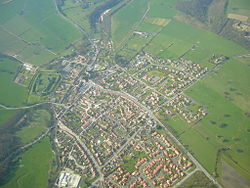
Helmsley
Helmsley est un village et une paroisse civile du Yorkshire du Nord, en Angleterre. Il est situé sur la rivière Rye (en), sur la route A170 (en), à l'est de Thirsk et à l'ouest de Pickering. La population comptait 1 702 habitants en 2021. Le sentier Cleveland Way (en) commence à Helmsley, et fait une boucle en fer à cheval autour du parc national des North York Moors jusqu'à Filey. Les restes d'un château, le Château de Helmsley, est vers Helmsley. Le groupe One Night Only est originaire de cette ville.
Nearby Places View Menu
127 m
Siege of Helmsley Castle
Helmsley Castle was a Royalist stronghold in North Yorkshire during the First English Civil War. It was besieged by Parliamentarian forces in September 1644 and surrendered on 22 November after a siege of two to three months.

237 m
Helmsley railway station
Helmsley railway station served the market town of Helmsley in North Yorkshire from 1871 until 1964, although the regular passenger service (and the line from Kirkbymoorside east to Pickering) ceased in 1953. Helmsley station was nearly 15 miles (24 km) from Pilmoor station on the East Coast Main Line, and 12 miles (19 km) from Pickering.

286 m
Helmsley
Helmsley is a market town and civil parish in North Yorkshire, England. Historically part of the North Riding of Yorkshire, the town is located at the point where Ryedale leaves the moorland and joins the flat Vale of Pickering.
Helmsley is situated on the River Rye on the A170 road, 14 miles (23 km) east of Thirsk, 13 miles (21 km) west of Pickering and some 24 miles (39 km) due north of York. The southern boundary of the North York Moors National Park passes through Helmsley along the A170 road so that the western part of the town is within the National Park.
The settlement grew around its position at a road junction and river crossing point. Helmsley is a compact town, retaining its medieval layout around its market place with more recent development to the north and south of its main thoroughfare, Bondgate. It is a historic town of considerable architectural character whose centre has been designated as a conservation area. The town is associated with the Earls of Feversham, whose ancestral home Duncombe Park was built overlooking Helmsley Castle. The Feversham Monument stands in the market place, along with the Helmsley Market Cross.
The town is a popular tourist centre and has won gold medals in the Large Village category of Yorkshire in Bloom for three years. The town square is a meeting place for motorcyclists as it is at the end of the B1257 road from Stokesley, which is a favourite with bikers.
The Cleveland Way National Trail starts at Helmsley, and follows a horseshoe loop around the North York Moors National Park and Yorkshire coast for 110 miles (180 km) to Filey. The remains of Helmsley Castle, which was destroyed in the Civil War, loom over the town.

380 m
Old Vicarage, Helmsley
The Old Vicarage is a historic building in Helmsley, a town in North Yorkshire, in England.
The vicarage was commissioned by Charles Gray, the Vicar of All Saints' Church, Helmsley. Gray was known for training new clergy, and wanted to large vicarage in order to accommodate both himself and his trainees. He commissioned Temple Moore to design a building, which was completed in about 1900. It is in the Queen Anne style, in contrast to Moore's usual Gothic. In 1974, the building became the headquarters of the North York Moors National Park Authority, and the vicar moved to Canons Garth. The building was grade II listed in 1985. In 2024, the authority announced plans to move to a smaller, purpose-built headquarters, and to convert the Old Vicarage into housing.
The building is constructed of sandstone, and has a tile roof with gable coping and shaped kneelers. It has two storeys and an attic, and seven bays. On the front is a French window, and the windows are sashes, in the ground floor with cambered heads. In the attic are dormers containing sashes.

414 m
Helmsley Bridge
Helmsley Bridge, sometimes known as Rye Bridge, is a historic bridge in Helmsley, a town in North Yorkshire, in England.
The bridge carries the A170 road over the River Rye, just below the mouth of the Borough Beck. It was constructed in the Mediaeval period, perhaps in the 14th century, and probably for Rievaulx Abbey. It is the oldest surviving bridge over the Rye, but was largely rebuilt in the late 18th century. The parapet may have been rebuilt, and it was repaired in 2023. It is a scheduled monument and has been a grade II listed building since 1955.
The bridge is built of sandstone and has two arches, one 37 feet (11 m) wide and the other only 23 feet (7.0 m) wide. Each has double arch rings, and they have buttresses between them. The bridge was originally about 12 feet (3.7 m) across, with pointed arches, but was later widened upstream, with round arches, to a total breadth of 20 feet (6.1 m). The bridge has a band, a parapet and coping.