Cathédrale de Tous-les-Saints de Wakefield
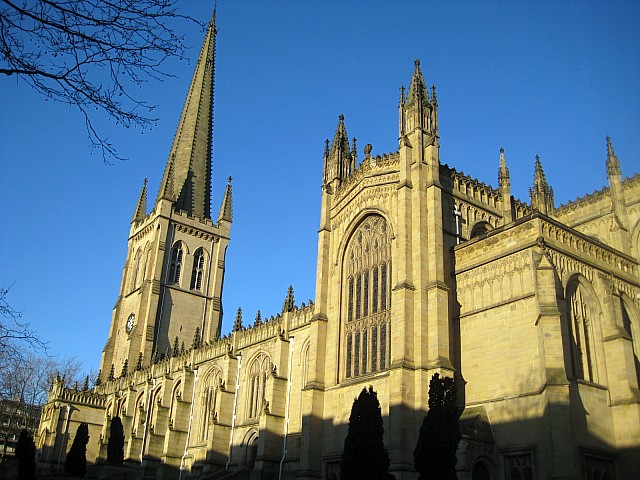
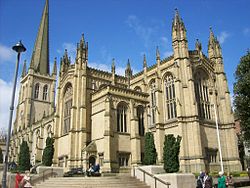
La cathédrale de Tous-les-Saints de Wakefield (en anglais : Cathedral Church of All Saints) est une cathédrale de l'Église d'Angleterre et, depuis 2014, une des trois cocathédrales du diocèse anglican de Leeds, avec la cathédrale de Bradford et la cathédrale de Ripon. De 1888 à 2014, elle est la cathédrale du diocèse de Wakefield, avant de sa suppression. La cathédrale possède la plus haute flèche du Yorkshire, et est le plus haut bâtiment de la ville de Wakefield.
Nearby Places View Menu
0 m
Capture of Wakefield
The capture of Wakefield occurred during the First English Civil War when a Parliamentarian force attacked the Royalist garrison of Wakefield, Yorkshire. The Parliamentarians were outnumbered, having around 1,500 men under the command of Sir Thomas Fairfax, compared to the 3,000 led by George Goring in Wakefield. Despite being outnumbered, Parliamentarians successfully stormed the town, taking roughly 1,400 prisoners.
Around 800 Parliamentarians had been taken prisoner after being defeated at Seacroft Moor, and Fairfax plotted the capture of Wakefield to take prisoners of his own to exchange for his men. He marched his force from Leeds and split it in two to attack from different directions. After around two hours of fighting early in the morning of 21 May, 1643, Fairfax broke through into Wakefield. Goring, who had been in bed suffering from either illness or a hangover, rose and led a counterattack in his nightshirt, but to no avail and the town was captured. Fairfax gained the prisoners he needed and much ammunition. According to his own account, the Parliamentarians lost no more than seven men.
0 m
Wakefield Cathedral
Wakefield Cathedral, or the Cathedral Church of All Saints in Wakefield, West Yorkshire, England, is a co-equal Anglican cathedral with Bradford and Ripon Cathedrals, in the Diocese of Leeds and a seat of the Bishop of Leeds. Originally the parish church, it has Anglo Saxon origins and, after enlargement and rebuilding, has the tallest spire in Yorkshire. Its 247-foot (75 m) spire is the tallest structure in the City of Wakefield. The cathedral was designated a Grade I listed building on 14 July 1953.
72 m
Wakefield
Wakefield is a cathedral city in West Yorkshire, England located on the River Calder. The city had a population of 109,766 in the 2021 census, up from 99,251 in the 2011 census. The city is the administrative centre of the wider Metropolitan Borough of Wakefield, which had a 2024 population of 367,666, the 27th most populous district in England. It is part of the West Yorkshire Built-up Area and the Yorkshire and the Humber region.
In 1888, it gained city status due to its cathedral. The city has a town hall and is home to the county hall, which was the former administrative centre of the city's county borough and metropolitan borough as well as county town for the West Riding of Yorkshire.
The Battle of Wakefield took place in the Wars of the Roses, and the city was a Royalist stronghold in the Civil War. Wakefield became an important market town and centre for wool, exploiting its position on the navigable River Calder to become an inland port. In the 18th century, Wakefield traded in corn, coal and textiles.
101 m
The Ridings Centre
The Ridings Shopping Centre is an indoor shopping centre in Wakefield, West Yorkshire, England. It opened on 17 October 1983. The pioneering centre was a UK first and subsequently served as a template for many shopping centres throughout the UK.
136 m
City of Wakefield
Wakefield, also known as the City of Wakefield, is a local government district with city status and a metropolitan district in West Yorkshire, England. Wakefield, the largest settlement, is the administrative centre of the district. The population of the City of Wakefield at the 2011 Census was 325,837.
The district includes the Five Towns of Castleford, Featherstone, Knottingley, Normanton and Pontefract. Other towns include Hemsworth, Horbury, Ossett, South Elmsall and South Kirkby (also forms the civil parish of South Kirkby and Moorthorpe). The city and district are governed by Wakefield Council from the County Hall. In 2010, Wakefield was named as the UK's third most musical city by PRS for Music.
English
Français