

 English
 Français

Rodney Gardens
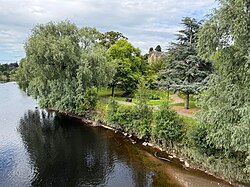
Rodney Gardens is an urban garden in the Kinnoull area of the Scottish city of Perth, on the eastern banks of the River Tay. Named for Admiral George Rodney of the Royal Navy, the gardens are situated on the former site of a mill. One sculpture, known as "Millais Viewpoint", is by Tim Shutter. The view, through the two lower corners of a stone picture frame, recreates the view seen in the 1856 painting Autumn Leaves by John Everett Millais. Immediately to the south of the gardens is Kinnoull Burial Ground, an ancient cemetery formerly part of an earlier guise of Kinnoull Parish Church. Its gates are kept locked; visitors wishing to enter are asked to get the keys from the reception in the adjacent Rodney Fitness Centre.
Nearby Places View Menu

103 m
Queen's Bridge, Perth
Queen's Bridge is a toll-free bridge in the city of Perth, Scotland. It spans the River Tay. It carries both automotive and pedestrian traffic of South Street, one of Perth's three main streets from mediaeval times. It stands about 500 yards (460 m) downstream from Perth Bridge and is 246 feet (75 m) in length.
Queen's Bridge replaced Victoria Bridge, which stood between 1902 and 1958–1959, and was opened by Queen Elizabeth II on 10 October 1960. The pier on the bridge's eastern side is a remnant of the previous structure.
The construction of Victoria Bridge required the demolition of Rodney Lodge, which stood in today's Rodney Gardens.
117 m
Norie-Miller Walk
Norie-Miller Walk is an urban park in the Scottish city of Perth, on the eastern banks of the River Tay. Named for Sir Stanley Norie-Miller, Bt, MC, DL, JP (1888–1973) it is situated between Smeaton's Bridge to the north and Queen's Bridge immediately to the south, and behind Kinnoull Parish Church.
In 2017, the park was lit up, in an event known as Light Nights, for a celebration in honour of Robert Burns.

129 m
Kinnoull Parish Church
Kinnoull Parish Church is a Church of Scotland church in the Kinnoull area of Perth, Scotland. A "Kinnoull Church" appears in documents when it was granted to Cambuskenneth Abbey in 1361. It was rebuilt in 1779 but demolished in 1826, after the completion of a church on the Perth side of the River Tay, which flows a short distance behind the church.
Standing on Dundee Road, today's church was built in 1827 to a design by William Burn. The remains of the earlier 1635 church, which is a scheduled monument, can be seen further south on Dundee Road, adjacent to the Rodney Gardens. Included in the historic designation are the remains of the church, the burial aisle, churchyard and its boundary wall and the gravestones within the churchyard.
The Kinnoull family's vault is beneath the floor of the old church, and a monument to George Hay, 1st Earl of Kinnoull, is inside it. It shows Hay "dressed in his Lord Chancellor's robes, standing within an ivy-clad Corinthian portico, with a table on which rests the Great Seal of Scotland. Above is an intricate heraldic panel, supported by fruit, unicorns, shields and spearhead finials."
The most striking feature of the present church is the west-facing Millais window, which was installed in 1870 and consists of fourteen painted glass panels depicting the parables of Jesus. These are interspersed with beautiful flower motifs. The parables are based on woodcuts by Sir John Everett Millais, president of the Royal Academy and second husband of Effie Gray.
The church contains some other fine stained-glass, notably the Strachan window above the east door, which was installed in memory of Rev Dr John Anderson, minister from 1852 to 1897.
The church's pipe organ was unveiled by Dr Albert Lister Peace on 23 April 1896. It was a gift of Mrs Jasmine F. Fuller, of Rosebank. The organ was the work of the Hope–Jones Organ Company of Birkenhead. The organ cases were designed by Perth architect David Smart.
Between 1929 and 1930, the interior of the church was remodelled, which included a major rebuild of the organ. It was further rebuilt in 1957 but proved difficult to tune and maintain and was replaced by a three manual Makin digital instrument in 2008.
191 m
Witchhill House
Witchhill House is an historic villa in Kinnoull, Perth and Kinross, Scotland. Located on Kinnoull Terrace, it is a Category B listed building, built around 1860. Designed by David Smart, it is one of five listed properties on the street, denoted by Historic Environment Scotland as items of special interest. Several of the properties appear on maps of Perth from the 1860s.
Along with the two other listed villas on its (the western) side of the street, it has a gate in the communal boundary wall that runs along a stretch of the Dundee Road to the west; however, the one for Langlands has been filled in.
Witchhill Quarry, which formerly stood on the site of Kinnoull Terrace, was the source of much of the stone used in Perth's buildings from the 19th century onwards.