Location Image

Nesyamon (scribe)

Nesyamon est un prêtre, porteur d'encens et scribe dans le temple de Karnak. Mort vers -1100, son corps a été momifié. Depuis qu'il est arrivé au musée de Leeds en 1823, il a été reconnu comme l'une des plus remarquables momies en Grande-Bretagne. Durant un bombardement en 1941, deux momies furent détruites mais celle de Nesyamon a échappé à la destruction. Une équipe multidisciplinaire a été mise en place en 1973 pour en savoir plus sur les conditions de vie, les maladies et causes de décès de l'ancienne population égyptienne, ainsi que pour établir des méthodes formelles non destructives d'examen des restes momifiés. La base de données internationale « Momie » fondée au musée de Manchester en 1979 est maintenant reconnu comme le plus grand centre pour la collecte et le stockage des informations liées à la momification dans le monde entier. En 1990, le directeur du musée de Leeds a invité le Dr Rosalie David pour entreprendre une nouvelle étude scientifique de la momie de Nesyamon. Depuis 2002, le musée de Leeds a documenté et étudié à la fois la décoration sur le cercueil, et le cercueil lui-même. Cela a conduit à une meilleure compréhension de la nature des rôles qu'avaient Nesyamon, en tant que prêtre au temple de Karnak. Le 4 septembre 2008, la momie a été déplacée dans un nouveau bâtiment du Leeds City Museum.

Nearby Places View Menu
0 m

Northern Film School

The Northern Film School is part of the Leeds Beckett University Leeds School of Arts. It is one of the largest full-time film schools in the UK, offering both bachelor's and master's degrees, and is situated in the city centre of Leeds. School was established in 1970 in Leeds, West Yorkshire, England.
Location Image
0 m

Nesyamun

Nesyamun, also known as Natsef-Amun or The Leeds Mummy, was an ancient Egyptian priest who lived during the Twentieth Dynasty c. 1100 BC. He was a senior member of the temple administration in the Karnak temple complex and held various titles including "god's father of Montu" and "scribe of Montu", and was responsible for presenting the daily food offerings to the gods and tallying the cattle of the Karnak temple estates. Nothing is known about his family. His body was discovered in the early 1820s during excavations of the Deir el-Bahari causeway by Giuseppe Passalacqua. He was shipped to Europe and sold several times before being purchased for the Leeds Philosophical and Literary Society's museum in Leeds, England. In 1824 his coffin and mummy was the subject of one of the earliest scientific investigations of an Egyptian mummy. His remains are now held in the collection of the Leeds City Museum. Study of his coffin and mummy cover found them to be of high quality. Nesyamun was the only one of the museum's mummies to remain intact following the 1941 Leeds Blitz, although his mummy cover sustained major damage. From the 1930s onward he has undergone various forms of testing which has revealed his general state of health and that he died aged between 50 and 60 years. In 2020, his mummified vocal tract was modelled using CT scan data, allowing it to produce a single sound; the study attracted criticism for its ethics and research value.
Location Image
86 m

Leeds Cathedral

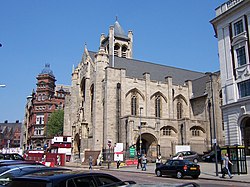
Leeds Cathedral, formally the Cathedral Church of St Anne, also known as Saint Anne's Cathedral, is the cathedral of the Roman Catholic Diocese of Leeds, and is the seat of the Roman Catholic Bishop of Leeds. It is in the city of Leeds, West Yorkshire, United Kingdom. The city of Leeds does not have a Church of England cathedral although it is in the Anglican Diocese of Leeds. The cathedrals of the Anglican diocese are in Ripon, Wakefield and Bradford. The city instead has a Minster which is similar to nearby Dewsbury Minster and Halifax Minster, all of which are parish churches. The original cathedral was located in St Anne's Church in 1878, but that building was demolished around 1900. The current cathedral building on Cookridge Street was completed in 1904, and was restored in 2006. The reredos of the old cathedral's high altar was designed by Pugin in 1842 and moved to the lady chapel of the new cathedral. The cathedral is a Grade II* listed building. The cathedral and the Church of the Holy Rosary on Chapeltown Road together serve the Leeds parish of Our Lady of Unfailing Help.
Location Image
100 m

Leeds Art Gallery

Leeds Art Gallery in Leeds, West Yorkshire, England, is a gallery, part of the Leeds Museums & Galleries group, whose collection of 20th-century British Art was designated by the British government in 1997 as a collection "of national importance". Its collection also includes 19th-century and earlier art works. It is a grade II listed building owned and administered by Leeds City Council, linked on the West to Leeds Central Library and on the East via a bridge to the Henry Moore Institute with which it shares some sculptures. A Henry Moore sculpture, Reclining Woman: Elbow (1981), stands in front of the entrance. The entrance hall contains Leeds' oldest civic sculpture, a 1712 marble statue of Queen Anne. In front of the gallery is Victoria Square, at the eastern end of which is the city's war memorial. This square is often used for rallies and demonstrations because of the speakers' dais provided by the raised entrance to the gallery.
Location Image
100 m

Leeds Central Library

Leeds Central Library is a public library in Leeds. Situated in the city centre, on Calverley Street, it houses the city library service's single largest general lending and reference collection and hosts the Leeds Art Gallery. Services available from the building include an Art Library, a Central Children's Library, a Central Lending Library, a Business and IP Centre, Information and Research Library, a Local and Family History Library and a Music Library.