

 English
 Français
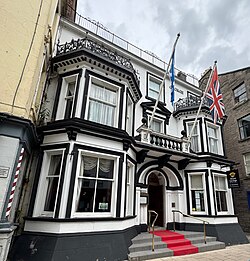
2 Tay Street
2 Tay Street is an historic building in Perth, Scotland. It is Category C listed, dating to around 1875, and stands on Tay Street, near its junction with Bridge Lane, Charlotte Street and West Bridge Street, at the foot of Perth Bridge. The three-storey building is described by Historic Environment Scotland as being constructed of "stugged red ashlar". Its central section is recessed slightly compared to its northern and southern sections, with a single window above the door.
Nearby Places View Menu
42 m
Royal George Hotel, Perth
The Royal George Hotel (also known as The Royal George) is a hotel and restaurant in Perth, Scotland. It is a Category B listed building dating to 1773. Its main entrance is on George Street, though its Tay Street frontage, overlooking the River Tay, is more well known. It is named for George III. It adjoins a reputed section of Perth City Walls.
Notable visitors to the hotel include Empress Eugenie and Queen Victoria, her husband, Albert, Prince Consort, and their children, who stayed there on 29 September 1848, during their journey south after holidaying at Balmoral Castle. (William Murray, 4th Earl of Mansfield, was out of town and, thus, they were unable to stay at Scone Palace, just under two miles to the north.) It was Victoria's first time staying in a hotel. After breakfast at the hotel the following morning, the family left for Carlisle on the recently built Scottish Central Railway. Then named The George Inn, the business was renamed The Royal George Hotel in her honour. (The street adjacent to the property on its southern side is named George Inn Lane.) Both the Royal Warrant and two lamps from the room the monarch slept in are still in the hotel today.
Queen Victoria returned to Perth in 1864 to unveil a statue of her husband, who died three years earlier, at the North Inch.
Local architect Donald Alexander Stewart, in partnership with Robert Matthew Mitchell, undertook some reconstruction work on the hotel in 1927.
Prince Edward, Earl of Wessex, dined at the hotel in 2003.
The hotel has 45 rooms.
The hotel regularly host events for right and far-right UK political parties, including events for the Scottish Conservatives, the launch of the British National Party Holyrood Manifesto in 2011, and the Reform UK Scottish Party Conference in 2024.

45 m
Perth Lade
Perth Lade (also known as King's Lade) is a historic 4.5-mile (7.2 km)-long former mill lade in Perth and Kinross, Scotland. Created in the 11th century or earlier, it has been used to power several watermills, such as those that functioned at Perth's Lower City Mills, which have existed since the 18th century. Over its course, at least nineteen industrial sites existed; today, the remains of nine of these can be seen, the rest lost to inner-city development and housing schemes of the 20th and 21st centuries. A footpath follows the majority of the lade's course.

59 m
Perth Art Gallery
Perth Art Gallery is the principal art gallery and exhibition space in the city of Perth, Scotland. It is located partly in the Marshall Monument, named in memory of Thomas Hay Marshall, a former provost of Perth.
The building was formerly known as Perth Museum and Art Gallery, ceasing to be so in anticipation of the new Perth Museum opening within Perth City Hall.

97 m
51st (Highland) Division War Memorial
The 51st (Highland) Division War Memorial, in the North Inch public park in Perth, Perth and Kinross, Scotland, is dedicated to the soldiers of the 51st (Highland) Division lost in World War II. It was unveiled on 13 May 1995, marking the 50th anniversary of the conclusion of the war.
The bronze sculptures depict a Highland piper being handed a rose from a bunch of flowers held by a young Dutch girl. A bronze dedication plaque is mounted on a tablet on the granite base. Another plaque, listing the regiment's battle honours, is at the rear. By the steps leading up to the memorial is a tablet explaining the memorial's symbolism. Two bronze relief plaques are on the sides of the base; one is a montage of soldiers in the field, the other depicts an artillery piece, an armoured personnel carrier, a tank, medics treating a wounded soldier, a piper leading two soldiers into battle, a chaplain at a burial service and three lorries at a depot.