


Dolga Vas (pronounced [ˈdɔ̀ːwɡa ˈʋáːs]; Slovene: Dolga vas, Hungarian: Hosszúfalu) is a settlement immediately north of Lendava in the Prekmurje region of Slovenia. It lies on the border with Hungary.
Location

1.4 km
The Municipality of Lendava is a municipality in the traditional region of Prekmurje in northeastern Slovenia. The seat of the municipality is the town of Lendava. Lendava became a municipality in 1994. It borders Croatia.
1.6 km
Dolgovaške Gorice is a settlement in the hills east of Lendava in the Prekmurje region of Slovenia. It lies on the border with Hungary.
1.6 km
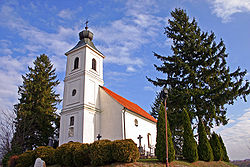
Lendavske Gorice is a settlement in the hills immediately east of Lendava in the Prekmurje region of Slovenia.
The local church in the settlement is dedicated to the Holy Trinity and belongs to the Parish of Lendava. It was built in 1728 by the Gludovácz family. When excavating for the foundations of the church, a wooden coffin was discovered containing the body of Mihael Hadik, who died fighting the Ottoman Turks in 1603. His mummy is now on display in the church.

1.8 km
Lendava is a town in Slovenia in the region of Prekmurje. It is the seat of the Municipality of Lendava. It forms part of the border crossing with Hungary at Dolga Vas–Rédics and it is near the border with Croatia at Mursko Središće. Alongside Slovene, Hungarian serves as an official language of the municipality.
The town is the centre of the Hungarian minority in Slovenia. It is also known for the monumental theater and Hungarian Community Centre designed by the architect Imre Makovecz.

1.9 km
The Lendava Synagogue is a former Orthodox Jewish congregation and synagogue, located in the small town of Lendava, Slovenia, a town that is close to the Hungarian border. The former congregation was established in 1773 and worshiped in the Ashkenazi rite. The former synagogue was completed in 1866 and was used as a synagogue up until 1944, when the community perished in The Holocaust.
Left vacant for many years, the former synagogue was repurposed as a Jewish museum, called the Galerija-Muzej Lendava, in the mid-1990s. The museum has a permanent exhibition on local Jewish history.