


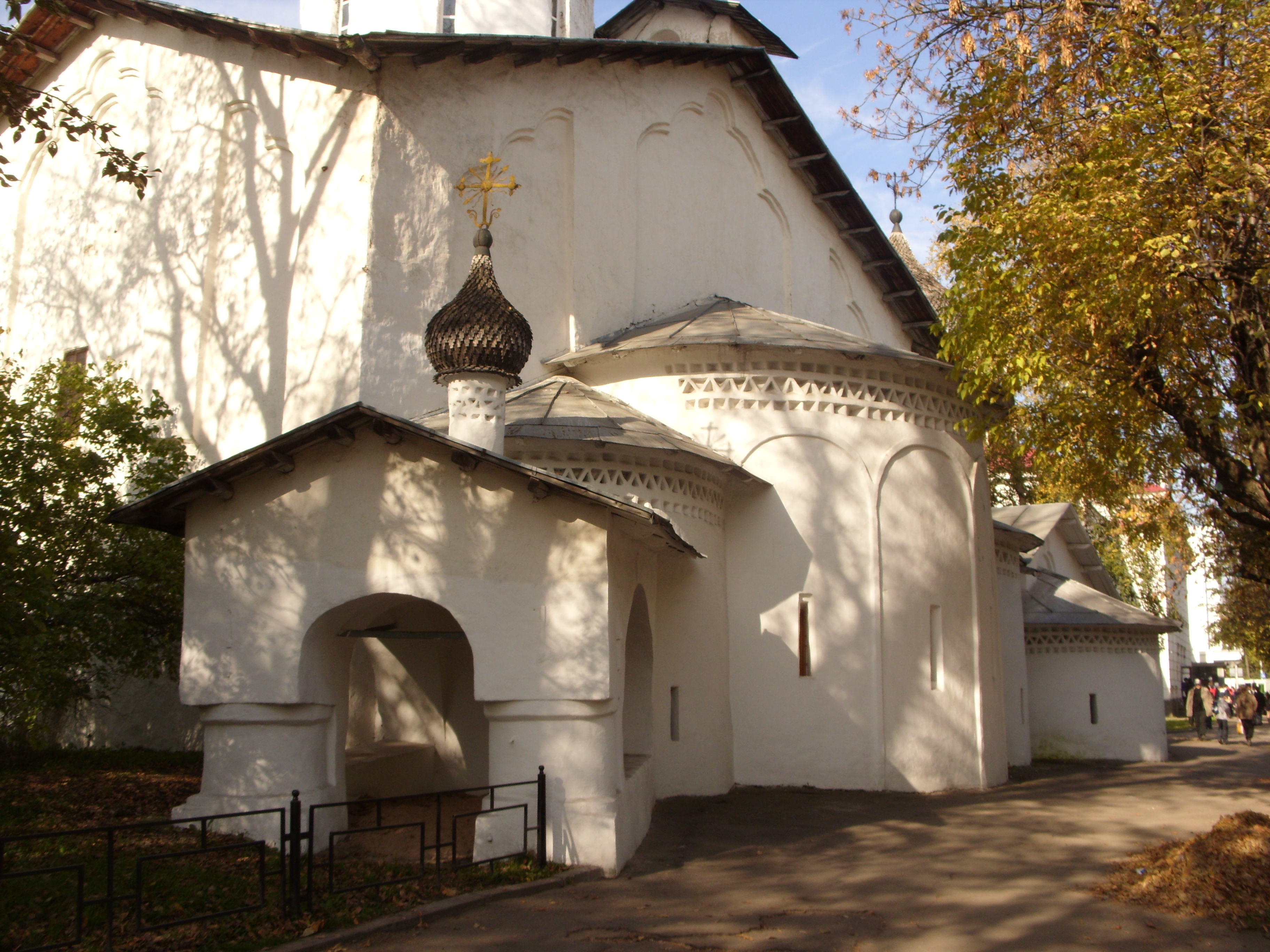
L'église Saint-Nicolas-du-Lieu-sec (en langue russe : Церковь Николы со Усохи) est une église orthodoxe située dans la ville de Pskov. Elle est classée comme édifice du XVe siècle- XVIe siècle d'intérêt historique et culturel dans la fédération de Russie. Elle se trouve dans le quartier du centre ville appelé Sredni gorad .
Book your tour near
Église Saint-Nicolas-du-Lieu-sec
Book Now
4.1
in partnership with
GetYourGuide.com
Gallery




Sponsored
Location
1 explorer visited this place
139 m
Pskov Viceroyalty was an administrative-territorial unit of the Russian Empire, which existed in 1777–1796. The seat of the Viceroyalty was located in Pskov. Both the predecessor and the successor of the viceroyalty was Pskov Governorate. In terms of modern administrative division of Russia, the area of the viceroyalty is currently split between Pskov, Leningrad, Tver, and Novgorod Oblasts.

139 m
Pskov Governorate was an administrative-territorial unit of the Russian Empire and the Russian SFSR, which existed in 1772–1777 and 1796–1927. Its seat was located in Opochka between 1772 and 1776, and in Pskov after 1776. The governorate was located in the west of the Russian Empire and bordered Saint Petersburg Governorate in the north, Novgorod Governorate in the northeast, Tver Governorate in the east, Smolensk Governorate in the southeast, Belarusian Governorate in the south, and Governorate of Livonia in the west.
In terms of modern administrative division of Russia, the area of the governorate is currently split between the Pskov, Tver, and Novgorod oblasts. The former border between Pskov Governorate and Governorate of Livonia still largely corresponds to the state border between Russia in the east and Estonia and Latvia in the west.

139 m
The siege of Pskov, known as the Pskov Defense in Russia, took place between August 1581 and February 1582, when the army of the Polish king and Grand Duke of Lithuania Stephen Báthory laid an unsuccessful siege and successful blockade of the city of Pskov during the final stage of the Livonian War of 1558–1583.
The first detachments of the Polish–Lithuanian army, which in the previous two years captured Polotsk and Velikiye Luki, appeared at the walls of Pskov on August 18, 1581. This action completely cut off Russian forces from the territory of Livonia. The main invading force laid siege to the city on August 24–26. Prince Vasili Skopin-Shuisky was nominally in charge of the defense of Pskov, but Prince Ivan Shuisky was the one to actually implement it. The latter had up to 4,000 dvoryane, streltsy, and Cossacks and some 12,000 armed citizens of Pskov and its surroundings at his disposal.
After a two-day shelling of Pskov, the Polish army attacked for the first time on September 8. The Russians repelled the assault, which resulted in heavy Polish losses. Attempts to blow up the fortifications with mines and a general attack on November 2 also turned out to be fruitless. In November some Polish forces attacked the Pskovo-Pechorsky Monastery, but to no avail.
King Stephen Báthory then ordered a passive siege, and the battle became a blockade. On December 1 the king left the siege together with most of the Lithuanian army, volunteers, and German, Hungarian, Romanian, Bohemian and Scottish mercenaries. Command of the remaining forces was given to Jan Zamojski. At the same time, during the siege in 1581, Polish cavalry raids devastated many regions of Russia, reaching Volga and Lake Ladoga. The regular cavalry was the best unit of the Polish forces. During the harsh winter of 1581-2 the rest of the besieging army would have mutinied but for the iron will of Chancellor Zamojski. The Chancellor held the blockade, although Russian partisans had been active in the Pskov area, attacking enemy foragers and communications.
The Pskovian garrison undertook frequent sallies, mostly in November and December 1581. There were 31 attacks by Polish troops during the five-month siege. The siege dragged on, with neither side able to end it; in the meantime diplomatic negotiations, in which the Vatican became involved, led to the end of hostilities.
Báthory and Ivan IV finally signed the Treaty of Jam Zapolski on January 15; Russia renounced its claims to Livonia and Polotsk and in exchange the Commonwealth returned Russian territories its armies had captured. On February 4, 1582, the last detachments of the Polish-Lithuanian army left the outskirts of Pskov.
The siege of Pskov is commemorated on the Tomb of the Unknown Soldier, Warsaw, with the inscription "PSKOW 24 VIII 1581-15 I 1582".

139 m
Pskov is a city in northwestern Russia and the administrative center of Pskov Oblast, located about 20 kilometers east of the Estonian border, on the Velikaya River. Population: 193,082 ; 203,279 ; 202,780 ; 203,789 .
Pskov is one of the oldest cities in Russia. During the Middle Ages, it served as the capital of the Pskov Republic and was a trading post of the Hanseatic League before it was incorporated into the Grand Duchy of Moscow and became an important border fortress in the Tsardom of Russia.

712 m
The Pskov Krom, also known as the Pskov Kremlin, is a citadel in Pskov, Russia. In the central part of the city, the Krom is located at the junction of the Velikaya and Pskova rivers. The citadel is of medieval origin, with the surrounding walls constructed starting in the late 15th century.
Son emplacement est un endroit asséché, anciennement rivière ou marais, d'où provient son nom.