


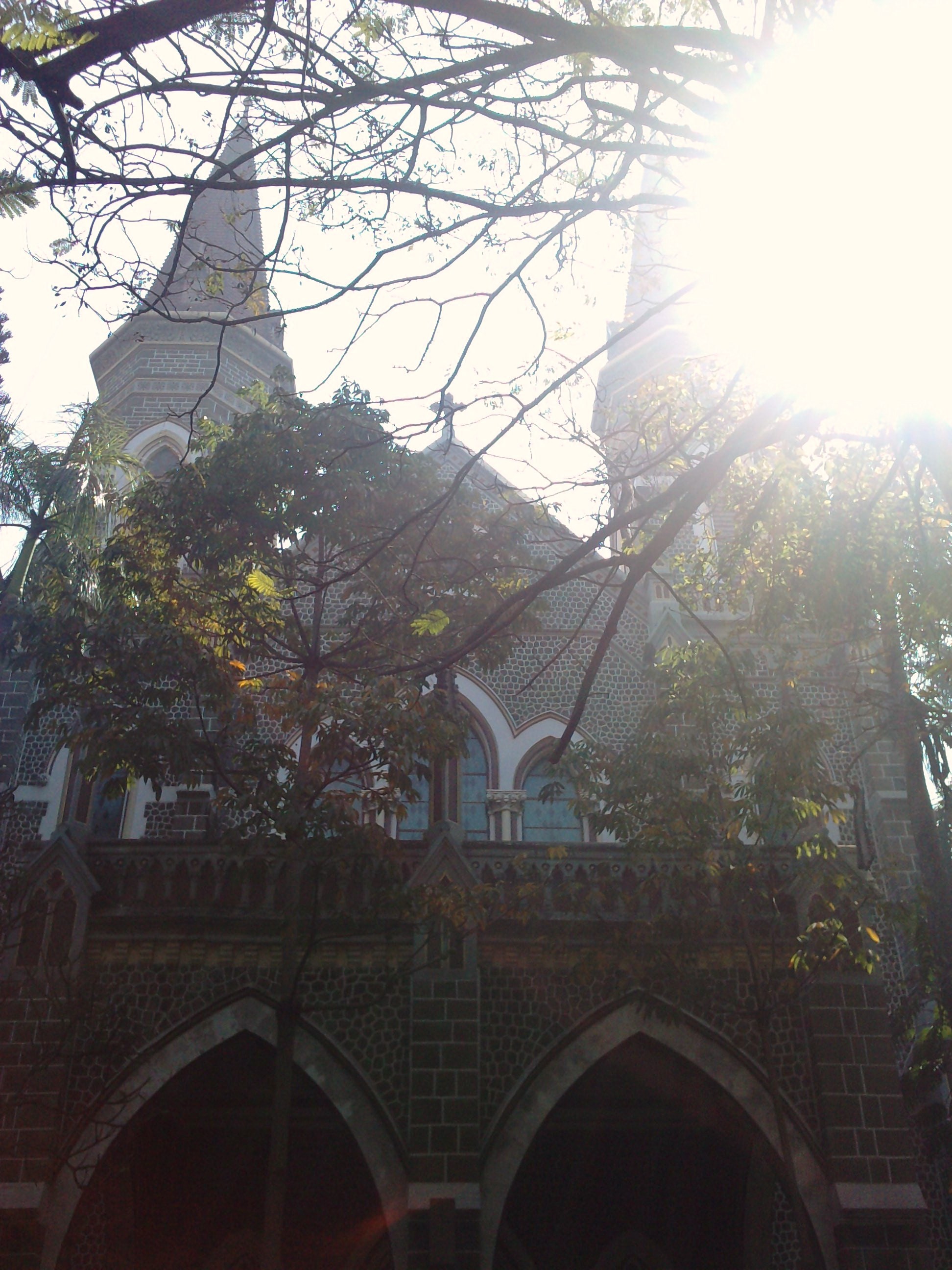
La cathédrale du Saint-Nom est un édifice religieux catholique de style néo-gothique, sis dans le quartier de Colaba, à l’extrême sud de la péninsule que forme la ville de Bombay, en Inde. Érigée au début du XXe siècle, l’église, alors paroissiale, est érigée en pro-cathédrale en 1942 puis cathédrale, en 1964, de l’archidiocèse catholique de Bombay.
Gallery



Sponsored
Location
119 m
Convent of Jesus and Mary School, also known as Fort Convent, is an educational institution opened in the Fort area of Mumbai on 6 November 1855 by sisters belonging to the Congregation of Jesus and Mary. It was the first in the long chain of Jesus and Mary Schools to be set up in Western India. The school got the name “Fort Convent” as it was the first Convent in the Fort area. In 1904, the school was shifted to a two storeyed building adjoining the ‘Holy Name Cathedral’ at Wodehouse Road. It is a Christian Minority Institute affiliated with the Maharashtra State Board and currently admits students from Kindergarten to Class 10.

119 m
The Horniman Circle Gardens is a large park in South Mumbai, Maharashtra, India, which encompasses an area of 1.01 hectares. It is situated in the Fort district of Mumbai, and is surrounded by office complexes housing the country's premier banks. Designed to be a large open space with grand buildings in the middle of the walled city, the area had been known as Bombay Green in the 18th century, later Elphinstone Circle. Following India's independence in 1947, the area was renamed in honour of Benjamin Horniman, editor of The Bombay Chronicle newspaper, who supported Indian independence.

161 m
The Reserve Bank of India,, is the central bank of India, regulatory body for the Indian banking system and Indian currency. Owned by the Ministry of Finance, Government of the Republic of India, it is responsible for the control, issue, and supply of the Indian rupee. It also manages the country's main payment systems.
The RBI, along with the Indian Banks' Association, established the National Payments Corporation of India to promote and regulate the payment and settlement systems in India. Bharatiya Reserve Bank Note Mudran is a specialised division of RBI through which it prints and mints Indian currency notes in two of its currency printing presses located in Mysore and Salboni. Deposit Insurance and Credit Guarantee Corporation was established by RBI as one of its specialized division for the purpose of providing insurance of deposits and guaranteeing of credit facilities to all Indian banks.
Until the Monetary Policy Committee was established in 2016, it also had full control over monetary policy in the country. It commenced its operations on 1 April 1935 in accordance with the Reserve Bank of India Act, 1934. The original share capital was divided into shares of 100 each fully paid. The RBI was nationalised on 1 January 1949, almost a year and a half after India's independence.
The overall direction of the RBI lies with the 21-member central board of directors, composed of: the governor; four deputy governors; two finance ministry representatives; ten government-nominated directors; and four directors who represent local boards for Mumbai, Kolkata, Chennai, and Delhi. Each of these local boards consists of five members who represent regional interests and the interests of co-operative and indigenous banks.
It is a member bank of the Asian Clearing Union. The bank is also active in promoting financial inclusion policy and is a leading member of the Alliance for Financial Inclusion. The bank is often referred to by the name "Mint Street".

174 m
Bombay Castle is one of the oldest defensive structures built in the city of Mumbai. The current castle is a structure built by the British on the site of the Manor House built by a Portuguese nobleman Garcia de Orta. Orta had leased the island of Bombay from the King of Portugal between 1554 and 1570.
The castle was built of local blue Kurla stone and red laterite stone from the Konkan region to the south. The islands came under the hands of the English in 1665, and the East India Company took possession of the castle in 1668. Over the next ten years, they built a defensive structure around the manor.
The castle had four Bastions, three of which were originally surrounded completely with water. These were named the Flag Staff Bastion, The Flower tree Bastion, and the Tank Bastion. The fourth was the Brab Tree Bastion, known for being near a Brab Tree. This would face the West.
Few records of the original Portuguese castle remain, and historians are trying to piece together the original location of the manor. Two gates of the manor are located within INS Angre, a naval station in South Mumbai. A sundial thought to date back to the Portuguese era is also present. This sundial does not mark out the 12 hours of a day, but rather marks out certain periods that the people of the time deemed important.
The main building within the castle was the Governor's House, in which Gerald Aungier, the second Governor of Bombay used to stay. The Governor's residence was later moved to Parel and then to Malabar Hill over the next two centuries. The current building houses the offices of the Flag Officer Commanding-in-Chief Western Naval Command.

265 m
St. Thomas Cathedral, Mumbai, is the 300-year old cathedral church of the Anglican Diocese of Mumbai of the Church of North India. It is named in honour of Saint Thomas the Apostle, who is believed to have first brought Christianity to India. The cathedral is located in Horniman Circle, the historic centre of Mumbai. It is in close proximity to famous Mumbai landmarks such as Flora Fountain and Bombay House. It is the oldest church in Mumbai. The Cathedral and John Connon School is run by the cathedral.
The foundation stone of the church was first laid in 1676, although the church was only finally consecrated for divine service on Christmas day 1718. It is the first Anglican church in Mumbai, within the walls of the fortified British settlement. The cathedral is a landmark in South Mumbai and is one of the oldest churches in India. The Cathedral and John Connon School was created in 1860, in order to provide choristers to the church. It is used by the school for its Founder's Day Service on 14 November every year, Carol Service on the last day before the school's Christmas vacation and other special occasions.
The Churchgate railway station derives its name from the St. Thomas Cathedral, as the station was linked to the cathedral by a road leading through one of the three gates of the fortified island city of Mumbai. The walls of the Bombay Fort were demolished in 1862 and the gate leading to the church was replaced by the Flora Fountain in 1864.
La résidence épiscopale jouxte la cathédrale.