

 English
 Français

Hatfield College Boat Club
Hatfield College Boat Club (HCBC) is the rowing club of Hatfield College at Durham University on the River Wear in England. HCBC is a registered Boat Club through British Rowing, with Boat Code "HAT" and is a member organisation of Durham College Rowing. The club is open to members of the Hatfield College JCR, MCR and SCR of all abilities. There is a Novice Development programme for absolute beginners. HCBC also trains coxes and has a dedicated Coxes Captain. The club competes in head races and regattas across the country, including the Head of the River Race, Henley Royal Regatta, Henley Women's Regatta, Durham Regatta, as well as inter-collegiate competitions run by Durham College Rowing.
Nearby Places View Menu

85 m
Hatfield College, Durham
Hatfield College is one of the constituent colleges of Durham University in England. It occupies a city centre site above the River Wear on the World Heritage Site peninsula, lying adjacent to North Bailey and only a short distance from Durham Cathedral. Taking its name from a medieval Prince-Bishop of Durham, the college was founded in 1846 as Bishop Hatfield's Hall by David Melville, a former Oxford don.
Melville disliked the 'rich living' of patrician undergraduates at University College, and hoped to nurture a collegiate experience that would be affordable to those of limited means; and in which the students and staff were to be regarded as part of a single community. In line with his ambitions, the college pioneered the concept of catered residences for students, where all meals were taken in the hall, and occupants charged fixed prices for board and lodgings — this system became the norm for Durham colleges, and later on at Oxford and Cambridge, before spreading worldwide.
As the 20th century progressed, Hatfield was increasingly characterised by its irreverent atmosphere among undergraduates, reputation for academic indifference, sporting achievement — especially in rugby — and possessing a high intake of students from English public schools. College administration, on the other hand, preferred to highlight the willingness of students to get involved in a wide variety of university activities; and argued that 'Hatfield man', contrary to his reactionary image, had often been at the forefront of significant reform on campus.
College architecture is an eclectic blend of buildings from a variety of styles and periods. The sloping main courtyard contains an eighteenth-century dining hall, the restrained Jacobethan Melville Building (designed by Anthony Salvin), a Victorian Gothic chapel, and the 'inoffensive neo-Georgian' C Stairs. The trend for revivalist and traditional buildings was disposed of with the modern Jevons Building, located in the college's second courtyard, which interprets older forms in a more 'contemporary' manner.
After many decades as a single-sex institution, the first female undergraduates were formally admitted in Michaelmas term 1988.
95 m
Grey College Boat Club
Grey College Boat Club (GCBC) is the rowing club of Grey College at Durham University in North East England.
The club has over 70 active members and shares its boathouse with Josephine Butler College Boat Club.
The club competes at a national, regional and college level.
GCBC is a registered Boat Club through British Rowing, with Boat Code "GRC" and is a member organisation of Durham College Rowing.

96 m
Durham Museum, Durham
Durham Museum (previously Durham Museum and Heritage Centre) was a museum in Durham, England. It detailed the history of the City of Durham from medieval times to the present day. The museum was located in the redundant church of St Mary-le-Bow, close to the World Heritage Site of Durham Cathedral and Durham Castle, which is bounded on the north and east by Hatfield College; on the south by Bow Lane, and the west by North Bailey. The costs of maintaining the building forced the museum's closure in 2024. The museum was mainly run by volunteers.
The museum contained a variety of objects, models, pictures and audio-visual displays. These exhibitions provided the visitor with an overview of life, labour and leisure in this ancient fortified city, centre of pilgrimage and capital of the Prince Bishops of Durham.
Many of the museum's displays involved the industry and trade that Durham is known for, including the manufacture of organs, which still continues. As well as these permanent displays, there were also periodic exhibitions and events that highlighted the lesser known aspects of Durham's social history. The museum also featured a centre for making brass rubbings as well as a souvenir shop.
111 m
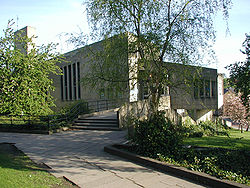
Dunelm House
Dunelm House is a Grade II listed building in Durham, England, built in 1966 in the brutalist style. It belongs to Durham University and houses Durham Students' Union. Its listing entry cites, among other factors, that it is "a significant Brutalist building that reflects the latest in architectural thinking for its date" and that it is "the foremost students’ union building of the post-war era in England".