Location Image

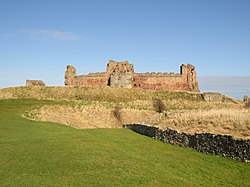
Château de Tantallon

Le château de Tantallon (Tantallon Castle en anglais) est une forteresse du milieu du XIVe siècle, située à cinq kilomètres à l’est de North Berwick, dans l’East Lothian en Écosse. Il se dresse sur un promontoire donnant sur le Firth of Forth, au sud de l’île de Bass Rock. Dernier château entouré d’une courtine à avoir été construit en Écosse, Tantallon ne possède en réalité qu’un seul mur d’enceinte protégeant l’accès au promontoire, les trois autres côtés étant naturellement défendus par des falaises donnant sur la mer. Le château fut construit vers le milieu du XIVe siècle par William Douglas, Ier comte de Douglas. Il fut transmis à son fils illégitime, fait comte d'Angus par la suite, et malgré de nombreuses vicissitudes demeura la propriété de ses descendants durant une grande partie de son histoire. Il fut notamment assiégé en 1491 par le roi Jacques IV, puis en 1528 par Jacques V, son successeur, qui le détruisirent en grande partie. Par la suite, il fut pris par les covenantaires en 1639 pendant la première guerre des évêques et à nouveau détruit en 1651 lors de l’invasion de l’Écosse par Oliver Cromwell. Il fut vendu par les Douglas en 1699 et tomba peu à peu en ruines avant de passer finalement sous la protection d’Historic Scotland. Il constitue désormais une attraction touristique importante et est classé en catégorie A et listé comme Scheduled Ancient Monument. En 2009, des photographies furent publiées dans la presse britannique montrant un supposé fantôme apparaissant à une des fenêtres du château.

Nearby Places View Menu
Location Image
607 m

Auldhame & Scoughall

Auldhame and Scoughall are hamlets in East Lothian, Scotland. They are close to the town of North Berwick and the village of Whitekirk, and are approximately 25 miles (40 km) east of Edinburgh.
Location Image
765 m

Auldhame Castle

Auldhame Castle is a ruined L-plan tower house standing on a ridge above Seacliff beach, about 3 miles east of North Berwick in East Lothian, and less than half a mile from Tantallon Castle.
Location Image
897 m

Canty Bay

Canty Bay is a small inlet and coastal hamlet on the northern coast of East Lothian, Scotland. It is 2 miles (3.2 km) east of North Berwick and is opposite the Bass Rock and Tantallon Castle. Other settlements nearby include Auldhame, Scoughall, Seacliff, and the Peffer Sands. Canty Bay means "bay of the little head" from the Gaelic ceanntan, diminutive of ceann. The Glen Golf Club is close to its western side, and to the east there are high coastal cliffs. There are two beaches separated by a rocky headland. The western beach is uninhabited and accessible by two paths that descend the grass-covered cliffs from the eastern end of the Glen golf course. The eastern beach is by the hamlet. This former fishing hamlet has been immortalised by William McGonagall in his poem Beautiful North Berwick and its surroundings. The Canty Bay Inn offered hospitality to the tourists who came to see the Bass Rock. The tenant of the Rock was usually also the innkeeper. The William Edgar Evans Charitable Trust maintains a house and two cottages for use by Scout and Guide troops. Dolphins can be seen at Canty Bay and from the Scottish Seabird Centre.
Location Image
1.1 km

Seacliff

Seacliff comprises a beach, an estate and a harbour. It lies 4 miles (6 kilometres) east of North Berwick, East Lothian, Scotland.
Location Image
2.3 km

Bass Rock Lighthouse

The Bass Rock Lighthouse on Bass Rock is a 20-metre (66 ft) lighthouse, built in 1902 by David Stevenson, who demolished the 13th-century keep, or governor's house, and some other buildings within the castle for the stone. The commissioners of the Northern Lighthouse Board decided that a lighthouse should be erected on the Bass Rock in July 1897 along with another light at Barns Ness near Dunbar. The cost of constructing the Bass Rock light was £8,087, a light first being shone from the rock on the evening of 1 November 1902. It has been unmanned since 1988 and is remotely monitored from the board's headquarters in Edinburgh. Until the automation the lighthouse was lit by incandescent gas obtained from vaporised paraffin oil converted into a bunsen gas for heating a mantle. Since that time a new biform ML300 synchronised bifilament 20-watt electric lamp has been used.