


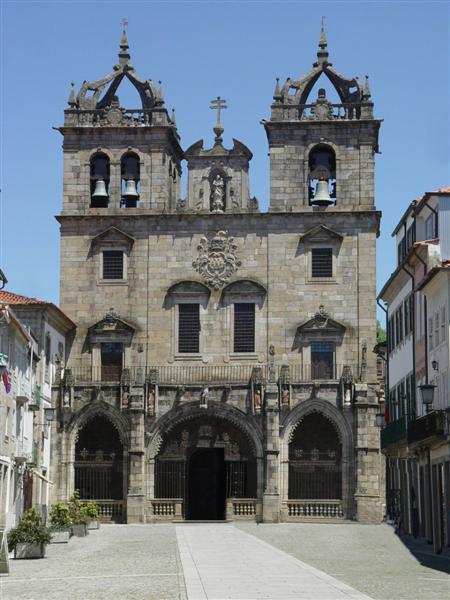
The Carmo Church in Portuguese, Igreja do Carmo is a Portuguese 17th-century church in Braga, Portugal, with a Latin cross Floor plan and a single nave. The church is part of the Carmelite Convent, founded in 1653. The main façade (from 1911) follows the plan of the tower façade, and the interior decoration features baroque golden woodwork retables and neoclassical retables and tiles.
Gallery

Sponsored
Location
1 explorer visited this place

290 m
The Garden of Santa Barbara is a municipal garden in the civil parish of Sé, municipality of Braga, alongside the eastern wing of the historical Archbishop's Palace of Braga.

334 m
Pópulo Church is a Neoclassical church located in Braga, Portugal. The church has been classified as Property of Public Interest since 1977.

341 m
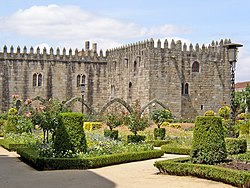
Castle of Braga is a historical fortification and defensive line encircling the city of Braga. While, in fact, the only remains of this structure are the various gates and towers along its perimeter, the main keep tower, located in the civil parish of São João do Souto, is the only true remnant of the medieval castle.
The old castle, today demolished, had an approximate rectangular plan, with towers on each vertex. Of the walls of the city, only the gate, tower of Santiago, tower of São Sebastião and Porta Nova remain.
Its perimeter barely exceeded 2,000 metres, and was delimited in the east by the Praça da República, west by the Rua do Castelo, Rua de São Marcos, Rua do Anjo, Largo de Santiago, Rua do Alcaide, Largo de Paulo Orósio, Rua de Jerónimo Pimentel, Campo das Carvalheiras, Avenida de São Miguel o Anjo, Largo da Porta Nova, Rua dos Biscainhos, Praça do Conselheiro Torres e Almeida and Rua dos Capelistas.
The demolition of the grounds began in 1858 in the Largo do Barão de S. Martinho, with the destruction of the Souto Gate, followed by the Eastern and São Bento Gates, still in the 19th century. After the beginning of the 20th century, many other lines of the castle were destroyed between the Arco da Porta Nova and Rua dos Biscainhos, and from Rua dos Biscainhos and Rua do Alcaide. Few remnants of the medieval lines remain today. The ancient wall can be seen in some of the backyards of homes along the Rua do Anjo and Rua de São Marcos. Still, further, there still exists the Gate of São Tiago, even if partially altered due to the construction in the second half of the 18th century, through the addition of the Capela da Senhora da Torre. Along Rua de São Marcos, in 1985, one property owner constructed over the foundations of one part of the wall, while in March 1990, there was a collapse of one part of the ancient wall, during the demolition of the old Facho garment factory.
353 m
The Archiepiscopal Palace of Braga, is a Portuguese episcopal palace in civil parish of Braga, in the municipality of the same name, in the northern district of Braga.

384 m
Braga is a city and a municipality, capital of the northwestern Portuguese district of Braga and of the historical and cultural Minho Province. Braga Municipality had a resident population of 201,583 inhabitants, representing the seventh largest municipality in Portugal by population. Its area is 183.40 km2. Its agglomerated urban area extends to the Cávado River and is the third most populated urban area in Portugal, behind Lisbon and Porto Metropolitan Areas.
It is host to the oldest Portuguese archdiocese, the Archdiocese of Braga of the Catholic Church and it is the seat of the Primacy of the Spains. During the Roman Empire, then known as Bracara Augusta, the settlement was the capital of the Roman province of Gallaecia and would later become the capital of the Kingdom of the Suebi, one of the first territories to separate from the Roman Empire in the 5th century. Inside the city there is also a castle tower that can be visited. Nowadays, Braga is among the most noted entrepreneurial and technological centers of the country, as well as a major hub for inland Northern Portugal, and it is an important stop on the Portuguese Way path of the Road of St James. The city hosted two games of the UEFA Euro 2004 and was the European Youth Capital in 2012.