


L'enceinte de Cambrai est un ancien ensemble de fortifications qui protégeait la ville de Cambrai entre le Moyen Âge et le XXe siècle.
Gallery


Sponsored
Location

19 m
The Hôtel de Ville is a municipal building in Cambrai, Nord, in northern France, standing on Place Aristide-Briand.
110 m
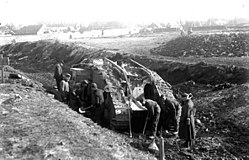
The Battle of Cambrai was a British attack in the First World War, followed by the biggest German counter-attack against the British Expeditionary Force since 1914. The town of Cambrai, in the département of Nord, in France, was an important supply centre for the German Siegfriedstellung and capture of the town and the nearby Bourlon Ridge would threaten the rear of the German line to the north. Major General Henry Tudor, Commander, Royal Artillery, of the 9th Division, advocated the use of new artillery-infantry tactics on his sector of the front. During preparations, J. F. C. Fuller, a staff officer with the Tank Corps, looked for places to use tanks for raids. General Julian Byng, commander of the Third Army, decided to combine both plans. The French and British armies had used tanks en masse earlier in 1917, although to considerably less effect.
After a big British success on the first day, mechanical unreliability, German artillery and infantry defences exposed the frailties of the Mark IV tank. On the second day, only about half of the tanks were operational and British progress was limited. In the History of the Great War, the British official historian Wilfrid Miles and modern scholars do not place exclusive credit for the first day on tanks but discuss the concurrent evolution of artillery, infantry and tank methods. Numerous developments since 1915 matured at Cambrai, such as predicted artillery fire, sound ranging, infantry infiltration tactics, infantry-tank co-ordination and close air support. The techniques of industrial warfare continued to develop and played a vital part during the Hundred Days Offensive in 1918, along with replacement of the Mark IV tank with improved types. The rapid reinforcement and defence of Bourlon Ridge by the Germans, as well as their counter-attack, were also notable achievements, which gave the Germans hope that an offensive strategy could end the war before American mobilisation became overwhelming.

115 m
The siege of Cambrai took place from 20 March to 19 April 1677 during the 1672–1678 Franco-Dutch War; then part of the Spanish Netherlands, it was invested by a French army under the duc de Luxembourg. Siege operations were supervised by the military engineer Vauban; Louis XIV was nominally in command but played little part in operations.
An attempt by a combined Dutch-Spanish force under William of Orange to relieve the nearby town of Saint-Omer was defeated by Luxembourg at Cassel on 11 April. Cambrai surrendered on 19 April and was ceded to France by Spain in the September 1678 Treaty of Nijmegen.
115 m
The siege of Cambrai was undertaken by an English army led by King Edward III of England during September and October 1339 in the early stage of the Hundred Years War. At the time Cambrai, located in the Nord department of the Hauts-de-France region in France, was not part of France but a Free imperial city of the Holy Roman Empire.
In 1339, Cambrai became the centre of a struggle between supporters of the Louis IV, Holy Roman Emperor, and William II, Count of Hainaut, on the one hand, and those of king Philip VI of France on the other. Among Philip VI's allies were counts John I of Bohemia, Philip III of Navarre, Aymon, Count of Savoy, Humbert II of Viennois and vassals of King Alfonso XI of Castile and León. Cambrai had allowed the French to garrison the city with 300 men-at-arms.
Meanwhile, Edward III left Flanders in August 1339, where he had been on the continent since July 1338. Edward had asserted his rights to the throne of France, openly defying the authority of Philip VI. Wanting to satisfy his Bavarian allies, he decided to seize Cambrai. Edward asked the bishop of Cambrai, Guillaume d'Auxonne, a vassal of the Holy Roman Empire, to let him in, however the bishop also had instructions from Philip VI informing him to hold on for a few days until he arrived with a French army. Guillaume proclaimed his allegiance to France and prepared to resist a siege.
The defence of Cambrai was provided by the governor Étienne de la Baume, grand master of the crossbowmen of France. The French garrison had artillery comprising 10 guns, five of iron and five of other metals. This is one of the earliest references to the use of cannon in siege warfare.
Edward launched several attacks from 26 September, with Cambrai resisting every assault for five weeks.
When Edward learned on the 6 October that Philip was approaching with a large army, he abandoned the siege on 8 October. He retreated across Picardy, devastating the plains of Cambresis along the way. A strong English garrison was left in the castle of Thun-l'Eveque. Edward then proceeded to Saint-Quentin. On 23 October, the armies of England and France faced each other across the plain between La Capelle and Buironfosse. They separated without engaging in battle.

115 m
The Battle of Cambrai, 1918 was fought between troops of the British First, Third and Fourth Armies and German Empire forces during the Hundred Days Offensive of the First World War. The battle took place in and around the French city of Cambrai, between 8 and 10 October 1918. The battle incorporated many of the newer tactics of 1918, in particular tanks. The battle witnessed over 300 tanks taking part, gaining considerable ground in less than 36 hours, with about 2,000 more British casualties than German, which was light relative to earlier phases of the war.
Vestiges
Une partie de l'enceinte est préservée comprenant :
Book your tour near
Enceinte de Cambrai
Book Now
4.2
in partnership with
GetYourGuide.com