


German submarine U-596 was a Type VIIC U-boat built for Nazi Germany's Kriegsmarine for service during World War II. She was laid down on 4 January 1941 by Blohm & Voss in Hamburg as yard number 572, launched on 17 September 1941 and commissioned on 13 November under Kapitänleutnant Gunter Jahn.
Location
1 explorer visited this place

1.9 km
Perama is a coastal town and a suburb of Piraeus. It belongs to the Piraeus regional unit and is the southwestern limit of Athens urban area. It lies on the southwest edge of the Aegaleo mountains, on the Saronic Gulf coast. It is 8 km northwest of Piraeus, and 14 km west of the center of Athens. The municipality has an area of 14.729 km2. It forms the western terminus of the Port of Piraeus, and there is also a passenger port that provides ferry services to Salamis Island.
The name Perama comes from the Greek word "perasma" which means "passage". Perama has a secondary soccer team named Peramaikos. The Battle of Salamis which took place in 480BC was located between the Salamis island and the mainland, part of which included Perama.

3.6 km
The Battle of Salamis was a naval battle fought in 480 BC, between an alliance of Greek city-states under Themistocles, and the Achaemenid Empire under King Xerxes. It resulted in a victory for the outnumbered Greeks.
The battle was fought in the straits between the mainland and Salamis, an island in the Saronic Gulf near Athens, and marked the high point of the second Persian invasion of Greece. It was arguably the largest naval battle of the ancient world, and marked a turning point in the invasion.
To block the Persian advance, a small force of Greeks blocked the pass of Thermopylae, while an Athenian-dominated allied navy engaged the Persian fleet in the nearby straits of Artemisium. In the resulting Battle of Thermopylae, the rearguard of the Greek force was annihilated, while in the Battle of Artemisium the Greeks suffered heavy losses and retreated after the loss at Thermopylae. This allowed the Persians to conquer Phocis, Boeotia, Attica and Euboea. The allies prepared to defend the Isthmus of Corinth while the fleet was withdrawn to nearby Salamis Island.
Although heavily outnumbered, the Greeks were persuaded by Athenian general Themistocles to bring the Persian fleet to battle again, in the hope that a victory would prevent naval operations against the Peloponnese. Persian king Xerxes was also eager for a decisive battle. As a result of subterfuge on the part of Themistocles, the Persian navy rowed into the Straits of Salamis and tried to block both entrances. In the cramped waters, the great Persian numbers were an active hindrance, as ships struggled to maneuver and became disorganized. Seizing the opportunity, the Greek fleet formed in line and achieved a victory.
Xerxes retreated to Asia with much of his army, leaving Mardonius to complete the conquest of Greece. The following year the remainder of the Persian army was defeated at the Battle of Plataea and the Persian navy at the Battle of Mycale. The Persians made no further attempts to conquer the Greek mainland. The battles of Salamis and Plataea thus mark a turning point in the course of the Greco-Persian Wars as a whole; from then onward, the Greek poleis would take the offensive.
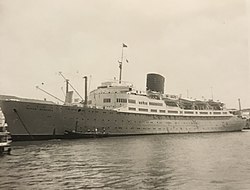
4.0 km
Ocean Monarch was a passenger steamship that was built by Vickers-Armstrongs in 1950. She served with Furness Bermuda Line for fifteen years, then with a Bulgarian company for three years, renamed Varna. She spent much of the 1970s laid up and was renamed Venus and then Riviera. In the early 1980s, she was renamed Reina del Mar and refitted for further use as a cruise ship, but a fire gutted her; and she was scuttled on 1 June 1981 after another fire broke out.
4.2 km
Skaramagas is a port town in the western part of the Athens agglomeration, Greece. It is part of the municipality of Haidari and is divided into three main neighborhoods, Ano Afaia, Kato Afaia and the coastal zone. It is known for its large shipyard. It took its name by the Chiot merchant Amvrosios Skaramagas.
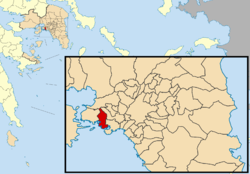
4.8 km
Keratsini-Drapetsona is a municipality in the Piraeus regional unit, Attica, Greece. The seat of the municipality is the town of Keratsini. The municipality has a population of 89,386 inhabitants, according to the 2021 census and an area of 9.326 square kilometres.
The municipality was formed at the 2011 local government reform by the merger of the two former municipalities Drapetsona and Keratsini, which became municipal units.
He was replaced on 28 July 1943 by Oberleutnant zur See Victor-Whilhelm Nonn who was superseded by Oblt.z.S. Hans Kolbus in July 1944. The boat's service began on 13 November 1941 with training as part of the 8th U-boat Flotilla. She was transferred to the 3rd flotilla on 1 July 1942 and moved on to the 29th flotilla on 19 November.