Northowram ( NOR-thar-əm) is a village lying north-east of the town of Halifax in Calderdale, West Yorkshire, England. It stands on the north side of Shibden valley. Southowram stands on the southern side of the valley. The name Owram derives from the plural form of the Old English ofer meaning 'a flat topped ridge'. The village was mentioned as a settlement in the Doomsday Book, within the Hundred of Morley, although there were no recorded inhabitants at that time. It was later documented in the 19th century as being in the parish of Halifax, 2+1⁄2 miles north-east of Halifax and 6+1⁄2 miles from Bradford. Its population at that point was 6,841 and Northowram Hall was the seat of J. F. Dyson, Esq. The ward is now called Northowram and Shelf. Following the 2021 census Northowram is defined by the Office for National Statistics as forming part of the Shelf and Northowram built-up area, which had a population of 9,195. The village has three churches: St Matthew's Church of England parish church, a Methodist church, and a Heywood United Reformed Church. St Matthew's is a Grade II listed building which is constructed of snecked local sandstone with a graded stone-slate roof. The village has one school, Northowram Primary School. The serial killer John Christie was born at Black Boy House near the village in 1899. The village hosts an annual Scarecrow Festival.

Nearby Places View Menu
Location Image
895 m

Coley, West Yorkshire

Coley is a village that is situated some 3.5 kilometres (2.2 mi) north-east of the town of Halifax in the English county of West Yorkshire. Coley lies in the unparished area of the borough of Calderdale, who are responsible for all local government activity in the village and surrounding areas. It lies in the borough ward of Hipperholme and Lightcliffe and the parliamentary constituency of Calder Valley. As a village in an unparished area, there are no formal civil parish boundaries defining Coley, but mapping shows it as adjoining the villages of Northowram to the west, Shelf to the north, Norwood Green to the east, and Hipperholme to the south. Coley first appeared in the Wakefield court rolls in 1277. Once part of the parish of Halifax, it became an ecclesiastical parish in 1749. The parish church is St John the Baptist, with records suggesting a church on the site as early as 1513. The present building was constructed in 1816, and is a grade II listed building. Situated on a hilltop location at 210 metres (690 ft) amsl, the church tower stands as a landmark visible for miles around. The ecclesiastical parish of Coley is rather larger than the village, and includes Norwood Green and parts of Hipperholme. Coley is also the location of a number of ancient halls. These include Coley Hall, built on the site of a medieval priory dating back to 1277, and itself built between 1572 and 1640. Wynteredge Hall is even older, with parts of the building believed to date from 1371, although it was rebuilt in the 1640s. Both halls and associated buildings are grade II listed, whilst the entrance arch to Coley Hall has the rarer grade II* listing. Go Ahead West Yorkshire operates bus service 571, from Halifax to Shelf, which passes through Coley once an hour in each direction on weekdays, and less frequently on Sundays and evenings. The nearest railway station is Halifax.
Location Image
1.1 km

Hipperholme Grammar School

Hipperholme Grammar School is a private grammar school in Hipperholme (near Halifax), West Yorkshire, England. It educates pupils between the ages of 3 and 16. Lightcliffe Preparatory School merged with Hipperholme Grammar School in 2003, under the Hipperholme Grammar Schools Foundation, and was subsequently renamed as Hipperholme Grammar Junior School. In 1648 (the date the school classes as its founding year) Matthew Broadley, paymaster to Charles I, endowed a large sum of money to build a school on land donated by Samuel Sunderland of Coley Hall; the school opened on its current site in 1661. Two of the current school houses, Broadley and Sunderland, are named after the founders. In 1783 a new school hall was constructed. Originally an all-boys school, it became private (ISA, AGBIS) in the 1980s and began admitting girls at the same time.
Location Image
1.2 km

Hipperholme railway station

Hipperholme railway station served the village of Hipperholme in West Yorkshire, England.
Location Image
1.2 km

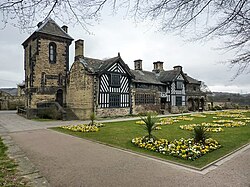
Shibden Hall

Shibden Hall is a Grade II* listed historic house located in a public park at Shibden, West Yorkshire, England. The building has been extensively modified from its original design by generations of residents, although its Tudor half-timbered frontage remains its most recognisable feature. One of its most notable residents was Anne Lister who inherited the hall from a relative. Lister has been described as being the "first modern lesbian" due to her "love... [of] the fairer sex" that she documented in her diaries.