


The Teufelsturm (also Butterweckfels or Mittagstein) is a prominent rock tower and climbing rock formed of Elbe Sandstone, about forty metres high in Saxon Switzerland in northeastern Germany. It is located east of the River Elbe on the upper edge of the valley between Schmilka and Bad Schandau in the Schrammsteinen.
Location
1 explorer visited this place
1.1 km
The Mühlgrundbach is a river of Saxony, Germany. It flows into the Elbe near the Schöna railway station, opposite the village Schmilka.

1.4 km
Reinhardtsdorf-Schöna is a municipality in the Sächsische Schweiz-Osterzgebirge district in the German federal state of Saxony. It has a population of approximately 1,600 and is located close to the Czech border in Saxon Switzerland, a popular tourist region.
Reinhardtsdorf-Schöna encompasses the villages of Reinhardtsdorf, Schöna and Kleingießhübel. The municipality of Reinhardtsdorf-Schöna was formed in 1973 from the merger of these three parishes.
1.5 km
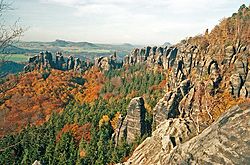
The Schrammsteine are a long, strung-out, very jagged group of rocks in the Elbe Sandstone Mountains located east of Bad Schandau in Saxon Switzerland in eastern Germany. To the north they are bordered by the Kirnitzsch valley, to the south by the Elbe valley and to the east by the Affensteine rocks. The high point of the chain lies at over 400 m above sea level. The viewing point on the Schrammsteine lies at a height of 417.2 m above HN.

1.8 km
Schmilka-Hirschmühle station is a railway halt on the Děčín–Dresden-Neustadt railway for the village of Schmilka, Saxony, Germany. The station is located across the Elbe river and can be reached from Schmilka by ferry. They station lies in the Reinhardtsdorf-Schöna municipality.
The station is served by the Dresden S-Bahn S1 service from Meißen, Dresden, Heidenau, Pirna to Schöna. There is also a Regionalbahn service every 2 hours from Děčín to Rumburk via Bad Schandau and Sebnitz.

1.9 km
The Falkenstein is one of the best-known climbing peaks in Saxon Switzerland.
It is situated near the rocky Schrammsteine ridge southeast of the town of Bad Schandau.
The Falkenstein is nearly 90 m high and consists of sandstone. In the Middle Ages there were fortifications on top of the rock. Even today, the steps carved into the rock are still visible.
The Teufelsturm is also referred to as the "Symbol of Saxon Climbing".
