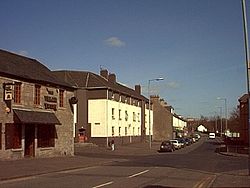
Hardgate is a village in West Dunbartonshire, Scotland. Hardgate has probably been settled since Neolithic times with a burial site at Knappers Farm, the Cochno Stone (a cup and ring marked stone), and a burial chamber near Cochno Loch providing evidence of this. Although it is a far older settlement, it is administratively part of nearby Clydebank along with the neighbouring village of Duntocher and now lies in the West Dunbartonshire local authority area. Along with Duntocher and Faifley, Hardgate falls within West Dunbartonshiire's Kilpatrick ward with a combined population of 12,719 in 2011. Dunn's Mills operated a cotton mill in the 19th century. It continued to produce thread and yarn until its destruction during the Clydebank Blitz in 1941. The village expanded due to house building by the Clydebank town council after World War II, and later by the Wimpey firm in the early 1970s on what had been green belt land. The village has one non-denominational school, Goldenhill Primary School.

Nearby Places View Menu
Location Image
657 m

Clydesdale Harriers

Clydesdale Harriers are an athletics club, founded in 1885. It was Scotland's first amateur open athletics club with the object of promoting amateur athletics generally and cross country running in particular. The club uses the athletics track at the St Peter the Apostle High School and train on Tuesday and Thursday evenings.
Location Image
890 m

St Peter the Apostle High School

St Peter the Apostle High School is a Roman Catholic high school in Drumry, Clydebank, Scotland. It was formed as an amalgamation of the former St Columba's High School and St Andrew's High School. St Peter the Apostle High School is one of two Roman Catholic secondary schools in West Dunbartonshire. St Peter the Apostle High School is a Roman Catholic comprehensive school serving the northern part of Clydebank, the village of Duntocher, Faifley, Hardgate and the Drumchapel area of Glasgow. Students come in substantial numbers from Old Kilpatrick, Knightswood and Scotstoun. Five primary schools provide the great majority of the first-year intake including; St Mary's Primary School, St Joseph's Primary School, St Eunan's Primary School, St Stephen's Primary School, and St Clare's Primary School, although a variety of others add to this number.
Location Image
900 m

Duntocher

Duntocher (Scottish Gaelic: Dùn Tòchair or Druim Tòchair) is a village in West Dunbartonshire, Scotland. It has an estimated population of 6,850. The etymology of the name of the village indicates that its name means "the fort on the causeway". Duntocher has effectively become a northern suburb of the nearby town of Clydebank, as have neighbouring Hardgate and Faifley. Duntocher expanded due to housebuilding by Clydebank Burgh Council after the Second World War, although the area was never formally absorbed into the burgh. When burghs were abolished by local government reorganisation in 1975, however, Duntocher was included in the larger Clydebank District, which existed until the creation of West Dunbartonshire in 1997. Further housing was built by the Wimpey firm in the late 1960s and early 1970s, on what had been green belt land. Along with Faifley and Hardgate, Duntocher falls within West Dunbartonshire's Kilpatrick ward with a combined population of 12,719 in 2011. At one time this was the most north westerly point on the Glasgow Corporation Transport tram system, trams operating from here via Hardgate to Clydebank, and at times, on to Partick depot. Duntocher historically had several cotton and corn mills, driven by the Duntocher Burn which is the traditional boundary between Duntocher and neighbouring village Hardgate. The Antonine Wall also runs through the village, and ancient Roman fortifications are still visible in the local Goldenhill Park. Lottery funding is to provide funds for a children's playpark at Goldenhill. Sir George Macdonald wrote about the findings at Duntocher. Duntocher has a Roman Catholic church – St. Mary's, a United Free Church of Scotland – Duntocher West, and a Church of Scotland – Duntocher Trinity. The village also has one Roman Catholic primary school – St Mary's and one non-denominational, Carleith Primary School. The village has a main street (Dumbarton Road) which acts as the main focal point for village activity. The majority of the villages shops and pubs, the cafe and the local churches and village halls are located along or very close to a small stretch of this road The village is at the southern edge of the Kilpatrick Hills.
Location Image
947 m

St Columba's High School, Clydebank

St Columba's High School was a Roman Catholic comprehensive school in Drumry, Clydebank, West Dunbartonshire, Scotland. It was one of two denominational schools in the town (the other being St Andrew's High) which merged in 2009 to become St Peter the Apostle High School. The school had an inspection by Her Majesty's Inspectorate of Education (HMIE) in 2006 and received positive results.