

 English
 Français
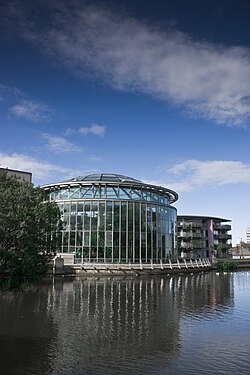
Sunderland Museum and Winter Gardens
Le Sunderland Museum and Winter Gardens (Musée de Sunderland et jardins d'hiver) est un musée municipal de Sunderland, en Angleterre. Il contient le seul exemplaire britannique connu de reptile planeur, le plus ancien vertébré connu capable de vol plané. Le specimen a été découvert dans la carrière d'Eppleton. Le musée possède une collection d'importance nationale.
Nearby Places View Menu

671 m
River Wear
The River Wear ( , WEER) in Northern England rises in the Pennines and flows eastwards, mostly through County Durham, to the North Sea in the City of Sunderland. At 60 mi (97 km) long, it is one of the region's longest rivers. The Wear wends in a steep valley through the cathedral city of Durham and gives its name to Weardale in its upper reach and Wearside by its mouth.

881 m
Roker
Roker ( ROH-kər) is a seaside resort in Sunderland, city of Sunderland district, Tyne and Wear. England. It is located north of the River Wear and Monkwearmouth, east of the southern part of Fulwell with the coastal resort of Seaburn to its north. It lies within historic County Durham.
The majority of the houses in Roker are terraced or semi-detached. Further west, to the part bordering Fulwell, are cul-de-sacs with semi-detached bungalows; these are owned mainly by members of Roker's sizeable elderly population. On the seafront, located on Roker Terrace, are apartments, guest houses and the Roker Hotel.
In addition to Seaburn seafront, the coast at Roker seafront played host to Sunderland International Airshow, the biggest free air show in Europe; this took place annually, usually over the last weekend in July. However, it was cancelled indefinitely as Sunderland City Council claimed it did not align with their vision to make the city carbon neutral. The popular event, which attracted hundreds of thousands of spectators to Roker, was last held in 2019, just before the COVID-19 pandemic.

926 m
Weardale Way
Weardale Way is a footpath that follows the River Wear in the North East of England. It is 73 miles long, starting at the Lindisfarne Memorial on the sea wall at Roker (a part of the City of Sunderland). It then passes through Chester-le-Street, Durham, Bishop Auckland, Wolsingham and Stanhope. The path ends outside the Post Office in the village of Wearhead in County Durham.
Within the area administered by the City of Sunderland local authority, the route is meant to follow that marked as the River Wear Trail; unfortunately, many of the markers for this route have been removed by vandals. Once the route goes into the area administered by the Durham County Council, it is waymarked to some extent by plastic disks attached to wooden and metal posts, trees and street furniture. There are several wooden 'finger' signs along the route that countdown the distance along the footpath in both directions.
This path is marked on the latest series of Ordnance Survey 1:25,000 maps, Explorer sheets 305, 307, 308 and OL31 cover the walk.
A guide to the walk is available: The Weardale Way, A Pictorial Walking Guide by Alistair Wallace (Jema Publications, 1997).

943 m
St Andrew's Church, Roker
St Andrew's, Roker (1905–7), is a Church of England parish church in Sunderland, England. It is recognised as one of the finest churches of the first half of the twentieth century and the masterpiece of Edward Schroeder Prior. The design of St Andrew's drew together many of the strings of Prior's philosophy and approach to design and building. Three years before commencing St Andrew's, Prior had written that the architect's first purpose was to provide;
"a dignified distinct building dedicated to the service of the Church. Church architecture, least of all, has been able to go beyond the trivial efforts of traditional picturesqueness; least of all our building it has been monumental".
At St Andrew's, Prior achieved a monumental church free from style. His experiments in structure, concern for materials and means of building reached their apogee at St Andrew's. The church was listed Grade I in 1950.

990 m
Sunderland Lifeboat Station
Sunderland Lifeboat Station is located at North Dock Marina in the port city of Sunderland, which sits at the mouth of the River Wear, in the county of Tyne and Wear.
A lifeboat was first stationed here in 1800 by the Sunderland Lifeboat Committee, followed by a succession of privately operated lifeboats. Overall control of all Sunderland lifeboats finally passed to the Royal National Lifeboat Institution (RNLI) in 1871.
The station currently operates two Inshore lifeboats; the B-class (Atlantic 85) Seagil (B-945), on station since 2024, and a D-class (IB1) Thee Andy Cantle (D-879), on station since 2023.