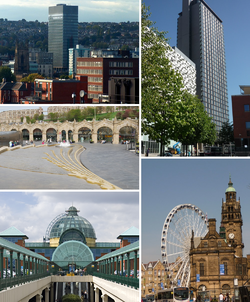
Sheffield (/ˈʃɛfiːld/ ) est une ville du Nord de l'Angleterre, située au confluent du Don et de la Sheaf, d'où elle tire son nom (field signifie champ en anglais). Sheffield se trouve dans le comté du Yorkshire du Sud et possède le statut de cité. Sa prospérité est due à son passé industriel, et plus particulièrement à la sidérurgie. La ville fut le berceau de nombreuses innovations techniques dans le domaine de la sidérurgie, notamment en 1740, la fabrication de l’acier au creuset inventée par l’horloger Benjamin Huntsman, et en 1913 l'invention de la formule de l’acier inoxydable par Harry Brearley, ingénieur de la manufacture d'armes Brown-Firth Steels. Durant la révolution industrielle, la population de la ville décupla, et cette dernière acquit en 1893 le statut de cité par assentiment royal (titre cérémonial). Durant les années 1970 et 1980, la concurrence internationale entraîna un déclin de l’industrie locale, accompagné d'un déclin de l'extraction minière locale. En 2011, on estimait la population de la ville à 551 800 habitants, ce qui en faisait la cinquième ville d'Angleterre.

Nearby Places View Menu
Location Image
164 m

Hunter's Bar

Hunter's Bar is a roundabout and former toll bar on Ecclesall Road in south-west Sheffield, England; the toll bar was active until the late 19th century. The name also attaches to the area surrounding Hunter's Bar roundabout at the intersection of Ecclesall Road, Brocco Bank, Sharrow Vale Road and Junction Road. The toll bar now stands in the middle of the roundabout. The gatekeeper for the toll bar, known as "Hunter's Toll Gate" lived in a house on the corner of Ecclesall Road and Sharrow Vale Road. In 1871, the gatekeeper was Jacob Thompson, who was born in Wirksworth, Derbyshire and had previously been a lead miner there. His wife and two daughters lived with him. The area is featured in the Arctic Monkeys' song "Fake Tales of San Francisco", in particular the lyric, "He talks of San Francisco, he's from Hunter's Bar". Hunter's Bar roundabout has its own Twitter account and its own website. Hunter's Bar is located where the Ecclesall ward of Sheffield Hallam constituency and Broomhill & Sharrow Vale ward of Sheffield Central constituency meet. The main shopping area is situated on Ecclesall Road. Much of the terraced housing in Hunter's Bar and nearby Sharrow Vale is directly attributable to the industrial revolution when housing was built for workers. Close to the roundabout are Endcliffe Park and Hunter's Bar Infant and Junior Schools. On Sharrow Vale Road and Ecclesall Road there are fashionable shops, restaurants, cafes and pubs. Football has been played at Hunter's Bar for over 100 years, notably when The Albion FC played at Hunter's Bar from 1872. Though long gone, the area still has its own team Hunter's Bar FC, who play in the Hope Valley League. Housing in the area is split between upmarket Yorkstone semi-detached houses and redbrick terraces. There is a high density of students from the nearby University of Sheffield and Sheffield Hallam University campuses. The former Wilson Road Synagogue lies near Hunter's Bar.
Location Image
167 m

Sheffield Round Walk

The Sheffield Round Walk is a 14 mi (23 km) walk through the south west of Sheffield, South Yorkshire, England. Starting from Hunters Bar, it travels along the Porter valley to Ringinglow. It then descends through the Limb valley and Ecclesall Woods to Abbeydale Road, before climbing through Ladies Spring Wood to Graves Park. The walk then passes through the Gleadless valley, Meersbrook Park and Chelsea Park before returning to Hunters Bar.
Location Image
300 m

Wilson Road Synagogue

The Wilson Road Synagogue is a former Orthodox Jewish congregation and synagogue, located at 11 Wilson Road, Ecclesall, Sheffield, England, in the United Kingdom. The congregation was formed in 1914 and worshiped in the Ashkenazi rite until the congregation was dissolved in 1997. The building has been used as a church since 2000.
Location Image
502 m

Sharrow Mills

Sharrow Mills are a collection of industrial buildings in Sheffield, England, which have been used for the production of snuff by the firm of Wilsons of Sharrow since the mid 18th century. The mills stands on the Porter Brook in the Sharrow Vale area of the city, just off Ecclesall Road.
Location Image
510 m

Wilsons of Sharrow

Wilsons of Sharrow, now named Wilsons & Company (Sharrow) Ltd, based at Sharrow Mills in the Sharrow district of Sheffield, United Kingdom, is a manufacturer of snuff tobacco since 1737. Since 1982 Wilsons now also manufactures the renowned Fribourg & Treyer snuff blends who were producing snuff since 1720. In the early 1740s, Joseph Wilson succeeded his father Thomas Wilson, a shearsmith, as tenant of Sharrow Mills (then a cutlers wheel). The mill suffered a fire in 1746, when his stock in trade included "tobacco snuff". In 1833, Joseph and Henry Wilson parted company with their cousins William and George (who retained Sharrow Mills), setting up a rival business at Westbrook Mill nearby on Sharrowvale Road. That remained a family business incorporated as Joseph and Henry Wilson Ltd in 1895. It remained in family ownership until 1953, when its elderly proprietors sold the business to Imperial Tobacco. Its archives are now deposited in the Sheffield Archives. At Sharrow Mills steam power was introduced in 1897, but the water wheel remains operational. The company is currently still owned by the Wilson family, the sixth generation since Thomas, still based at Sharrow Mills, in Sheffield.